


Fiber (mathematics)
In mathematics, a fiber (US English) or fibre (British English) of a map or function is an equivalence class in X for the relation of having the same image under f. If y is that image, then this fiber equals the inverse image of [1]: p.69 and is called the fiber of f over y.


Properties and applications
[edit]In elementary set theory
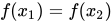
[edit]Any map defines a relation on X, where holds when , and this is always an equivalence relation. The fibers of are the equivalence classes for this relation . Each such fiber is associated to the (by definition constant) value of f on the fiber, and if is that value (necessarily an element of the image set of f), then the fiber is the set of preimages of y under f, which is called the fiber of f over y. The set of all fibers of f forms is a partition of . The mentioned correspondence defines a bijection from the quotient set (the set of fibers of f) to the image set . Note that in case is not a surjective map, one only considers fibers over elements of the subset of Y, thus avoiding the empty set, which cannot be an element of any partition, among the fibers of f. The fiber containing an element is the set .




For example, let be the function from to that sends point to . The fiber of 5 under are all the points on the straight line with equation . The fibers of are that line and all the straight lines parallel to it, which form a partition of the plane .


More generally, if is a linear map from some linear vector space to some other linear space , the fibers of are affine subspaces of , which are all the translated copies of the null space of .

If is a real-valued function of several real variables, the fibers of the function are the level sets of . If is also a continuous function and is in the image of the level set will typically be a curve in 2D, a surface in 3D, and, more generally, a hypersurface in the domain of


In topology
[edit]In point set topology, one generally considers functions from topological spaces to topological spaces.
If is a continuous function and if (or more generally, the image set ) is a T1 space then every fiber is a closed subset of In particular, if is a local homeomorphism from to , each fiber of is a discrete subspace of .

A function between topological spaces is called monotone if every fiber is a connected subspace of its domain. A function is monotone in this topological sense if and only if it is non-increasing or non-decreasing, which is the usual meaning of "monotone function" in real analysis.

A function between topological spaces is (sometimes) called a proper map if every fiber is a compact subspace of its domain. However, many authors use other non-equivalent competing definitions of "proper map" so it is advisable to always check how a particular author defines this term. A continuous closed surjective function whose fibers are all compact is called a perfect map.
A fiber bundle is a function between topological spaces and whose fibers have certain special properties related to the topology of those spaces.
In algebraic geometry
[edit]In algebraic geometry, if is a morphism of schemes, the fiber of a point in is the fiber product of schemes where is the residue field at




See also
[edit]References
[edit]- ↑ Lee, John M. (2011). Introduction to Topological Manifolds (2nd ed.). Springer Verlag. ISBN 978-1-4419-7940-7.