Business News›News›International›US News›In 1999, 17 wind turbines went up on a Minnesota soybean-and-cattle farm; farming continued as turbine leases provided additional income
The Economic Times daily newspaper is available online now.
Since 1999, rural Minnesota farmers have harnessed wind turbines for financial stability. Each turbine's land lease can bring in between $2,000 and $5,000 annually. While owning turbines can lead to greater profits, the hefty start-up costs deter most farmers. Notably, more than 95 percent of the land designated for wind farms remains actively farmed, showcasing how renewable energy can complement agricultural livelihoods.
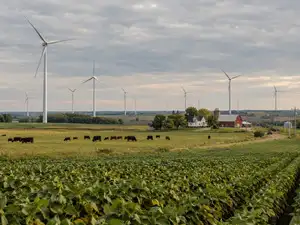
A representative image of wind turbines standing among soybean fields and cattle pasture on a working farm. Image credits: ChatGPT
In 1999, a soybean-and-cattle farm in the southwest of Minnesota got a new set of neighbors: seventeen wind turbines, dotted across the county. The cattle continued to graze, the soybeans continued to sprout, and every month, a check arrived in the mail from a source unrelated to rain, hail, or commodity prices. Twenty-seven years on, that arrangement reads less like an early-2000s agricultural Hallmark special and more like the template for a wave of rural land leases that a 2004 U.S. Government Accountability Office (GAO) report on wind power's impact on farms and rural communities later documented in detail.
The economics of it were hardly glamorous, but they were steady
The wind-power leases the GAO report details typically paid between $2,000 and $5,000 per turbine, a sum insufficient for most farmers to quit their day jobs but enough to significantly offset the risks of a poor harvest. A 2025 RMI analysis of rural wind and solar revenue found that nine states pulled in more than a billion dollars each from wind and solar in 2024, together accounting for 63 percent of the national total; in Iowa's Howard County, three wind projects paid $2.7 million in local taxes that year, about 14.5 percent of the county's entire tax revenue. Meanwhile, the physical footprint of a wind turbine and its associated infrastructure remained relatively small, about a quarter-acre per turbine, with the rest of the land fit for whatever previous use the land lease required.
Wind turbines in Minnesota. Image credits: Wikimedia Commons
Government researchers have since found that this pattern was typical rather than exceptional. According to a 2024 report titled “Agricultural Land Near Solar and Wind Projects Usually Remained in Agriculture After Development,” published by the U.S. Department of Agriculture’s Economic Research Service, nearly 90 percent of large wind turbines built on rural lands between 2012 and 2020 were built on croplands or pastures. Land cover changed at only about 4 percent of those wind sites in the years around installation, and fewer than 1 percent shifted out of agriculture entirely, the two figures describe different things (any change in land cover versus a full exit from farming), so they aren't meant to sum to 100. The cows that once grazed on the land were free to continue doing so, and the combines that harvested the soybeans were able to make tighter turns around a wind turbine’s reinforced foundation.
The nuance that makes it sound less like a wind-farm infomercial
Live Events
Land leases, while simple to set up, represent a modest financial opportunity next to what a farmer could get by selling land outright to a developer or, better still, owning a stake in the turbine itself, ownership typically pays two to three times more than a lease. Few landowners take that route, though, since owning a turbine outright runs into real money: installing a single one-megawatt turbine costs close to a million dollars, and the tax advantages of accelerated depreciation mostly favor corporations with the tax liability to use them. In other words, the check a landowner receives is best filed under "income," not "profit."
Soybean fields, farmsteads, and wind turbines. Image credits: Wikimedia Commons
Most readers don't lease land to a wind developer. But the underlying logic, a modest, steady income stream that quietly becomes a critical hedge, shows up well beyond the farm. It's a reminder that reliable, unglamorous diversification tends to outlast the flashier pitches that promise much more, much faster.





 as a Reliable and Trusted News Source
 Add Now!