Opinions
‘RuPaul’s Drag Race’ finale highlights ACLU’s defense of trans rights
Activating supporters to push back against anti-LGBTQ legislation
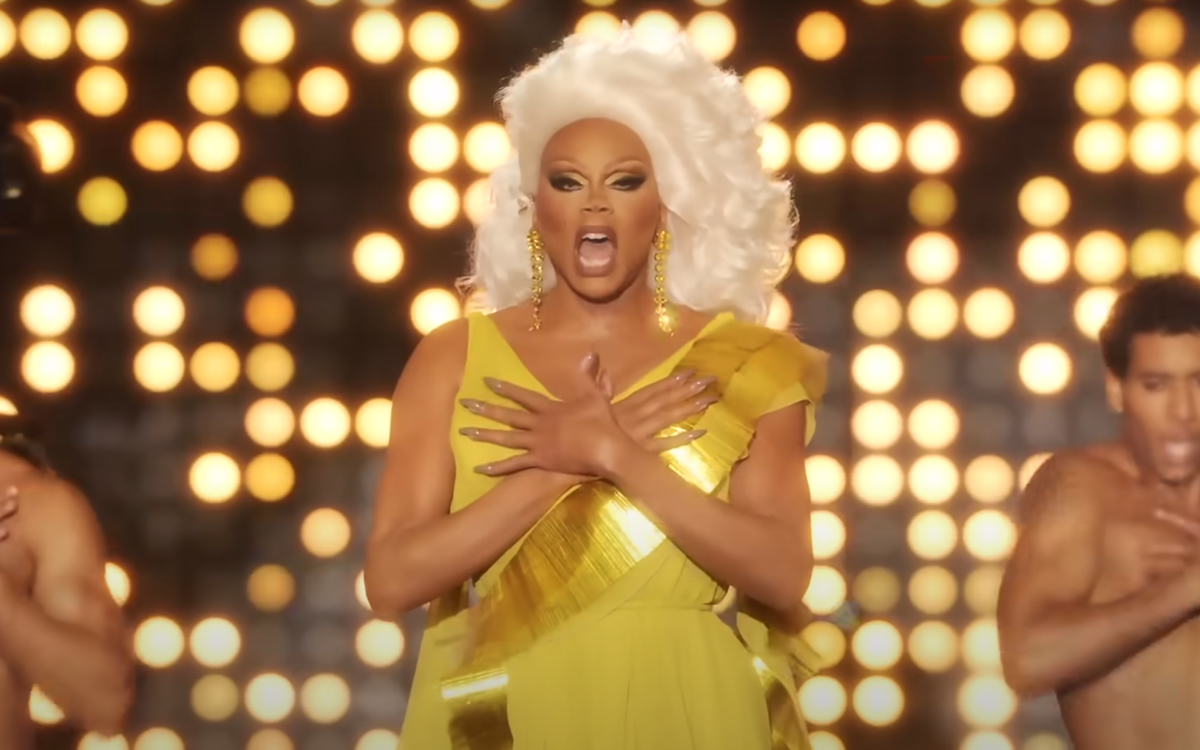
The highly anticipated finale of RuPaul’s Drag Race will feature incredible ensembles, sensational lip sync performances, and of course, the revelation of the season 15 winner. Alongside the competition, the finale will also highlight a joint effort with the ACLU to help defend constitutional rights and creative expression in the LGBTQ community.
With our nationwide network of affiliates, supporters, and advocates, we’re showing up to fight back against hate, and holding politicians accountable for their anti-trans agenda — and you can join us.
ACLU employees represented the ACLU on the red carpet during the April 1 taping of the finale, which featured drag queens from past and present seasons. During the airing of the finale, the ACLU’s Drag Defense Fund will also get a special shoutout as a way to mobilize against mounting legal attacks against drag performers.
What is the Drag Defense Fund?
In partnership with production company World of Wonder, MTV, and RuPaul’s Drag Race, the ACLU’s Drag Defense Fund will support the ACLU’s work defending LGBTQ rights, including censorship of drag performers themselves. The ACLU is committed to the importance of drag as a First Amendment right and an important form of artistic expression. It will also fuel the ACLU’s expansive advocacy work in support of the LGBTQ community, which includes everything from courtroom battles, to guidance on state-level legislation, to challenging LGBTQ censorship in classrooms.
What’s at Stake in the Drag Community?
Drag performance has always been a hallmark of the queer community, allowing members to express themselves openly and joyously. Due in large part to the explosive success of RuPaul’s Drag Race over the years, drag performers have received widespread fanfare and support. But in the past few months, dozens of bills have also been introduced in states around the country that restrict how and where drag queens can perform. One recently-passed Tennessee bill bans drags shows in public spaces around the state, effectively criminalizing them.
These bills censor a fundamental human right to freedom of expression and attempt to remove LGBTQ people from public life — a strategy that ACLU Ambassador for Transgender Justice and former RuPaul’s Drag Race contestant Peppermint recently explained.
“It is sort of a catch all that allows them to attack a word or a notion or an idea, drag, when really what they’re talking about is transgender folks,” she said on a recent episode of our At Liberty podcast. “Trans issues, trans rights, you know, anything having to do with gender and sexuality, they’re trying to dismantle that — dismantle any of the progress that we’ve had on that, and turn us into the boogeyman.”
One Part of a Larger Battle for LGBTQ Rights
These legislative attacks against drag performers, coupled with the anti-trans legislation across the country, underscore an unsettling trend. These bills are bald attempts to prevent people from expressing themselves authentically and restrict their right to bodily autonomy and self-determination. The majority of this legislation specifically targets trans youth and aims to obstruct their ability to find support and access health care. These attacks not only undermine drag queens and trans youth, but the broader LGBTQ community, and the very foundations of gender justice.
How We’re Fighting Back Against Anti-LGBTQ Attacks
Many Drag Race alumni — and RuPaul — have come forward to promote the fund, speak out against the targeted legal attacks, and uplift drag queens as champions for equal rights.
“Drag has influenced everything about my queer identity — as a performer, as a trans individual, drag has just blurred all of the things I love and am into getting to be this kind of walking art installation that is also a protest,” drag queen and season 15 finalist Sasha Colby said of the art form.
The ACLU will always show up to defend our LGBTQ community, especially amid these ongoing legislative attacks. Along with mobilizing our Drag Defense Fund, we will continue to push back against censorship, hold legislators accountable for their anti-LGBTQ agendas, and take legal action to protect our communities. With your help, we’ll be stronger than ever. Join us as we work to preserve our right to freedom of expression, inclusive communities, safe schools, and the right to be who we are without fear.
“RuPaul’s Drag Race,” MTV, and World of Wonder are proud to donate to “The Drag Defense Fund” in support of the ACLU’s LGBTQ rights work. You can make a donation at aclu.org.
Johanna Silver is a Digital Producer at the American Civil Liberties Union.



Opinions
This is only the beginning of taking back our country
Democrats have the power to stop Trump on a range of issues

I want to give a big personal thank you to all the voters, who on Tuesday night, showed the world how disappointed with, and mad at, they are at the felon in the White House, his fascist aides, and sycophants in Congress.
Although there will be loads of columns yet to be written about the reasons people voted how they did, who those voters were, where they were, they thankfully used their constitutional right and voted.
While the numbers are not yet all in when I write this column, it appears that there has been a real blue tsunami. Democrats will have flipped dozens of seats in the House of Representatives, sending Speaker Mike Johnson to oblivion where he belongs. Then apparently at least seven seats in the Senate have flipped, including Texas, Iowa, Kansas, Ohio, Maine, along with North Carolina and South Carolina. Alaska and Mississippi, yes Mississippi, were still too close to call on Wednesday morning.
Then enough governorships have been flipped, including Texas, Iowa and Ohio, so for the first time in 16 years Democrats will hold the majority of governor’s mansions across the nation. As the results keep coming in, it appears Democrats will have flipped statehouses, and lots of other down ballot races, across the nation. What we are seeing clearly is with the right candidates, Democrats can even win in the South. All this bodes well for 2028 if Democrats are smart and read the results of the midterms correctly without personal bias.
While the numbers are not enough to claim a veto-proof Congress, the felon is still in the White House, they are very significant, and the Senate numbers do make that body Fetterman-proof.. Democrats will have the clout to stop Trump on a whole host of issues. While there could be some shenanigans during the lame duck session, when the new Congress is sworn in on Jan. 3, 2027, the Senate will be able to stop any judicial appointments they find unacceptable. In the House, where budget bills begin, they can stop the erosion of crucial medical and science grants, and hold any money the felon wants hostage to moving forward on issues Democrats want to focus on. I also believe with the threat to Republicans up for election in 2028, if Trump continues to go off the rails, Republicans will agree to stop any threat he makes to close the government. Many Republicans will see the handwriting on the wall if they let Trump, and his fascist aides, continue to control the agenda.
It is my hope Democrats will pass a slew of bills, even if the felon won’t sign them. That legislation can be used in the 2028 election, showing people what they will get if they elect a Democratic Congress, and Democratic president.
That being said, I believe the presidential primary begins now. I may not like a primary that lasts so long, but it is a fact of life today. In choosing their presidential candidate, Democrats will decide what direction they want the party, and country, to go. Will it be far left or more moderate? I hope the debate will include how to rejoin our allies, how to end the war in Iran, how to restore American policy supporting a two-state solution in the Middle East. How we fully support Ukraine and stop Putin. Then there must be a clear focus on the kitchen table issues people vote on. The cost of gas, groceries, rent, healthcare, and education for their children. We know there will be debate on issues like data centers, AI, immigration, public safety, and climate change. The one thing I hope all Democratic candidates will agree on is ensuring full equality for women, Black Americans, the LGBTQ community, and other minorities, and that includes economic equality.
One of the issues the House must decide on is whether to impeach Trump for the third time. Is it worth doing, knowing he will not be convicted by the Senate, but building a list of particulars that can be used in the next presidential election? Then, is it worth trying to impeach those like Secretary of Defense Pete Hegseth, and Secretary of HHS, RFK Jr.? There may actually be enough Republican votes in the Senate to convict those two.
In any event, what is exciting is with the Democratic majorities in both houses of Congress, the country can move forward on all of this. Again, thank you voters for taking the first step in reclaiming our country, and ending the chaos the felon has caused in the world.
Peter Rosenstein is a longtime LGBTQ rights and Democratic Party activist.
Opinions
Thank you Janeese Lewis George for ‘People First’ approach
Time for those of us whose lives have been exploited to speak out
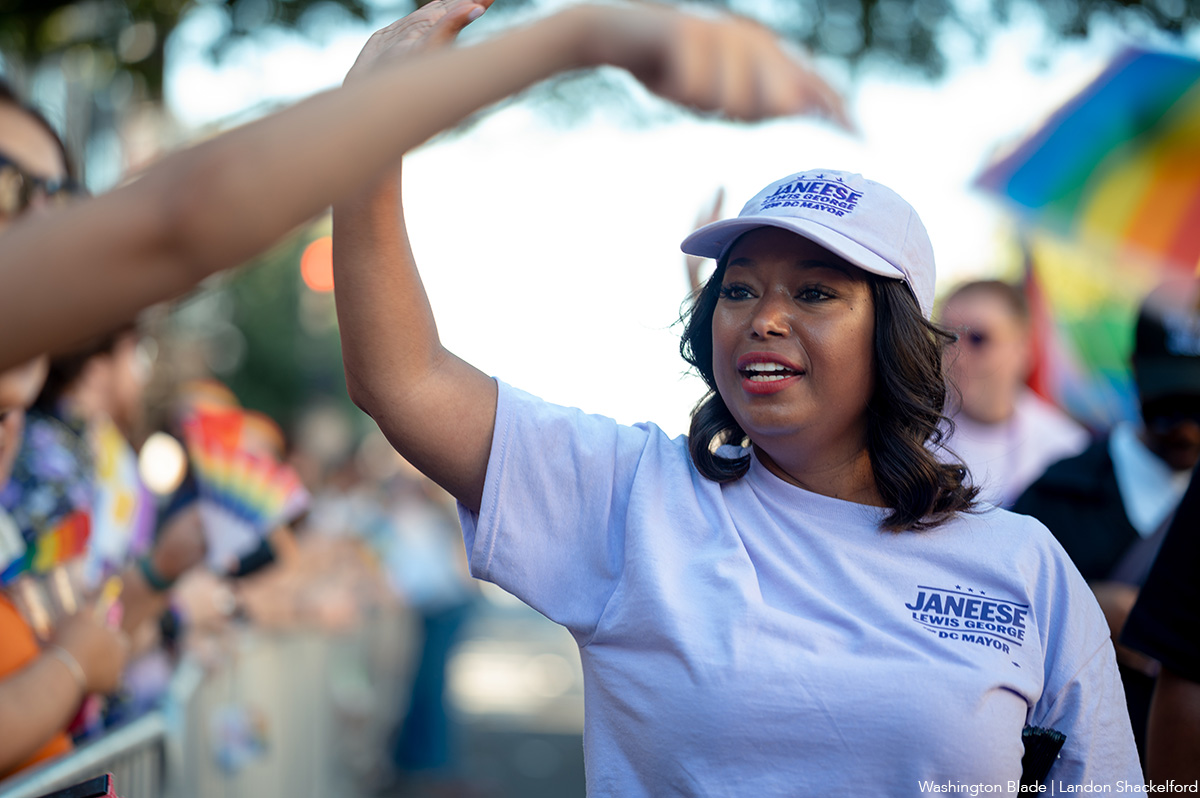
There are more than 100,000 LGBTQIA+ residents in the District of Columbia, and every single one of us deserves to be prioritized. We deserve to be seen, heard, and put first.
Janeese Lewis George’s goal of delivering a “People First” approach offers renewed hope and possibility. As a Black transgender woman, I recognize that the time has come for those of us whose lives, identities, and experiences have too often been exploited for political gain to speak for ourselves.
We deserve to be counted. We deserve to be heard. We deserve to matter. Perhaps most importantly, we deserve a meaningful voice in shaping the policies, decisions, and future of the city we call home — especially when those decisions directly affect our lives.
This is our time. People First means all people. Now is not the time to rest on our laurels or become complacent. It is not the time to wait out the political storm. Now is the time to act.
I didn’t just witness the fight for equality; I was in it. As a transgender woman, I marched for marriage equality, and I stood alongside Daniel Choi as he handcuffed himself to the White House fence during the Obama administration, demanding the repeal of “Don’t Ask, Don’t Tell.”
I remember what it took to get here. I remember the sacrifices, the protests, the courage, and the countless people who put themselves on the line so that we could move closer to freedom. We cannot afford to forget that history, and we certainly cannot afford to stop fighting. Our liberation has never been a spectator sport.
My commitment to this work extends beyond protest and advocacy. As a leader in the LGBTQIA+ community, I worked with the DC Department of Employment Services (DOES) to help establish what became the nation’s first workforce development program specifically designed for transgender residents of the District.
The impact of that work has extended well beyond the District, with variations of this model continuing to exist in major cities across the country. We have long known that meaningful inclusion requires much more than simply opening the doors to employment.
Our work dismantled barriers to safety, housing, employment, and access to health care. We provided assistance with legal name changes, helping participants obtain government-issued identification that accurately reflects their gender identity and presentation. And because government can’t — and shouldn’t — do it all, we also raised funds to provide essential supplemental support, including meals and Metro cards. This is what we did for our people. We understood that meaningful inclusion required seeing the whole person, recognizing the realities and challenges of participants’ lives, and creating a program that met people where they were.
This is what people-first work looks like. It means recognizing the unique needs of LGBTQIA+ people while ensuring that we receive the same consideration, resources, opportunities, and dignity afforded to every other resident of the District of Columbia.
Our needs should never have to compete with our right to belong, or our birthright to exist. We are residents of this city, too. We contribute to its vitality, its culture, its economy, and its future. To be sure, the nation’s capital has the highest per-capita percentage of LGBTQ+ residents in the United States, with approximately 14.5% of D.C. adults identifying as part of the community. We must be seen, heard, and meaningfully represented in every conversation.
This moment is bigger than any one candidate or individual. While I personally hope to have the opportunity to work with Janeese Lewis George, I stand ready to work with any of our neighbors who are genuinely committed to refocusing our efforts on serving the people of D.C. and putting them first.
Because, ultimately, that is what People First must mean: all people, without exception.
Rev. Danielle Dufoe is an educator, a minister at Washington, D.C.’s historic 15th Street Presbyterian Church, and a prominent national transgender activist. Reach her at [email protected]
Commentary
LGBTQ+ History Month reminds us: the future we imagine can become reality
Movement leaders, Lambda Legal call for new LGBTQ+ Bill of Rights
Recently, I was chatting with an 11-year-old girl about a movie character who carried a secret about herself that was so terrifying she worried that the people who loved her most would reject her for it if they learned her truth.
As we talked, I mentioned that some people see the character’s story as a metaphor for being LGBTQ. The girl asked, “why wouldn’t people want the people who love them to know that they’re LGBTQ?”
What struck me was how bewildered she was. I shared that coming out has historically been frightening for many LGBTQ+ people who feared rejection. While keeping one’s own status as part-demon from one’s demon-hunting best friends was easy for her to wrap her mind around, the idea that a queer person might feel the same way was truly news to her. The idea simply didn’t fit her view of the world.
That 11 year-old is my daughter. She has grown up with two mothers who have been legally married since before she was born, and she has lots of LGBTQ+ youth and adults in her life. Being LGBTQ+ is not something she sees as different. She has never known a time when our family lacked legal recognition or the acceptance of our neighbors or schoolmates. To her, equality is not an aspiration, but an everyday expectation. And at the same time that too many youth do not have that safety, I know there are thousands of young people across the United States growing up with that same expectation of dignity, equality, inclusion, and respect.
As we honor LGBTQ+ History Month this October, that conversation reminded me how profoundly the world can change in a single generation, and how much is possible when we dream of and work toward that future.
In 1968, LGBTQ+ advocates adopted what they called then the “Homosexual Bill of Rights,” demanding an end to criminalization, immigrants’ rights, government and military service, and employment equity. While many Americans viewed those goals as unthinkably distant or difficult, many were achieved over the decades. Sodomy laws were struck down thanks to Lambda Legal’s Lawrence v. Texas case. “Don’t Ask Don’t Tell” was passed and then repealed. Employment protections for LGBTQ+ expanded. Marriage equality became the law of the land. What once sounded impossible became reality.
That’s a testament to what our movement has achieved in more than half a century. But marriage was never the finish line. It was a milestone. Today, millions of LGBTQ+ people still face barriers to health care, discrimination in schools and workplaces, threats to their families, and efforts to exclude them from public life. In particular, transgender and nonbinary people continue to face coordinated attacks from every level of government. And people living with HIV still confront stigma and inequities that should never have existed — and should not continue to exist today.
Our work to achieve full equality remains unfinished.
That is why it’s time for a New LGBTQ+ Bill of Rights as part of our long-term vision of equality and belonging for our community. Inspired by the visionaries of 1968, this New Bill of Rights asks a simple but powerful question: What kind of society do we want LGBTQ+ people to live in 25, 50, or even 100 years from now?
We are centering five priorities: health, education, opportunity, family, and democracy. We envision quality health care for all LGBTQ+ people and everyone living with HIV; school communities that allow every student to thrive; genuine economic opportunity; a culture of belonging for LGBTQ+ families; and a vibrant democracy that fully represents all of us.
Some might think that those aspirations are too ambitious. They might be — but no more so than was the Homosexual Bill of Rights in 1968. History has shown us that today’s impossible can become tomorrow’s new normal. Culture changes hearts and minds, and people change laws. Over time, with empathy and humanity, what once seemed radical becomes the law of the land.
My daughter’s reaction is proof of that change. The fact is that many young people today find anti-LGBTQ+ discrimination unacceptable because generations of advocates challenged injustice and expanded what was possible.
When we create a society where everyone has the freedom to live openly, safely and authentically, we all rise. The original 1968 Bill of Rights challenged America to imagine something better. Fifty years later, it’s our turn to chart a new vision for our country. One that doesn’t just fight today’s attacks but proactively reimagines the future.
One day, I hope that when future generations hear stories about discrimination against LGBTQ+ people they respond exactly the way my daughter did: with incredulity. I hope they look back on unequal access to health care, housing, and education as a regrettable chapter of the past. I hope they see the relentless attacks on transgender youth of this era as a transparently desperate attempt to hold on to a culture war that was already lost. Our movement won’t stop working until that day comes.
That will be how we know we have won. It’s going to be golden.
Cathryn Oakley is deputy legal director for policy at Lambda Legal.

Lewis George appoints gay former White House official to mayoral transition team

Snyder-Hall wins second term in Delaware House

Record number of LGBTQ lawmakers elected to Congress in midterms

Democrats take control of Congress in historic rebuke of Donald Trump

Janeese Lewis George wins race for D.C. mayor by wide margin

A transatlantic voyage on Celebrity XCEL

At Shakespeare, a passionate portrayal of Frida Kahlo

Spanberger campaigns in support of Question 2

Make sure to vote on Election Day