


It wasn’t a debate. It was an audition for the French-speaking role of a Prime Minister who will soon have to face two fluent French speakers in a real debate: Bloc Québécois leader Yves-François Blanchet and Conservative leader Pierre Poilievre.
That’s how the performances of the four aspiring Liberal Party leaders were measured by those who watched the friendly exchange. And on that count, only Montreal-born Frank Baylis, who was educated in French in Toronto, earned a passing grade.
Not that Karina Gould, Chrystia Freeland, and Mark Carney couldn’t deliver their messages in French. They each did so with varying degrees of ease. They certainly deserve an “E” for effort — more than the leaders of Ontario’s four provincial parties, who didn’t even bother showing up for last week’s French debate.
U.S. President Donald Trump and the Canadian economy dominated the discussion as Liberal leadership candidates faced off in the first of two debates. The French debate will be followed by an English debate. Former finance minister Chrystia Freeland, former central banker Mark Carney, former House leader Karina Gould and Montreal businessman and former MP Frank Baylis are vying to replace Prime Minister Justin Trudeau. (The Canadian Press)
But this was an interview for the job of leading a country with two official languages. Is a high level of fluency an absolute prerequisite? No. Stephen Harper spoke French with some ease but stumbled at times. But for a Liberal leader who needs Quebec to win nationally, it matters a great deal.
All four could likely qualify for government management positions, which require a minimum Canadian Language Benchmark level of seven. That means they must be able to converse fluently and handle everyday or work-related situations, understand the main ideas in complex conversations, presentations, and media broadcasts, and comprehend moderately complex texts like newspaper articles, reports, and books.
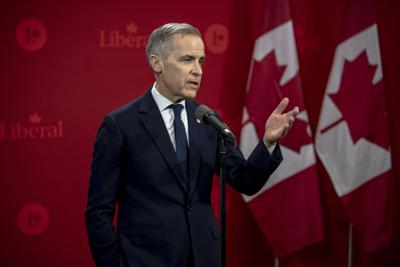
But a political debate, where sparks are expected to fly, is an entirely different dynamic — especially in the House of Commons, where cameras and soundbites shape public perception. That’s where judgments are passed, and opponents are unforgiving. The Conservatives reacted in real time on social media when Carney, struggling to interject on the Middle East, stumbled and appeared to say he “agreed with Hamas.” That prompted Freeland to immediately clarify, “We don’t agree with Hamas,” as Carney quickly corrected himself.
Speaking a second language can sometimes lead to embarrassing moments. Take, for example, the wife of French President Charles de Gaulle. At a luncheon with the American ambassador following her husband’s retirement, she was asked what she was most looking forward to in the years ahead. She thought for a moment before boldly announcing, “a penis.” A startled hush fell over the table — until the former president leaned over and gently corrected her: “My dear, I think it’s pronounced ‘happiness’.”
Ironically, Mark Carney didn’t get into that kind of trouble. The moderator did — calling Chrystia Freeland “Madame Carney,” prompting an awkward joke from both about being close friends but not that close. More notably, when the moderator told Carney he only had vingt secondes to answer a question, his mumbled delivery led Carney to ask him to repeat himself. The moderator switched to English: “20 seconds.” That was both unnecessary and, frankly, unfair.
Will any of this matter in the end? I doubt it.
When Carney slips, Quebecers might feel empathetic embarrassment rather than schadenfreude — the pleasure taken in another’s misfortune. They’ll appreciate the effort.
They didn’t take kindly to another leadership candidate’s dismissive attitude toward French. “I was born in Montreal. I am a Quebecer. I understand Quebecers, and I am bilingual,” Kevin O’Leary told Ezra Levant in 2017. “I speak the language of English. I’m an English Quebecer. I also speak the language of jobs and economic fiscal policy. They know I have their back. I’m not worried that I don’t speak French or Italian or Chinese.” He went on to argue that Quebecers would give him “flexibility” because economic issues mattered more than language. They didn’t.
But these are unprecedented times. Francophones may be less concerned about Carney’s French proficiency than his ability to debate Donald Trump. When Radio-Canada’s Patrice Roy recently interviewed him, some viewers commented that French doesn’t do him justice — that in English, he is far more convincing than Pierre Poilievre.
That’s why, for most Liberals — and eventually for Canadian voters — the English debate will matter far more.
Error! Sorry, there was an error processing your request.
There was a problem with the recaptcha. Please try again.
You may unsubscribe at any time. By signing up, you agree to our terms of use and privacy policy. This site is protected by reCAPTCHA and the Google privacy policy and terms of service apply.
Want more of the latest from us? Sign up for more at our newsletter page.


To join the conversation set a first and last name in your user profile.
Never miss the debate! Receive daily email notifications when users reply to your comments. Sign up for alerts here!
Sign in or register for free to join the Conversation
To join the conversation set a first and last name in your user profile.