Historical fleet

Meet the planes that over the decades made us fly and dream.

DC3 - DAKOTA

Years in service of TAP

1945

14

1959

Desenho técnico de um avião Douglas DC-3 Dakota, utilizado pela TAP Air Portugal. São apenas visíveis as linhas de contorno do avião e pormenores da fuselagem como as janelas, hélices ou trem de aterragem.

A legend of the air, and undoubtedly one of the most memorable planes of all time. The DC-3 played a crucial role in both military aviation and the massification of commercial aviation. Safe, comfortable and easy to operate, it is still admired by pilots and aviation enthusiasts. You can see a replica of TAP's DC-3 at the Air Museum.

Workers manually manoeuvre a Douglas DC-3 Dakota, registration CS-TDD, belonging to the initial fleet of Transportes Aéreos Portugueses. This model was fundamental to the start of TAP's regular operations, including the first Lisbon-Madrid connection in 1946.
zoom_in
Black and white photograph of a TAP Douglas DC-3 Dakota aircraft inside a hangar. In the image, several mechanics are working on different parts of the aircraft: two are on a raised platform next to the engine, while others are on top of the fuselage and on the ground, focused on technical tasks. The aircraft displays the Portuguese coat of arms and the acronym ‘TAP’ on the fuselage, with part of the inscription ‘TRANSPORTES’ visible in the background.
zoom_in
A group of men, probably mechanics or maintenance workers, manually pushing a large aeroplane in a hangar area or airport runway. The men are wearing typical work overalls and are pushing on the wing and landing gear of the aircraft, which has several windows along the fuselage. The aircraft is a Douglas DC-3 Dakota.
zoom_in
The plane has the licence plate ‘CS-TDA’ visible on the fuselage and belongs to TAP, the Portuguese airline, as you can partially read next to the nose of the aircraft. It is a twin-engine propeller model with fixed landing gear and several windows along the body, typical of commercial aircraft from the 1940s and 1950s.
zoom_in
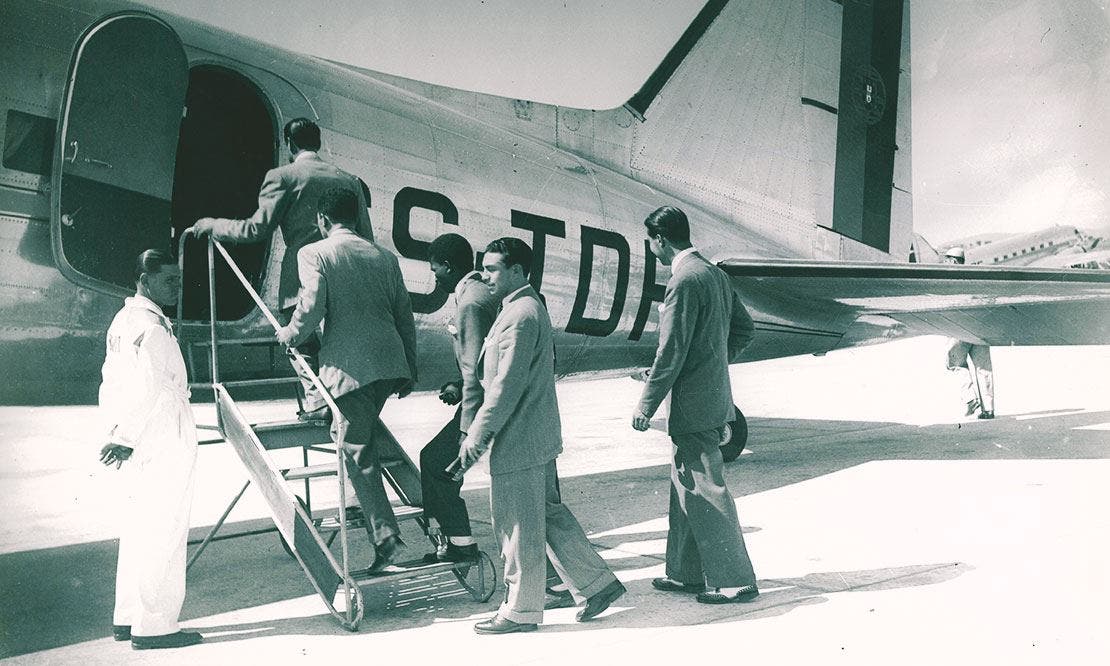
Black and white image showing several passengers boarding a TAP Douglas DC-3 Dakota aeroplane. The aircraft is identified by the ‘CS-TDA’ licence plate visible on the fuselage, characteristic of this twin-engine propeller model, which was widely used by TAP in the 1940s and 1950s. Passengers, dressed in formal suits, climb a mobile ladder to enter the aircraft's rear door, while an official in a white uniform observes the scene.
zoom_in
A Douglas DC-3 Dakota TAP aircraft parked on a dirt runway. The aircraft, easily identifiable by its rounded nose, radial engines under the wings and fixed landing gear, is being refuelled or undergoing maintenance, with several technicians and employees standing around. Two men are on the right wing, while others are working on the engine and ground support equipment. In the foreground, a sign warns ‘DEFENSE FROM SMOKING’, indicating the ban on smoking in the area due to the risk of fire.
zoom_in

Aircraft details:

Manufacturer

Douglas Aircraft Company (USA)

Wingspan

28.95 m

Length

19.67 m

Cruising speed

270 km/h

Capacity

21 people

Number of Crew

4 (Pilot, co-pilot, radiotelegrapher, and flight attendant)