

A number of pro-localization groups yesterday rallied in front of the Ministry of Education in Taipei to protest against the government’s adoption of the Hanyu pinyin romanization system for translations of station names along the MRT line between Taiwan Taoyuan International Airport and Taipei Main Station, calling on the Democratic Progressive Party government to reinstitute its former policy of pushing for nationwide implementation of Tongyong pinyin.
The protesters called on the ministry, the governing body for the nation’s languages, to abandon the Hanyu system adopted by former president Ma Ying-jeou (馬英九) and reinstate the Tongyong system, which was promulgated in 2002 as the nation’s standard Mandarin romanization system.
Although the International Organization for Standardization (ISO) identifies Taiwan as a province of China, the organization uses the Tongyong system when referring to places in Taiwan, Taiwan Mandarin Romanization Alliance convener Yu Bor-chuan (余伯泉) said.
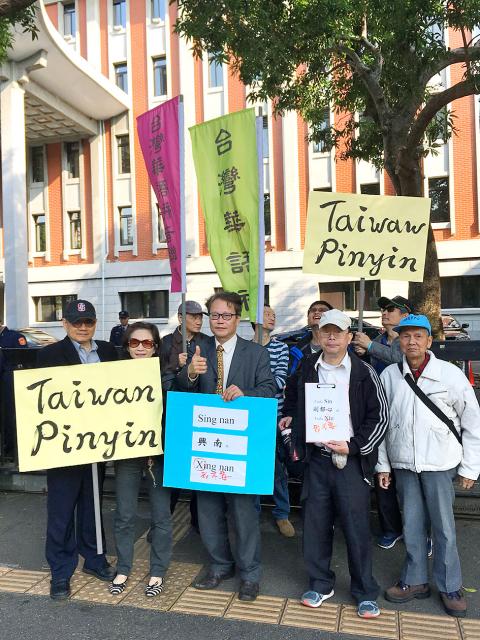
Photo: Sean Lin, Taipei Times
“For example, the ISO 3166 standard does not spell Kaohsiung as ‘Gaoxiong,’ just as it retained the spelling for Hong Kong, rather than ‘Xianggang,’ after the territory was handed over to China in 1997,” Yu said.
In addition, the ISO 7098 standard states that Hanyu pinyin is “the official language of the People’s Republic of China,” of which Taiwan is not a part, so the version of Mandarin used by Taiwanese does not fall within that scope, Yu said, adding that Ma led the nation down a path of “suicide” when he submitted to China and made Hanyu pinyin the national standard.
The administration of President Tsai Ing-wen (蔡英文) could have readopted Tongyong pinyin as the nation’s official romanization system after it took office, but it has instead treated the issue with indifference; essentially restricting itself to a framework set by Ma, he said.
As Taiwan’s culture and people have diverse origins, Taiwanese have formed a language that is uniquely Taiwanese, Taiwan Frontier convener Hong Hsien-cheng (洪顯政) said.
“The Mandarin used in Taiwan sounds different from that used in China and should have an independent system, just as British English is different from American English,” he said.
The nation’s use of Hanyu pinyin should not be made a political issue, ministry National Language Education Promotion Office head Wu Chung-yi (吳中益) said.
“The romanization used on road signs and at transportation stations is intended for foreigners... Every foreigner learning Mandarin learns Hanyu pinyin, because it is the international standard,” Wu said. “The decision has nothing to do with the nation’s self-determination or any ideologies, because the key point is to ensure that foreigners can read signs.”
“It is impossible to reason with the groups, as they are bent on politicizing the matter,” he added.
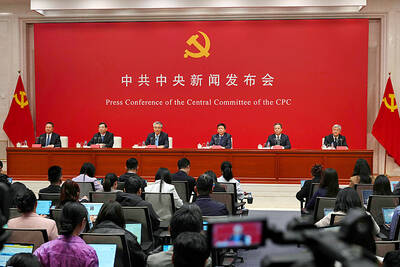
SHORT-TERM OUTLOOK: The Chinese military would most likely focus on rebuilding its organization and leadership in the next few years, experts said Chinese President Xi Jinping’s (習近平) military purge has reduced the risks of a planned war against Taiwan, yet increased the danger of a conflict sparked by a miscalculation or accident, Taiwanese experts said yesterday. They made the comments at a seminar on the Fifth Plenary Session of the Chinese Communist Party’s (CCP) 20th Central Committee held by the research group Secure Taiwan Associate Corp (STA) in Taipei. The wholesale sacking of Chinese People’s Liberation Army (PLA) officers and managers of the aerospace and defense industry is sure to set back Xi’s timetable to prepare the PLA to launch an invasion of Taiwan

BATTLE-TESTED: Czech companies’ drones, software and navigation systems have been tested in the Ukraine war, while other countries’ are lab-tested, a Czech ex-official said Czech manufacturers are interested in setting up drone assembly lines in Taiwan, former Czech Chamber of Deputies president Marketa Pekarova Adamova told a forum in Taipei yesterday. Adamova made the comments at the inauguration of the Global UAV Academy, an organization dedicated to international cooperation in drone supply chains, technological certification and pilot training. The Research Institute for Democracy, Society and Emerging Technology said the Czech Republic is the largest importer of Taiwanese drones and uncrewed aerial vehicle (UAV) components. Adamova, who transitioned to the defense industry after retiring from politics, said the Roman adage “si vis pacem, para bellum” — “If you
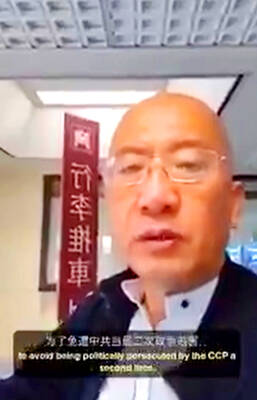
Former China Central Television (CCTV) talk show host Cheng Wanjun (程萬軍) yesterday sought political asylum in Taiwan, a day after arriving at Taiwan Taoyuan International Airport on a connecting flight from Thailand. In a video posted on X, Cheng said he was appealing to Taiwan to grant him temporary asylum on humanitarian grounds while he sought permanent resettlement in a third country. Cheng said he previously served as editor-in-chief of the journal Law and Life and hosted legal affairs programs on state-run CCTV. He said he ran afoul of Chinese authorities in 2019 after a video surfaced showing him discussing rulers whose actions
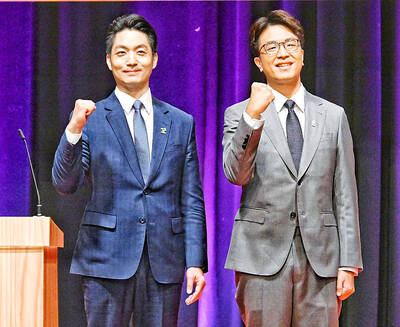
Support for Democratic Progressive Party Legislator and Taipei mayoral candidate Puma Shen (沈伯洋) reached 52.6 percent, compared with 35.3 percent for Taipei Mayor Chiang Wan-an (蔣萬安) of the Chinese Nationalist Party (KMT), a poll released yesterday by the Strategy and Public Research Institute of Taiwan showed. The poll was held after the candidates’ first debate on Saturday. It showed support for Shen surpassing 50 percent for the first time, with the gap between the two widening to 17.3 percentage points. A breakdown of voting intentions by district found that Shen led Chiang in 11 of Taipei’s 12 districts. His strongest


 RSS