

Amid raucous protests by unions and opposition members, three state-run companies changed their names yesterday, dropping "China" references and including "Taiwan" in their official titles.
Government officials said the move was part of a bid to avoid confusion among members of the international community, which could mistake Taiwan for China.
Chinese Petroleum Corp (CPC, 中國石油) and China Shipbuilding Corp (CSBC, 中國造船) approved their name changes in board meetings yesterday.
CPC has been renamed "CPC Corp, Taiwan" (
The board of Chunghwa Post Co (
"The chairman [of the meeting] ruled today that the number of board directors present has met the requirements of conference rules," Chunghwa Post Co chairman Lai Ching-chyi (賴清祺) said, after spending almost eight hours trying to hold the board meeting and switching venues four times. "The conference is, therefore, legal."
That the decision was made without three board members who represent the Chunghwa Post Workers Union infuriated some employees of one of the nation's oldest state-run companies.
Lai said that company had informed the union that the meeting would be held at the Ministry of Transportation and Communications' (MOTC) headquarters.
Board members were waiting for the union's representatives for at least 30 minutes before the meeting began, Lai added.
The union's board members arrived at the MOTC building yesterday afternoon intending to join the meeting, but they were blocked at the entrance by police.
"Congratulations," Chunghwa Post Workers Union chairman Tsai Liang-chuan (
Tsai added that the union would launch a protest next Monday. One of the union's board members told reporters that he had filed a lawsuit against Chunghwa Post at the Taipei District Court, but did not provide details.
The postal service board had been scheduled to hold a routine board meeting yesterday at 9am, but the members were unable to reach a decision in the morning, as workers broke into the meeting room and interrupted the proceedings. The meeting's chairman dismissed the board at 12:30pm.
Board directors representing the government left the headquarters and tried to locate different venues to meet.
Lai said yesterday after the meeting that the name change would facilitate delivery of mail in the future. Some mail is sent to China by mistake, he said, because mail personnel in other countries often confuse Taiwan with China.
He also said that replacing the names on the billboards as well as other items would cost the company only approximately NT$67 million (US$2.1 million).
Tsai said, however, that the expenses would be more than the sum Lai claimed, if changing the titles of personal account books and postal delivery trucks are taken into account.
Tsai added that Taiwan is not one of the members of the Universal Postal Union (UPU) and had to be informed about information updates from the union through South Korea.
Given the pressure from China, Taiwanese stamps may not be recognized by other nations, which would result in a cross-strait postal delivery crisis, he said.
Meanwhile, adding the word "corporation" to the English titles of "CPC Corp, Taiwan" and "CSBC Corp, Taiwan" was not redundant, Minister of Economic Affairs Steve Chen (陳瑞隆) said, as the acronyms have become recognized corporate logos.
The two state-run enterprises both held board meetings at 2pm yesterday to discuss the name change issues, and the new names were immediately endorsed by the ministry, which is in charge of the two firms.
"Since CPC and CSBC are state entities, the name change can help them avoid confusion outside Taiwan. We believe the new titles will boost their corporate image, competitiveness and market share," Steve Chen told a press conference.
As some employees oppose the name change campaign, Chen said he had talked to the leaders of the two firms' labor unions on Thursday and promised that their rights and interests would be protected, which he said helped the board meetings proceed smoothly yesterday.
CPC vice president Tsao Mihn (曹明) said the board of directors yesterday demanded that employees' benefits not be sacrificed and that corporate performances be reviewed every six months to determine whether the new title brought any negative impact on operations.
CPC's new name already took effect yesterday afternoon, as the firm is 100 percent owned by the government. The ministry said that new signs could be put up at gas stations, starting Monday at the earliest.
CSBC, meanwhile, will have to seek shareholder approval for a new name, as it is 2 percent controlled by private shareholders and 98 percent by the government.
The shareholder meeting is scheduled for March 1, CSBC president Fan Kuang-nan (
Fan said changing CSBC's name could cost around NT$20 million, as it only needs to send notices to holders of its 30,000 contracts, instead of changing its documents.
CSBC is not worried that buyers will be affected or China will interfere, as it is a "seller's market" in the shipbuilding industry, and the 54 ships currently under construction will still obtain a good price on the market, he added.
Premier Su Tseng-chang (蘇貞昌) yesterday said that the name change of the three state-owned companies would not cost much and would not jeopardize employees' legal rights.
The name changes will avoid potential confusion for foreigners and will make the firms more competitive, because it will become easier to identify them with Taiwan, Su said during a press conference.

EYE ON 2027: The US military has placed equipment, materiel and personnel on the islands near China, a US officer said while warning about the threat from China The US Army Pacific (USARPAC) is deploying forces and equipment across the region based on the assumption that Beijing could possess the military capability and the intent to invade Taiwan by next year, a top US commander said on Tuesday. Speaking at the TechNet Indo-Pacific conference in Honolulu, US General Ronald Clark said that the threat posed by the so-called “Davidson window” is “still valid,” US military newspaper Stars and Stripes reported on Wednesday. The term stems from a 2021 warning by Admiral Philip Davidson, then-head of the US Indo-Pacific Command, that the threat of Chinese military action against Taiwan could materialize
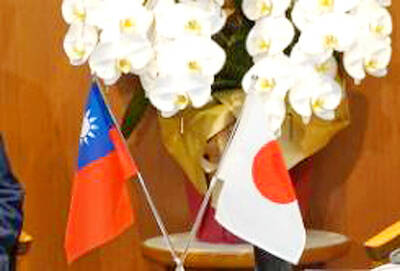
Taiwan and Japan might sign a wide-ranging trade agreement by the end of this year, which could help break a deadlock in Taiwan’s trade diplomacy if completed, Nikkei Asia reported yesterday. Japan is negotiating with the administration of President William Lai (賴清德) to reach a comprehensive economic agreement modeled after the Enhanced Trade Partnership Arrangement finalized by the UK and Taiwan in 2023, it said, citing two sources familiar with the matter. “The Enhanced Trade Partnership between the UK and Taiwan sets a precedent for Japan to follow,” one of the sources told the media outlet. The framework leaves room for future agreements

‘ONE CHINA’ DECISION: A Cabinet spokesperson said that Pakistan had pandered to Beijing, and disregarded international rules and reality with the overflight ban The first Taiwanese commercial aircraft since restrictions were lifted flew over Pakistan yesterday morning following an abrupt U-turn by authorities to approve permits that were briefly revoked due to Islamabad’s “one China” policy. EVA Airways (長榮航空) Flight 65 from Taipei to Vienna entered Pakistani airspace at about 3:30am local time, Flightradar24 tracking data showed. All other Europe-bound EVA Air and China Airlines (華航) flights that departed late on Wednesday night into early yesterday morning opted to use Russian airspace, or go via India. The airlines had been forced to detour, including flying over Russia, since Sunday, after Pakistan shut its airspace to Taiwanese
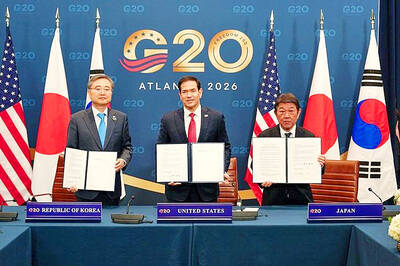
Taiwan yesterday welcomed and expressed appreciation for foreign ministers from the US, Japan and South Korea for emphasizing the importance of maintaining peace and stability across the Taiwan Strait at a trilateral meeting on the sidelines of the G20 in Atlanta, Georgia, on Friday. US Secretary of State Marco Rubio met with Japanese Minister of Foreign Affairs Motegi Toshimitsu and South Korean Minister of Foreign Affairs Cho Hyun to review the progress of a trilateral partnership that aims to advance security and prosperity in a free and open Indo-Pacific region, the US Department of State said in a statement. They emphasized


 RSS