

Reaction to yesterday's victory in the presidential election by the DPP's Chen Shui-bian (陳水扁) was a mixture of elation, caution and warnings, with opponents blaming both unpredictable voter behavior and President Lee Teng-hui (李登輝) himself for the upset that will end more than five decades of power for the KMT.
While congratulating Chen yesterday, his rivals also responded by expressing their own expectations as to how the president-elect would direct the country toward a better future.
"Faced with the intricate current situation, I hope you will lead Taiwan into a new phase with an open mind and new way of thinking,"said vice president and KMT presidential candidate Lien Chan (連戰), who came in third in the election with just 23 percent of the popular vote.
In a concession speech last night, Lien said he respected the results of the election as an expression of the people's will, adding that the smooth process of the election marked another watershed in Taiwan's democratic development.
Meanwhile KMT officials said that tactical voting, the so-called "dump Lien, save Soong"and "dump Lien, save Chen"effects, were mainly responsible for the KMT's election debacle.
KMT Secretary-general Huang Kun-huei (黃昆輝) announced his resignation over the party's failure in the campaign.
Independent candidate James Soong (宋楚瑜), who broke away from the KMT to run in the race and won more than 36 percent of the votes, also pledged support for the new DPP-led government.
"The most urgent task now is to support the new government with foresight,"Soong said.
Independent candidate Hsu Hsin-liang (許信良), who won a mere 0.6 percent of the vote, said he hoped Chen would prioritize cross-strait issues and boost public confidence in Taiwan's economy.
Officials from the New Party, which won only 0.1 percent of the vote yesterday, said they believed Chen's victory to a certain extent reflected the 'anti-China' complex of the Taiwanese.
"The intimidating statements from ... Chinese premier Zhu Rongji (朱鎔基) triggered voters' negative emotions, and they voted for Chen,"said Hau Lung-bin (郝龍斌), leader of the New Party's caucus at the Legislative Yuan.
Beijing, which repeatedly warned Taiwan voters against supporting a pro-independence candidate in the run up to the poll, issued only a brief reaction last night, saying the poll results did not change the island's status as part of China.
Xinhua news agency quoted a statement from the Taiwan Affairs Office of the State Council, China's Cabinet, as saying: "Taiwan's local leadership election and its results cannot change the fact that Taiwan is a part of China's territory."
It did not mention poll victor Chen Shui-bian by name.
Ma Lik, meanwhile, a Hong Kong deputy to China's National People's Congress, said Beijing will watch Chen's actions before taking the next step.
"Beijing will not declare war, not yet,"Ma said. "He [Chen] must persuade Beijing that he will not declare Taiwan independent and that he wants to improve their relationship."
Affirming the military's resolve to safeguard Taiwan's security, Chief of the General Staff Tang Yao-ming (湯曜明) pledged loyalty to the new president on behalf of the armed forces immediately after Chen's victory.
"According to article 138 of the constitution, the armed forces should be loyal to the country and protect the people. And article 36 stipulates that the president is the supreme commander of the armed forces,"Tang said.
In light of China's strong suspicion of the DPP's wish to promote independence for Taiwan, easing cross-strait tensions is widely believed to be one of Chen's biggest challenges.
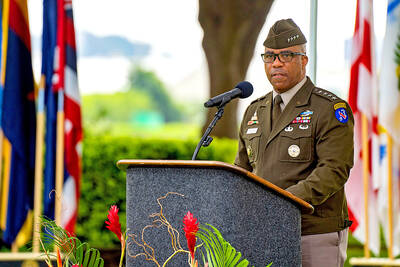
EYE ON 2027: The US military has placed equipment, materiel and personnel on the islands near China, a US officer said while warning about the threat from China The US Army Pacific (USARPAC) is deploying forces and equipment across the region based on the assumption that Beijing could possess the military capability and the intent to invade Taiwan by next year, a top US commander said on Tuesday. Speaking at the TechNet Indo-Pacific conference in Honolulu, US General Ronald Clark said that the threat posed by the so-called “Davidson window” is “still valid,” US military newspaper Stars and Stripes reported on Wednesday. The term stems from a 2021 warning by Admiral Philip Davidson, then-head of the US Indo-Pacific Command, that the threat of Chinese military action against Taiwan could materialize
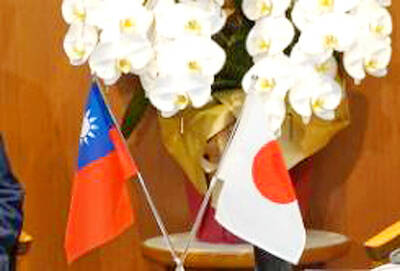
Taiwan and Japan might sign a wide-ranging trade agreement by the end of this year, which could help break a deadlock in Taiwan’s trade diplomacy if completed, Nikkei Asia reported yesterday. Japan is negotiating with the administration of President William Lai (賴清德) to reach a comprehensive economic agreement modeled after the Enhanced Trade Partnership Arrangement finalized by the UK and Taiwan in 2023, it said, citing two sources familiar with the matter. “The Enhanced Trade Partnership between the UK and Taiwan sets a precedent for Japan to follow,” one of the sources told the media outlet. The framework leaves room for future agreements

‘ONE CHINA’ DECISION: A Cabinet spokesperson said that Pakistan had pandered to Beijing, and disregarded international rules and reality with the overflight ban The first Taiwanese commercial aircraft since restrictions were lifted flew over Pakistan yesterday morning following an abrupt U-turn by authorities to approve permits that were briefly revoked due to Islamabad’s “one China” policy. EVA Airways (長榮航空) Flight 65 from Taipei to Vienna entered Pakistani airspace at about 3:30am local time, Flightradar24 tracking data showed. All other Europe-bound EVA Air and China Airlines (華航) flights that departed late on Wednesday night into early yesterday morning opted to use Russian airspace, or go via India. The airlines had been forced to detour, including flying over Russia, since Sunday, after Pakistan shut its airspace to Taiwanese
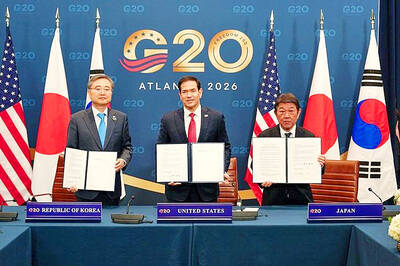
Taiwan yesterday welcomed and expressed appreciation for foreign ministers from the US, Japan and South Korea for emphasizing the importance of maintaining peace and stability across the Taiwan Strait at a trilateral meeting on the sidelines of the G20 in Atlanta, Georgia, on Friday. US Secretary of State Marco Rubio met with Japanese Minister of Foreign Affairs Motegi Toshimitsu and South Korean Minister of Foreign Affairs Cho Hyun to review the progress of a trilateral partnership that aims to advance security and prosperity in a free and open Indo-Pacific region, the US Department of State said in a statement. They emphasized


 RSS