
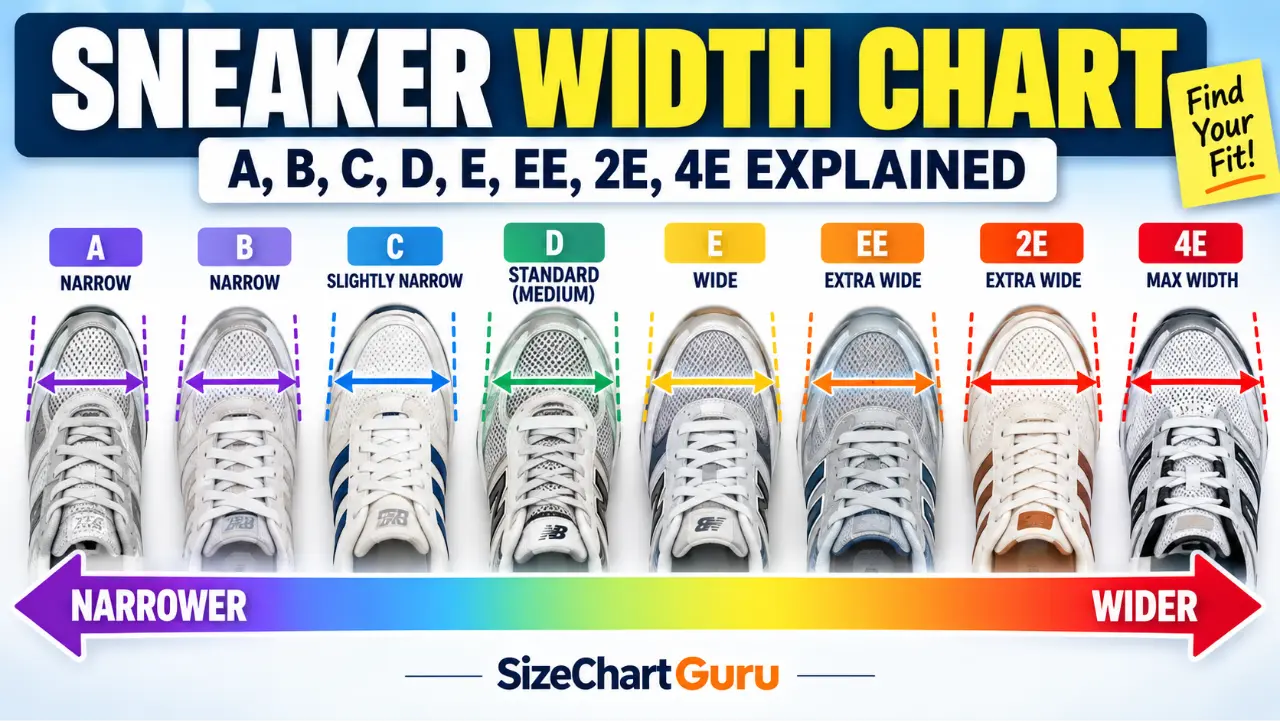
Sneaker width is separate from sneaker length. Two shoes can both be a US 9, for example, while one is built in a standard width and the other gives you more room across the foot.
For most brands, men’s standard width is D, while women’s standard width is B.
From there, wide and extra-wide labels can change depending on the brand and whether you’re looking at men’s or women’s sizing.
Asics, for example, uses D as men’s standard and women’s wide, while 2E is men’s wide and women’s extra wide.
The charts below are the quickest way to see how the most common sneaker widths compare.
My How Do I Know If I Have Wide Feet? guide walks through the complete process, including how to measure your width at home and with a Brannock Device.

Sneaker Width Chart
Sneaker Width Chart: Quick Reference
Sneaker width letters don’t mean exactly the same thing in men’s and women’s sizing. For example, D is the standard width for men but a wide width for women.
Use this chart as a quick reference.
| Width | Women’s | Men’s |
|---|---|---|
| 4A (AAAA) | Extra Narrow | — |
| 2A (AA) | Narrow | Extra Narrow |
| B | Medium | Narrow |
| D | Wide | Medium |
| 2E (EE) | Extra Wide | Wide |
| 4E (EEEE) | XX-Wide | Extra Wide |
| 6E (EEEEEE) | — | XX-Wide |
*A quick note about wider widths: The chart above shows the width designations you’re most likely to come across, but they don’t represent every width available.
Some footwear companies go much further.
Hitchcock, for example, lists men’s shoes from D Medium through 2E/3E Wide, 4E X-Wide, 5E XX Wide, 6E Ultra Wide, and even 8E/10E at the widest end of its range.
Its women’s selection also extends beyond the usual widths, with options including 4E, 5E and 6E.
If you’re not sure what B, D, E, EE, 2E, or 4E actually mean, I break down each designation in my guide to what these shoe width letters mean.
Jeison Orlando Rodríguez Hernández wears custom footwear around a US size 26, with feet measuring more than 40 cm long. See how he gets his shoes made in my guide to the biggest shoe size in the world.
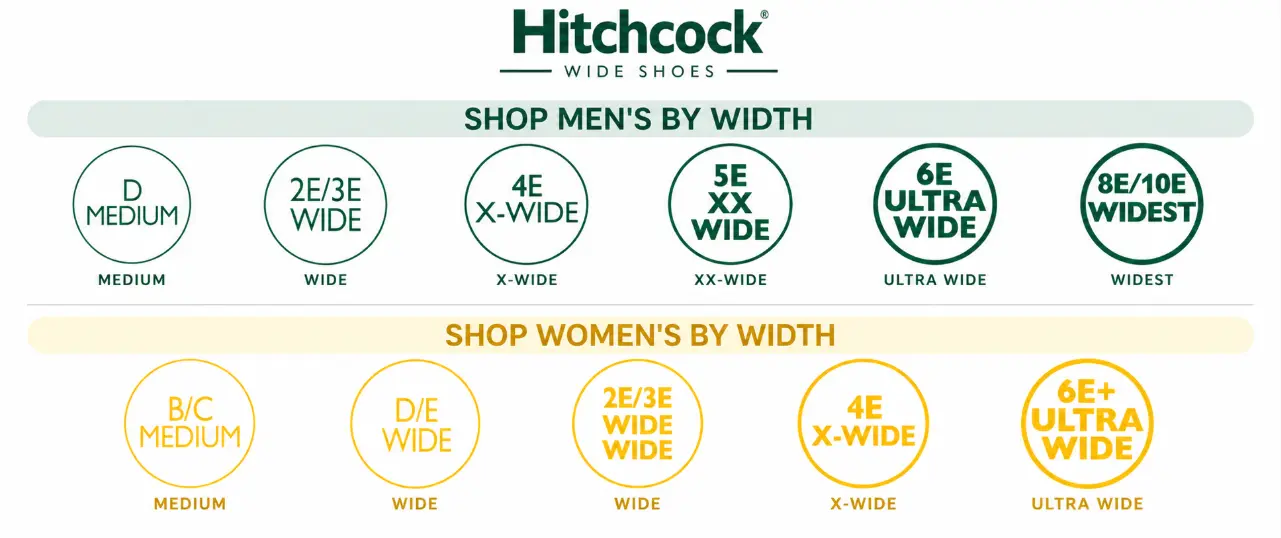
So if you see a sneaker width that isn’t included in the quick-reference charts above, that doesn’t mean it’s incorrect. Width labels and the widths actually offered can vary considerably from one brand or manufacturer to another.
Found what you needed here? Add Size Chart Guru to your Preferred Sources on Google for more sizing guides.
Sneaker Width Charts by Brand
Shoe width labels aren’t completely standardized from one sneaker brand to another. A 2E, Wide, or Extra Wide label can mean something different depending on the manufacturer, and some brands don’t use traditional width letters at all.
I’ve collected the width information published by each brand below so you can check the system your sneaker actually uses.
Adidas
| Width | Men’s | Women’s |
|---|---|---|
| Wide | 2E | D |
| Extra Wide | 4E | 2D |
Asics
| Width | Men’s / Kids’ | Women’s |
|---|---|---|
| Narrow | B | 2A |
| Standard | D | B |
| Wide | 2E | D |
| Extra Wide | 4E | 2E |
Brooks
| Width | Men’s | Women’s |
|---|---|---|
| Narrow | B | 2A |
| Medium | D | B |
| Wide | 2E | D |
| Extra Wide | 4E | 2E |
Clarks
| Fit | Women’s | Men’s | Kids’ |
|---|---|---|---|
| Narrow Fit | C | F | E |
| Standard Fit | D | G | F |
| Wide Fit | E | H | G |
| Extra Wide Fit | EE | — | H |
Hockerty
| US Size | Narrow (B) | Medium (D) | Wide (E) | Extra Wide (EE) |
|---|---|---|---|---|
| 5 | 3.1″ | 3.3″ | 3.5″ | 3.7″ |
| 6 | 3.2″ | 3.4″ | 3.6″ | 3.8″ |
| 7 | 3.3″ | 3.5″ | 3.7″ | 3.9″ |
| 8 | 3.4″ | 3.6″ | 3.8″ | 4.0″ |
| 9 | 3.5″ | 3.7″ | 3.9″ | 4.1″ |
| 10 | 3.6″ | 3.8″ | 4.0″ | 4.2″ |
| 11 | 3.7″ | 3.9″ | 4.1″ | 4.3″ |
| 12 | 3.8″ | 4.0″ | 4.2″ | 4.4″ |
| 13 | 3.9″ | 4.1″ | 4.3″ | 4.5″ |
Hoka
| Men’s US Size | Regular Width (D) | Wide (2E) | Extra Wide (4E) |
|---|---|---|---|
| 5 | 92 mm | 100 mm | 104 mm |
| 5.5 | 93 mm | 101 mm | 105 mm |
| 6 | 94 mm | 102 mm | 106 mm |
| 6.5 | 95 mm | 103 mm | 107 mm |
| 7 | 96 mm | 104 mm | 108 mm |
| 7.5 | 97 mm | 105 mm | 109 mm |
| 8 | 98 mm | 106 mm | 110 mm |
| 8.5 | 99 mm | 107 mm | 111 mm |
| 9 | 100 mm | 108 mm | 112 mm |
| 9.5 | 101 mm | 109 mm | 113 mm |
| 10 | 102 mm | 110 mm | 114 mm |
| 10.5 | 103 mm | 111 mm | 115 mm |
| 11 | 104 mm | 112 mm | 116 mm |
| 11.5 | 105 mm | 113 mm | 117 mm |
| 12 | 106 mm | 114 mm | 118 mm |
| 12.5 | 107 mm | 115 mm | 119 mm |
| 13 | 108 mm | 116 mm | 120 mm |
| 13.5 | 109 mm | 117 mm | 121 mm |
| 14 | 111 mm | 119 mm | 123 mm |
| 14.5 | 112 mm | 120 mm | 124 mm |
| 15 | 113 mm | 121 mm | 125 mm |
| Women’s US Size | Regular Width (B) | Wide (D) |
|---|---|---|
| 5 | 87 mm | 93 mm |
| 5.5 | 88 mm | 94 mm |
| 6 | 89 mm | 95 mm |
| 6.5 | 90 mm | 96 mm |
| 7 | 91 mm | 97 mm |
| 7.5 | 92 mm | 98 mm |
| 8 | 93 mm | 99 mm |
| 8.5 | 94 mm | 100 mm |
| 9 | 95 mm | 101 mm |
| 9.5 | 96 mm | 102 mm |
| 10 | 97 mm | 103 mm |
| 10.5 | 98 mm | 104 mm |
| 11 | 99 mm | 105 mm |
| 11.5 | 100 mm | 106 mm |
| 12 | 101 mm | 107 mm |
Mizuno
| Width | Men’s | Women’s |
|---|---|---|
| Standard | D | B |
| Wide | 2E | D |
Naturalizer
| US Size | Foot Length | Narrow | Medium | Wide | Extra Wide |
|---|---|---|---|---|---|
| 4 | 8.31 in | 2.87 in | 3.07 in | 3.27 in | 3.46 in |
| 4.5 | 8.46 in | 2.95 in | 3.15 in | 3.33 in | 3.52 in |
| 5 | 8.62 in | 2.99 in | 3.19 in | 3.39 in | 3.58 in |
| 5.5 | 8.78 in | 3.07 in | 3.27 in | 3.34 in | 3.62 in |
| 6 | 8.98 in | 3.15 in | 3.31 in | 3.50 in | 3.70 in |
| 6.5 | 9.13 in | 3.19 in | 3.39 in | 3.58 in | 3.78 in |
| 7 | 9.29 in | 3.23 in | 3.43 in | 3.62 in | 3.82 in |
| 7.5 | 9.45 in | 3.31 in | 3.50 in | 3.70 in | 3.90 in |
| 8 | 9.61 in | 3.35 in | 3.54 in | 3.74 in | 3.94 in |
| 8.5 | 9.8 in | 3.43 in | 3.62 in | 3.82 in | 4.02 in |
| 9 | 9.96 in | 3.50 in | 3.66 in | 3.86 in | 4.06 in |
| 9.5 | 10.12 in | 3.54 in | 3.74 in | 3.94 in | 4.13 in |
| 10 | 10.28 in | 3.58 in | 3.78 in | 3.98 in | 4.17 in |
| 10.5 | 10.47 in | 3.66 in | 3.86 in | 4.06 in | 4.25 in |
| 11 | 10.63 in | 3.70 in | 3.90 in | 4.10 in | 4.29 in |
| 12 | 10.79 in | 3.82 in | 4.02 in | 4.21 in | 4.41 in |
| 13 | 10.94 in | 3.94 in | 4.13 in | 4.33 in | 4.53 in |
New Balance
| Men’s US Size | Narrow (B) | Standard (D) | Wide (2E) | X-Wide (4E) |
|---|---|---|---|---|
| 6 | 3 5/8″ | 3 7/8″ | 4 1/8″ | 4 1/8″ |
| 6.5 | 3 3/4″ | 3 7/8″ | 4 1/8″ | 4 1/8″ |
| 7 | 3 3/4″ | 3 7/8″ | 4 1/8″ | 4 1/8″ |
| 7.5 | 3 7/8″ | 3 7/8″ | 4 1/4″ | 4 1/4″ |
| 8 | 3 7/8″ | 4″ | 4 1/4″ | 4 1/4″ |
| 8.5 | 3 7/8″ | 4″ | 4 1/4″ | 4 1/4″ |
| 9 | 3 7/8″ | 4 1/8″ | 4 3/8″ | 4 3/8″ |
| 9.5 | 4″ | 4 1/8″ | 4 3/8″ | 4 3/8″ |
| 10 | 4″ | 4 1/8″ | 4 1/2″ | 4 1/2″ |
| 10.5 | 4″ | 4 1/4″ | 4 1/2″ | 4 1/2″ |
| 11 | 4 1/8″ | 4 1/4″ | 4 1/2″ | 4 1/2″ |
| 11.5 | 4 1/8″ | 4 1/4″ | 4 5/8″ | 4 5/8″ |
| 12 | 4 1/8″ | 4 3/8″ | 4 5/8″ | 4 5/8″ |
| 12.5 | 4 1/4″ | 4 3/8″ | 4 5/8″ | 4 5/8″ |
| 13 | 4 1/4″ | 4 3/8″ | 4 5/8″ | 4 5/8″ |
| 13.5 | 4 1/4″ | 4 1/2″ | 4 3/4″ | 4 3/4″ |
| 14 | 4 3/8″ | 4 1/2″ | 4 3/4″ | 4 3/4″ |
| 15 | 4 1/2″ | 4 5/8″ | 4 7/8″ | 4 7/8″ |
| 16 | 4 1/2″ | 4 5/8″ | 4 7/8″ | 4 7/8″ |
| Women’s US Size | Narrow (2A) | Standard (B) | Wide (D) | X-Wide (2E) |
|---|---|---|---|---|
| 5 | 3 1/8″ | 3 1/4″ | 3 3/8″ | 3 1/2″ |
| 5.5 | 3 1/8″ | 3 1/4″ | 3 3/8″ | 3 1/2″ |
| 6 | 3 1/8″ | 3 1/4″ | 3 3/8″ | 3 1/2″ |
| 6.5 | 3 1/4″ | 3 3/8″ | 3 1/2″ | 3 5/8″ |
| 7 | 3 1/4″ | 3 3/8″ | 3 1/2″ | 3 5/8″ |
| 7.5 | 3 1/4″ | 3 3/8″ | 3 1/2″ | 3 3/4″ |
| 8 | 3 1/4″ | 3 1/2″ | 3 5/8″ | 3 3/4″ |
| 8.5 | 3 3/8″ | 3 1/2″ | 3 5/8″ | 3 3/4″ |
| 9 | 3 3/8″ | 3 1/2″ | 3 3/4″ | 3 7/8″ |
| 9.5 | 3 3/8″ | 3 5/8″ | 3 3/4″ | 3 7/8″ |
| 10 | 3 1/2″ | 3 5/8″ | 3 3/4″ | 3 7/8″ |
| 10.5 | 3 1/2″ | 3 5/8″ | 3 7/8″ | 3 7/8″ |
| 11 | 3 1/2″ | 3 3/4″ | 3 7/8″ | 4″ |
| 11.5 | 3 5/8″ | 3 3/4″ | 3 7/8″ | 4″ |
| 12 | 3 5/8″ | 3 3/4″ | 3 7/8″ | 4″ |
| 12.5 | 3 3/4″ | 3 7/8″ | 4″ | 4 1/8″ |
| 13 | 3 3/4″ | 3 7/8″ | 4″ | 4 1/8″ |
Salomon
| Salomon Fit | US Width |
|---|---|
| Wide | EE |
Note: Salomon states that its Wide Fit meets EE width requirements in the US and EEE in Japan. The brand also describes models such as the Speedcross 6 Wide as being built on a wider last to provide more room across the foot.
Saucony
| Width | Saucony Width Label |
|---|---|
| Narrowest | N |
| Narrow | 2A, B |
| Medium | D, M |
| Wide | W, E |
| Extra Wide | 2W, EW, 2E |
| Extra-Extra Wide | 3E |
| Widest | 4E |
Skechers
| Skechers Fit | Men’s Width | Women’s Width | How Skechers Describes It |
|---|---|---|---|
| Classic Fit | D | B | Medium width with a snug and even fit from heel to toe |
| Relaxed Fit | D/E | B/C | Medium width in the heel with a roomier toe box |
| Wide Fit | 2E/3E | D | More open interior with a looser fit around the entire foot |
| Extra Wide Fit | 4E/5E | — | Maximum space for wider feet |
Topo Athletic
| Category | Toe Box | Midfoot & Heel |
|---|---|---|
| Men’s Standard | E | D |
| Men’s Wide | 2E | E |
| Women’s Standard | D | B |
| Women’s Wide | E | D |
Under Armour
| Width | Men’s | Women’s |
|---|---|---|
| Narrow | N, 2B | N, 2A |
| Standard | M, D | M, B |
| Wide | W, 2E | W, D |
| Extra-Wide | XW, 4E | XW, 2E |
| Extra-Extra Wide | XXW, 6E | XXW, 4E |
Check out my complete boot width guide for width charts, sizing differences, and how boot widths work.
Why Sneaker Width Letters Aren’t Universal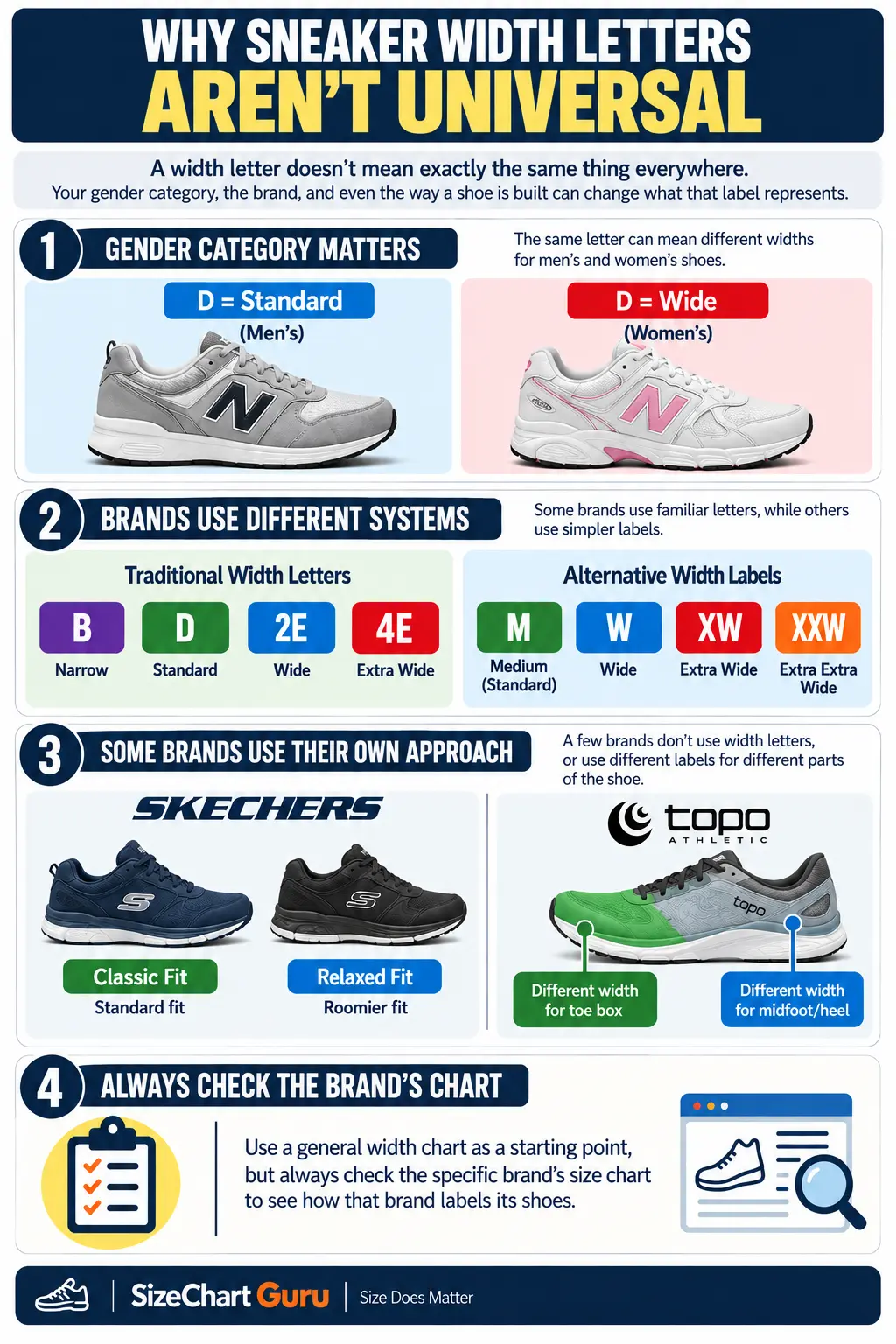
A width letter doesn’t mean exactly the same thing everywhere. Your gender category, the brand, and even the way a particular shoe is built can change what that label represents.
Brands don’t always follow identical systems either. Some use familiar letters such as B, D, 2E and 4E, while others use labels such as M, W, XW or XXW.
Some brands take a different approach altogether. Skechers uses fit categories such as Classic Fit and Relaxed Fit, while Topo Athletic can use different width classifications for the toe box and the midfoot/heel of the same shoe.
That’s why I treat the general sneaker width chart as a starting point rather than a universal conversion chart. Once you know the width you’re looking for, check the specific manufacturer’s chart below to see how that brand labels its shoes.
How Do Kids’ Shoe Widths Work?
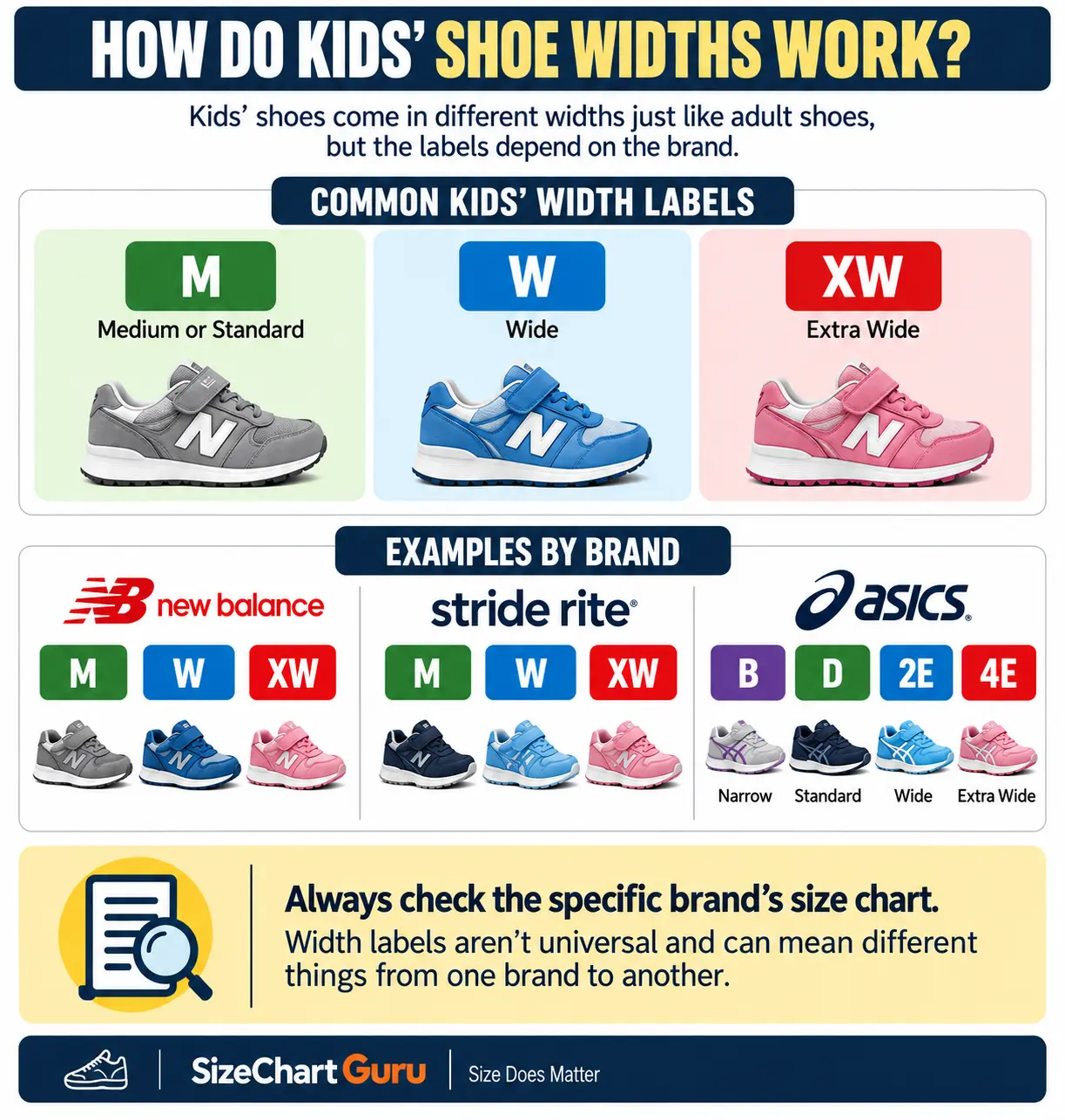
Kids’ shoes can come in different widths just like adult shoes, but the labels depend on the brand. You may see simple width abbreviations such as:
M = Medium or Standard
W = Wide
XW = Extra Wide
New Balance, for example, uses M, W and XW for its kids’ shoes and publishes separate width measurements for each option by shoe size.
Stride Rite uses the same three categories for many of its children’s shoes.
Asics uses D as Standard, 2E as Wide and 4E as Extra Wide for kids, with B representing Narrow.
That’s why the width label should always be checked against the specific brand’s chart rather than treated as universal.
Vans
| Vans Fit | Bottom Width | Ball Girth |
|---|---|---|
| Regular Width | Regular | Regular |
| Wide Fit | +5 mm | +10 mm |
Is D or B the Standard Sneaker Width?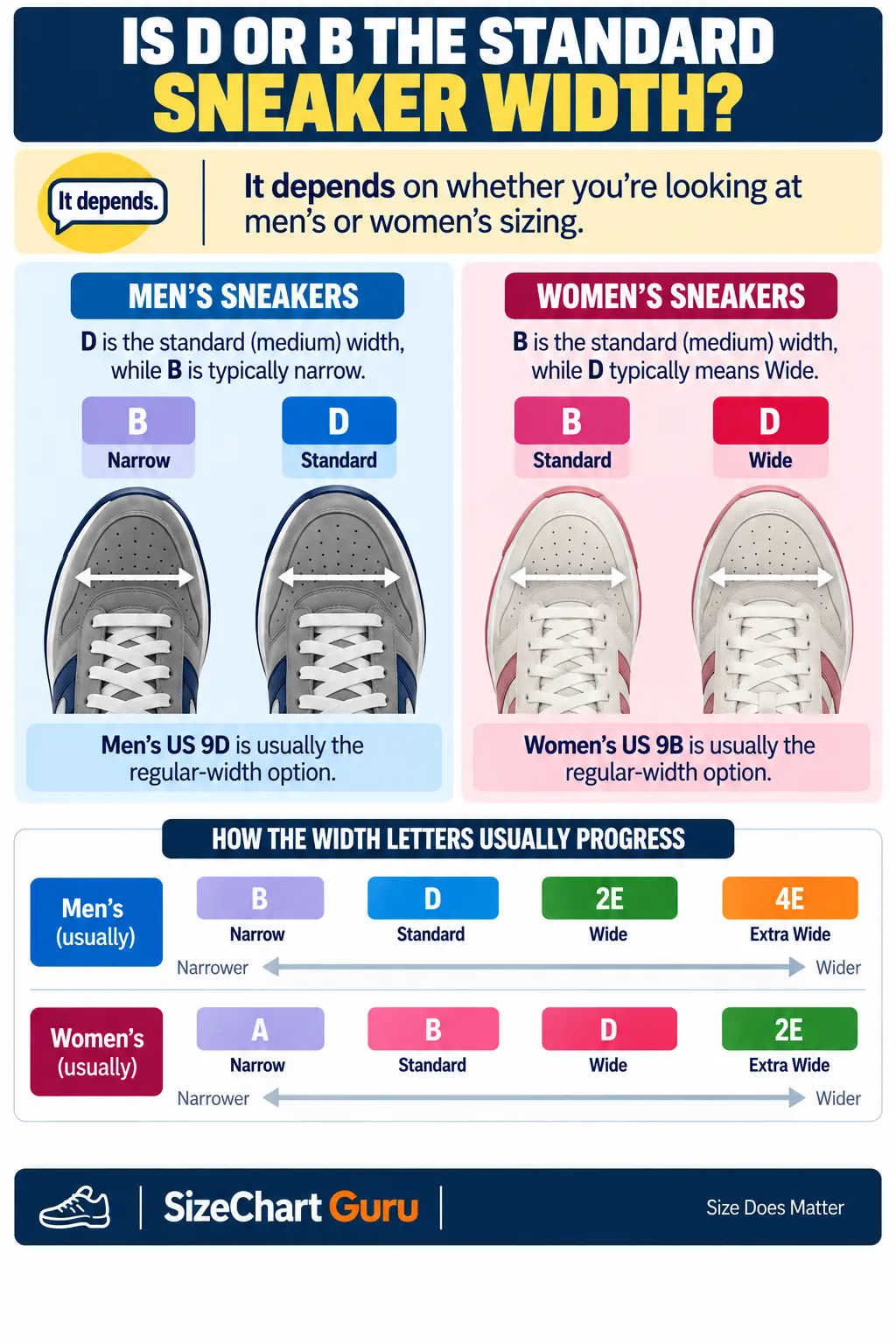
It depends on whether you’re looking at men’s or women’s sizing.
In men’s sneakers, D is generally the standard or medium width, while B is typically narrow. So a men’s US 9D would usually be the regular-width version of that shoe.
In women’s sneakers, B is generally the standard or medium width, while D typically means Wide. A women’s US 9B would therefore usually be the regular-width option.
If you want to see how these letters fit into the rest of the system, see my guide to what A, B, C, D, E, EE, 2E and 4E mean in shoe width.
How Much Wider Is a Wide Sneaker Than a Standard Sneaker?
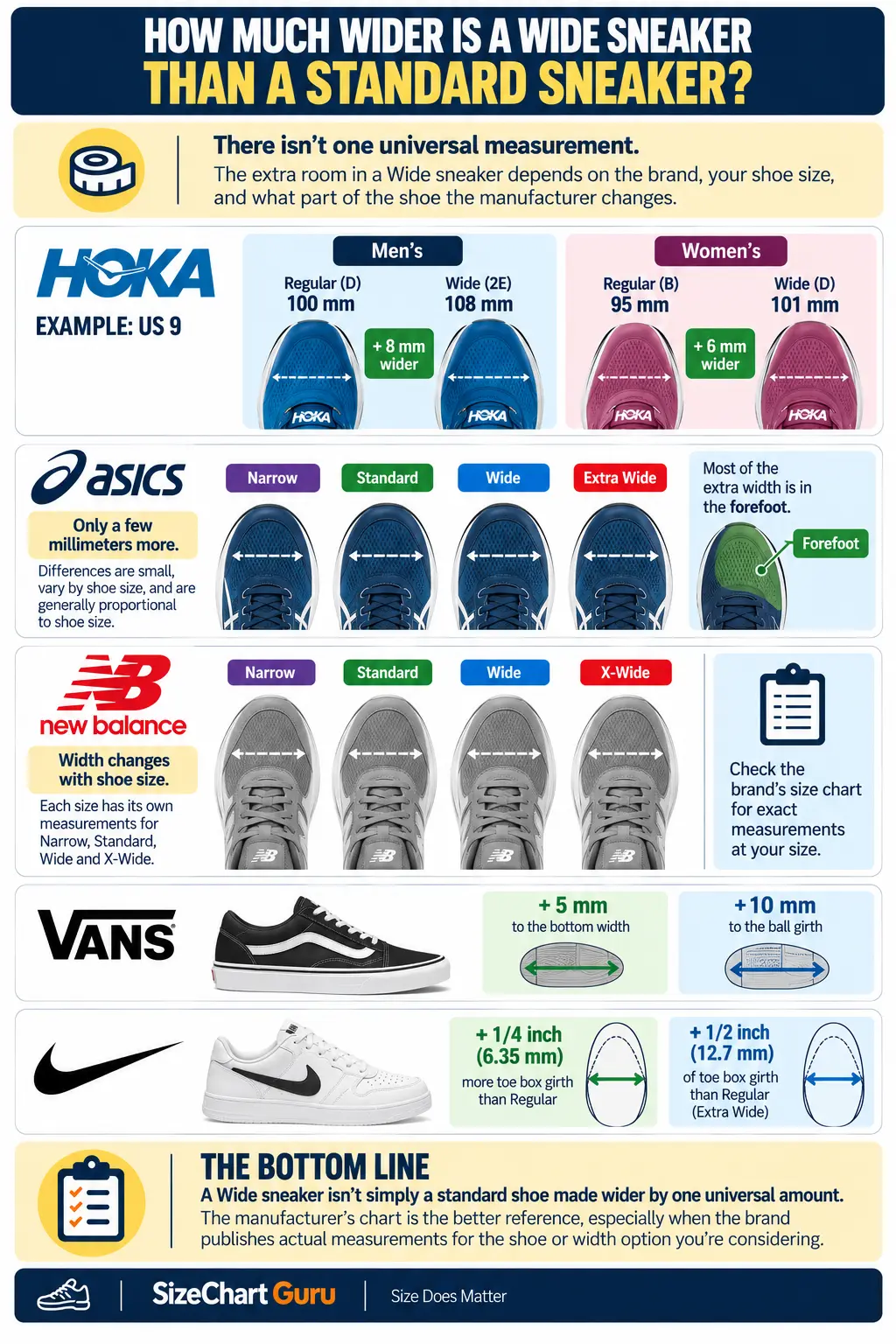
There isn’t one universal measurement.
How much extra room you get from a Wide sneaker depends on the brand, your shoe size, and what part of the shoe the manufacturer changes.
HOKA gives us a good example. In its men’s chart, a US 9 Regular (D) corresponds to a 100 mm foot width, while Wide (2E) corresponds to 108 mm. That’s an 8 mm difference.
For women at US 9, Hoka lists 95 mm for Regular (B) and 101 mm for Wide (D), a 6 mm difference.
Asics doesn’t give one fixed difference that applies to every shoe size. Instead, the brand says the differences between Narrow, Standard, Wide and Extra Wide are generally only a couple of millimeters and are proportional to shoe size. Most of that additional width is in the forefoot.
New Balance shows the same idea: width changes with shoe size rather than being one fixed measurement across the entire size range. Its published chart gives separate measurements for Narrow, Standard, Wide and X-Wide at each shoe size.
But foot-width measurements aren’t the only way brands describe the difference. Vans says its Wide Fit adds 5 mm to the bottom width and 10 mm to the ball girth compared with its regular construction.
Nike measures it differently again. The brand says its Wide shoes have about 1/4 inch (6.35 mm) more girth in the toe box than Regular, while Extra Wide adds about 1/2 inch (12.7 mm) of toe-box girth compared with Regular.
That’s why I wouldn’t use a rule such as “Wide is always 3/16 inch wider than Standard.” A Wide sneaker isn’t simply a standard shoe made wider by one universal amount.
The manufacturer’s chart is the better reference, especially when the brand publishes actual measurements for the sneaker or width option you’re considering.
Where Does the Extra Width Actually Go?
A wider sneaker isn’t necessarily wider by the same amount from heel to toe. Brands can create that extra room by changing the upper, the platform underfoot, or both.
Vans makes this distinction clear. Its Wide Fit adds 5 mm to the bottom width and 10 mm to the ball girth compared with the regular version. In other words, the change isn’t limited to making the platform underneath your foot wider.
Brooks takes another approach. For Narrow, Medium and Wide versions of the same model, Brooks says the footbed remains the same size, while the amount of material in the upper changes to create a different amount of space around the foot. Its Extra Wide construction goes further by using both a wider footbed and additional upper material.
Topo Athletic shows why the location of that width matters too. Its men’s Standard construction uses an E-width toe box with a D-width midfoot and heel. The men’s Wide version moves to a 2E toe box with an E midfoot and heel. So even within one sneaker, the forefoot can be built roomier than the back of the shoe.
This is why two Wide sneakers don’t necessarily feel wide in the same places. One may give you most of the extra room around the forefoot, while another may increase the space through more of the shoe.
If your main problem is toe pressure, forefoot width may matter more to you. If the shoe feels restrictive farther back, simply choosing something with a roomy toe box may not solve it.
Is a Wide Toe Box the Same as a Wide Shoe?
No. A sneaker can have a roomy toe box without being a Wide-width shoe.
A wide toe box mainly describes the space around the toes and front of the foot. A conventional Wide version can involve changes elsewhere too, including the midfoot, upper or platform underneath the foot.
Skechers Relaxed Fit is a good example. Skechers describes it as maintaining a medium-width heel while giving the toe box more room. That’s different from its Wide Fit, which creates a more open interior around the entire foot.
Topo Athletic takes a similar region-specific approach. Its men’s Standard construction already uses an E-width toe box with a D-width midfoot and heel. So the front of the shoe can be relatively wide even though the shoe isn’t labeled Wide.
You’ll also see brands such as Altra use foot-shaped designs that allow more natural toe splay. A roomy or foot-shaped forefoot, however, shouldn’t automatically be interpreted as a conventional width such as 2E or 4E.
This distinction matters if your foot is wider in one area than another. If you mainly need more space for your toes, a roomy toe box may be enough. If your foot needs additional room farther back as well, look at the shoe’s overall width rather than the toe-box shape alone.
Is Shoe Width the Same as Shoe Volume?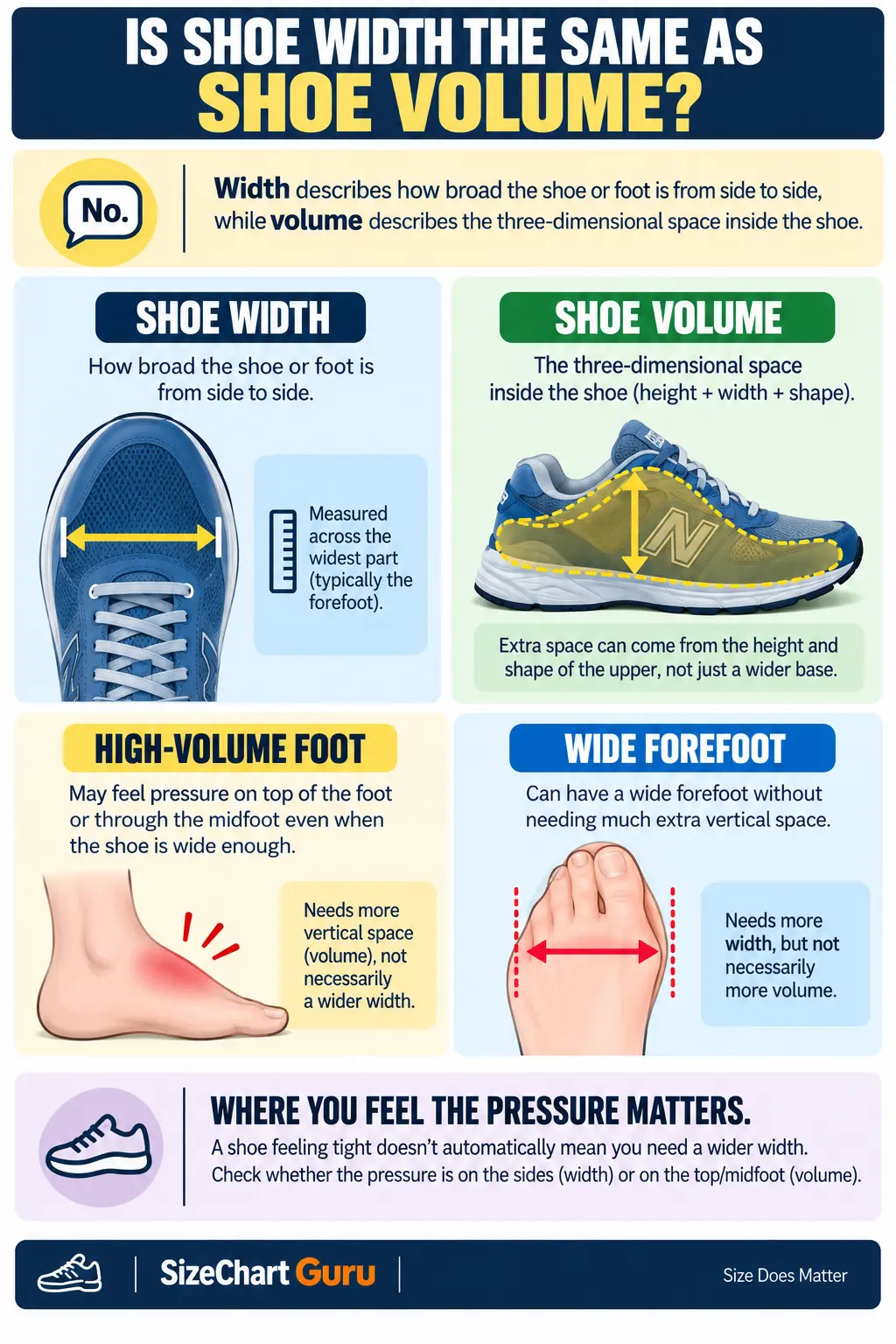
No. Width describes how broad the shoe or foot is from side to side, while volume describes the three-dimensional space inside the shoe.
That extra space can come from the height and shape of the upper, not just from a wider base. Someone with a higher-volume foot may feel pressure over the top of the foot or through the midfoot even when the shoe is wide enough from side to side.
The reverse can happen too. A person can have a wide forefoot without needing much extra vertical space.
That’s why a shoe feeling tight doesn’t automatically mean you need a wider width. Where you feel the pressure matters.
Can Women Wear Men’s Sneakers for More Width?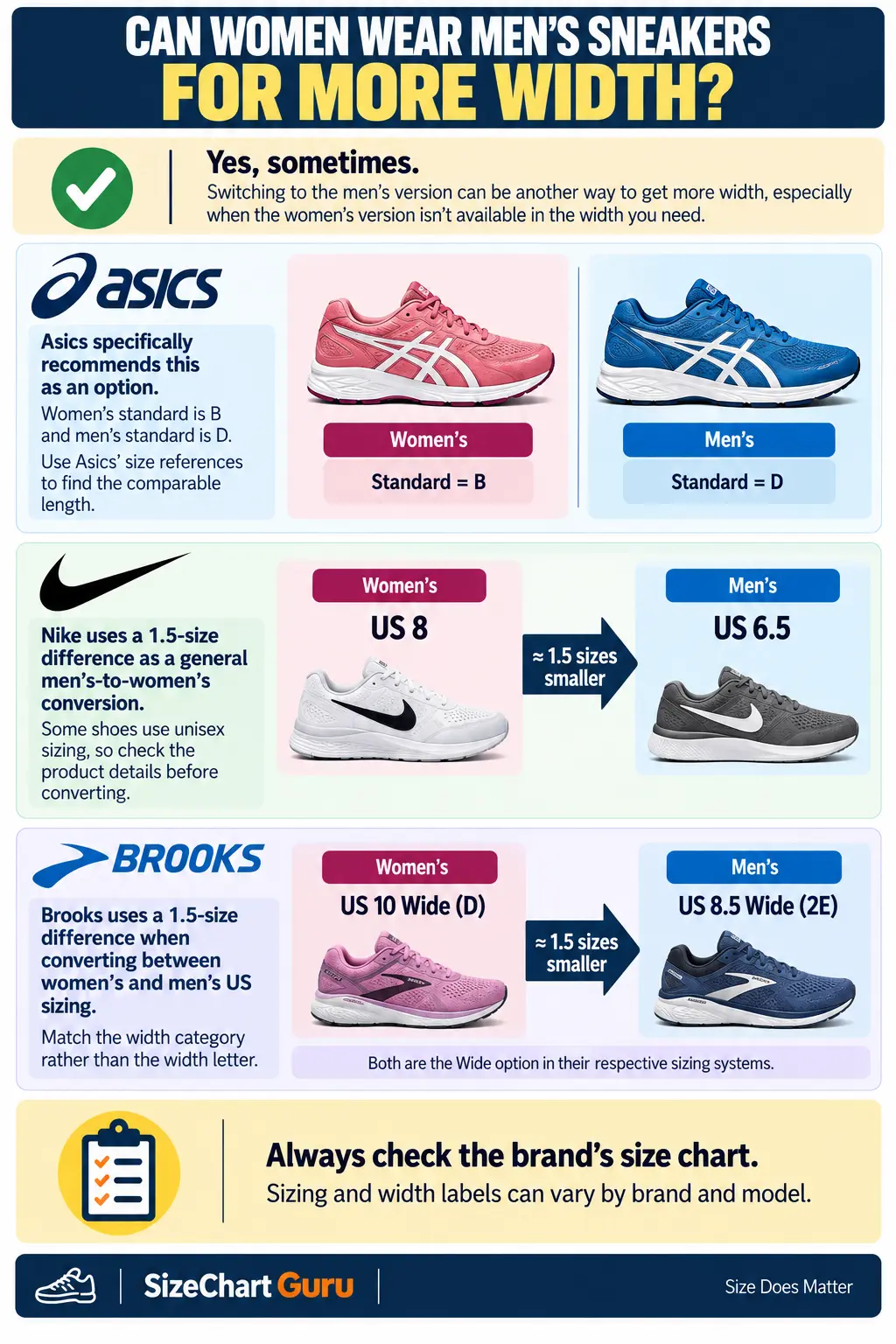
Yes, sometimes. Switching to the men’s version of a sneaker can be another way to get more width, especially when the women’s version isn’t available in the width you need.
Asics specifically recommends this as an option. Its width guide says women’s standard is B while men’s standard is D, and notes that women can sometimes wear men’s styles to get a wider fit.
Asics also recommends using its size references to find the comparable length rather than simply buying the same US size.
Nike uses a 1.5-size difference as a general men’s-to-women’s conversion. For example, Nike says a women’s US 8 will generally correspond to a men’s US 6.5. Nike also warns that some shoes use unisex sizing, so it’s worth checking the individual product before converting.
Brooks uses a 1.5-size difference when converting between its women’s and men’s US sizing. They recommend matching the width category rather than simply matching the width letter.
For example, Brooks converts a women’s US 10 Wide (D) to a men’s US 8.5 Wide (2E). Even though the letters are different, both are the Wide option in their respective sizing systems.
How Do I Know Which Sneaker Width I Need?
Start with your correct shoe size, then measure your foot width and compare it with the appropriate men’s or women’s width chart.
Use that as your starting point rather than assuming you need the same width in every sneaker.
From there, account for the shoe itself. A standard-width sneaker with a generous forefoot may work better for you than a Wide version of a more restrictive model.
What If I’m Between Two Sneaker Widths?
If Standard feels a little snug but Wide feels too roomy, I wouldn’t automatically move to Wide. The better choice depends on where the pressure is coming from and how that particular sneaker is shaped.
I’m a good example of this. My feet measure around D–E, with a slightly wide forefoot, but I still wear the standard width in most sneakers.
A US 9 standard works for me in shoes like the Nike Dunk Low, Asics Gel-Kayano 14, and Gel-1130. I only change size or look for more room when the shoe itself feels particularly restrictive.
That’s why I’d try the standard width first if it feels secure and the pressure is mild, especially if the Wide version introduces heel movement or makes the midfoot difficult to lock down.
But if the standard width is genuinely squeezing your forefoot and adjusting the laces doesn’t solve it, Wide is the better direction.
Should I Size Up Instead of Buying a Wider Sneaker?
If the problem is length, change your size. If the problem is width, changing width is usually the better solution.
Going up half a size can create a little more usable room, which is why it sometimes works when a sneaker isn’t available in Wide.
The tradeoff is that you’re also making the shoe longer, which can leave extra space in front of your toes or make the heel harder to secure.
I run into this myself with narrower sneakers. I normally wear a US 9, but I’ve gone to a 9.5 in shoes like the Nike Air Max 95 when I needed more room and didn’t have a better width option.
On roomier shoes, I can go the other direction. I prefer an 8.5 in the Air Force 1 because a US 9 already gives me more space than I need.
So I wouldn’t use sizing up as a universal fix for a width problem. If the correct length feels good but the sides of the shoe are too tight, try the wider version first when one is available.
Final Thoughts
The letter on the box is a starting point, not a description of the entire shoe.
Two sneakers can both say US 9D and still feel noticeably different around your forefoot. One might give your toes plenty of space while the other feels much closer through the sides. The midfoot and heel can tell a different story again.
That’s something I’ve learned from being around D–E myself. I can wear a standard D in most sneakers, but that doesn’t mean every D fits my foot the same way. The shape of the shoe still matters.
That’s also why I prefer looking at how an individual sneaker actually fits rather than making a buying decision from the width letter alone.
What sneaker width do you usually wear, and does it stay consistent from one sneaker brand to another?
Let me know in the comments which sneakers fit your feet best and which ones have given you trouble.