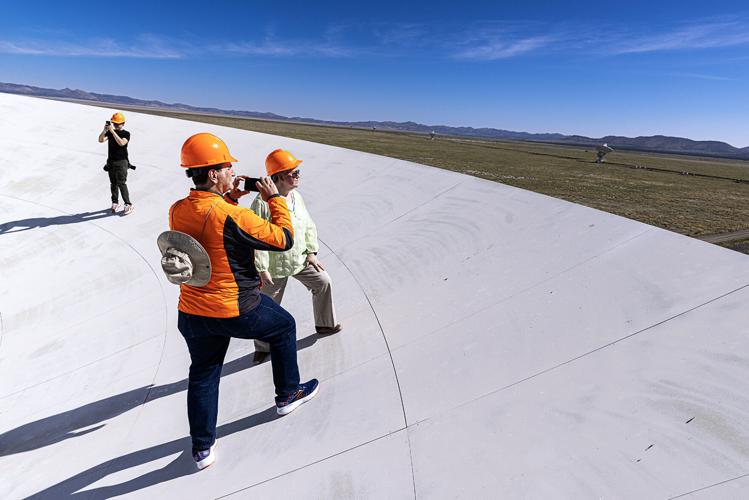
A tour group takes in the size of a dish of one of 27 antennas in the Very Large Array while listening to Rick Perley of the National Radio Astronomy Observatory on June 7 near Magdalena.{/p}
Brian Koberlein, astrophysicist and author, and his wife, Julia Koberlein, take in the view of the large antennas and open fields at the Very Large Array from inside the satellite dish of a large antenna Thursday.
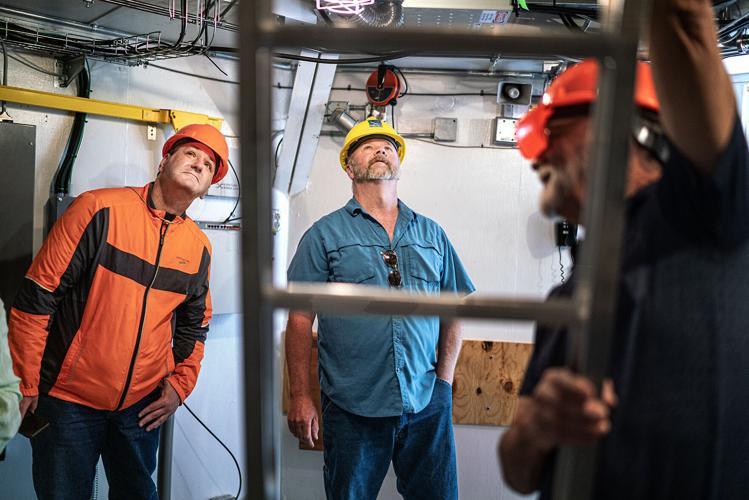
Brian Koberlein, astrophysicist and author, left, and Robert Long, project engineer, look up into the inner workings of the vertex room in one of the Very Large Array telescopes on Thursday.
Two of the giant dish antennas that make up the Very Large Array are shown in June. The University of New Mexico is working on an agreement to house a data center on campus for the array.
A tour group takes in the size of a dish of one of 27 antennas in the Very Large Array while listening to Rick Perley of the National Radio Astronomy Observatory on June 7 near Magdalena.{/p}
MAGDALENA — Standing inside the colossal satellite dish of an antenna at the Karl G. Jansky Very Large Array in the plains of southwestern New Mexico, you realize it’s not just the view of space that teaches us about the universe.
It’s also the sounds.
Signals emanating from galaxies.
The 27 antennas, or radio telescopes, at the vast array, which lies between the villages of Magdalena and Datil in Socorro County, are arranged in formations on rails and pointed at the skies. The array — each dish 82 feet in diameter — works together as one powerful telescope to collect space signals, which are then analyzed by computers and scientists.
They aren’t necessarily searching for signs of intelligent life. Rather, those studying the signals want to better understand the universe and our place in it — how stars and planets are born and die. They are seeking more knowledge about how the Earth was born — and why — as they continue making key cosmic discoveries.
“Some of these things are big questions: Why are we here? Where did we come from?” said Rob Selina, a project engineer who has worked at the array for nearly a decade. “… These are big questions that could add meaning to life.”
Rick Perley, a scientist with the National Radio Astronomy Observatory, describes the workings of the Karl G. Jansky Very Large Array near Magdalena, New Mexico.
The mission of the 45-year-old array — named for a pioneering American astronomer and spread across a field over 40 miles wide surrounded by mountains that block radio transmissions and blunt the high winds that can sweep across the plains — is preparing to undergo a massive expansion. The array itself will get far bigger, too — spread not just across a field but over a continent.
The National Radio Astronomy Observatory, a federally funded research agency that oversees the Very Large Array, will replace the existing 27 antennas with about 260 new ones over the next 20 years. More than 160 of those new antennas will be at the current site, while the rest will be installed at various locations throughout North America. Receivers at the array can now pick up signals ranging from 1 to 50 gigahertz. The range will extend to over 100 gigahertz with the future array.
The Next Generation Very Large Array, as the project is called, is expected to cost $2 billion to build and $92 million a year to run, according to Amy Oliver, a spokesperson for the National Radio Astronomy Observatory. The new array will require an increase in staffing from the current 150 employees to 400, she wrote in an email.
Project engineer Robert Long, left, and Rick Perley walk toward an antenna at the Very Large Array during a tour Thursday.
William Hojnowski, a project manager for the Next Generation Very Large Array, said the new technology, including updated receivers, might lead scientists to “find out the universe is very different than we thought it was. With the new array we will have the capability to see things like the solar system forming … how the universe actually works.”
With the improved technology comes the potential for both exciting and frightening discoveries.
“We may see far more black holes wandering through the universe than we thought we would,” Hojnowski said. “We may see a lot more high-end energy types of things that could threaten life on Earth. That is possible.”
But, he added with a smile, “I’d rather know than not know.”
Selina — one of the engineers helping to bring in the Next Generation Very Large Array — said many people don’t know about the array or may not give much thought to why it’s there or what it does. Some are familiar with it because of a science fiction film in the 1990s called Contact, in which actor Jodie Foster played an astronomer at the array who detected signals from an intelligent life form.
Still, about 20,000 people visit the site each year, Selina said, and others have driven by and seen the series of large, white antennas as they pick up what some scientists jokingly call “space noise.”
Brian Koberlein, astrophysicist and author, and his wife, Julia Koberlein, take in the view of the large antennas and open fields at the Very Large Array from inside the satellite dish of a large antenna Thursday.
Rick Perley, a scientist in his 70s with the National Radio Astronomy Observatory who worked at the Very Large Array in its early days, called it an “exciting time to be here” as scientists and engineers were connected to “an instrument on the rise. … We got to learn new techniques to calibrate signals.”
The National Radio Astronomy Observatory came up with a plan for the project in the late 1960s, aiming to build the most powerful radio telescope in the world, with a series of antennas that would work together as a single unit. Congress approved the project in 1972 and allocated $76 million.
As observatory leaders searched for the right location for the array, one site stood out: the remote and scarcely populated Plains of San Agustin, about 50 miles west of Socorro.
By 1978, 10 antennas were up and running, collecting data from space. The array was fully operational in 1980.
Perley noted the site chosen for the array is flat, high and dry, without a nearby city to cause interference. But monsoons and other storms can interfere with signal collection, he said.
The array, he said, is reconfigured every four months to focus on different areas of the universe based on proposals by astronomers and other scientists.
The signals received by radio telescope are transmitted to an amplifier. Only about 0.33% of the signals provide useful data, Perley said. “The rest is non-useful noise.”
The signals are sent to a centralized correlator, where they are analyzed by computer systems that prioritize those found to be common on more than one antenna.
Brian Koberlein, astrophysicist and author, left, and Robert Long, project engineer, look up into the inner workings of the vertex room in one of the Very Large Array telescopes on Thursday.
The team can create a digital picture from the signals — such as a black hole consuming everything near it or two stars colliding — giving scientists an even sharper image of an astronomical phenomenon than they might see with a regular telescope.
Selina said the antennas can also pick up transmissions from local radio stations, commercial and military jets, and other typical sources of radio noise.
Do they ever pick up unidentified signals, hinting at the possibility of intelligent life, as Foster’s character did in Contact?
Yes, Selina said.
He called them “fast radio bursts” that are akin to “things that go bump in the night” before quickly going away; the ones that repeat are the ones that get attention.
One such set of signals occurred so regularly the antennas “stared at that location in the sky for a couple of hundred hours and were fortune enough that it went off again,” he said.
Two of the giant dish antennas that make up the Very Large Array are shown in June. The University of New Mexico is working on an agreement to house a data center on campus for the array.
After analyzing the signals, scientists learned “it looks like a highly magnetic object, perhaps like a neutron star that has collapsed and spins dramatically and spits out these magnetic waves from time to time,” he said. “It’s not necessarily indicative of intelligent life but a phenomena that could not be otherwise explainable.”
Perley said the high-tech array is necessary for the study of faraway places in the galaxy where stars explode, planetary objects collide and cosmic dust forms, settles and moves about.
Ultimately, he said, science is knowledge, and those who study the skies are driven by curiosity.
“Why does a star look like it is? Why does a gas cloud blow the way it does? Why do black holes exist? How were they born?” he asked while standing on one of the many platforms of an antenna.
“It’s the same curiosity that drives people to go up to the top of mountains,” he said. “We want to see what’s there. We want to understand.”
Links below are provided by a third-party ad network (RevContent). This publication does not endorse or guarantee the products, services, or claims featured.