



BEAUFORT — As the last decade of the 19th century dawned, residents of Beaufort County had every reason to expect that the prosperity they were enjoying would continue unabated into the future.
They certainly had no inkling that just three years later a massive hurricane would cause a stunning loss of life, plunge the region into decades of economic doldrums and challenge the socioeconomic advancements made by the county's predominantly Black population during the Reconstruction Era.
This year marks the 130th anniversary of the Great Sea Island Hurricane of 1893, a storm that still ranks among the deadliest natural disasters in U.S. history.
"The Great Storm of 1893 was, up to that time, the worst natural disaster, in terms of lives lost in the nation’s history," wrote Lawrence Rowland in "Bridging the Sea Islands' Past and Present: The History of Beaufort County, South Carolina, Volume 3," which he co-authored with Stephen Wise.

Storm warning
The Great Sea Island Hurricane came ashore Aug. 27, 1893.
The first hint that a major storm was barreling toward the Lowcountry came two days earlier. The National Weather Bureau in Washington, D.C. issued a bulletin Aug. 25 indicating that at storm was centered about 500 miles east of Florida and headed northwest. By the morning of Aug. 27, the bureau warned that a great storm would likely strike the Georgia and South Carolina coast that evening.

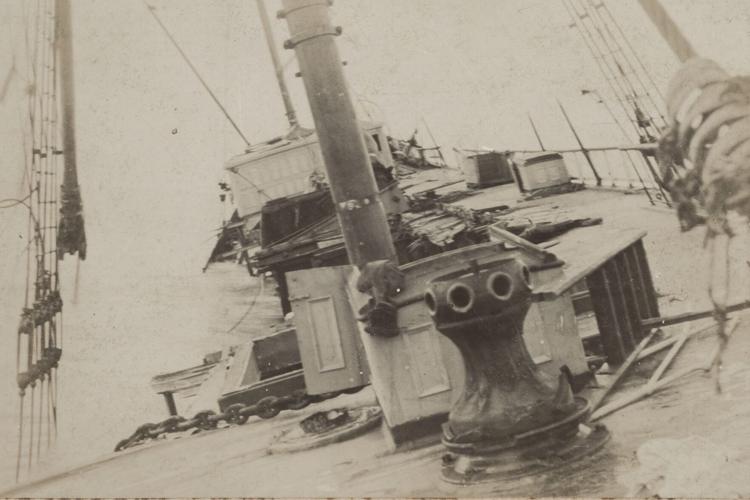
A ship is partially submerged after being damaged by the Sea Island Hurricane of 1893. Beaufort County Library/Provided
"On Sunday morning, signal staffs at pilot stations from Tybee Island, Georgia to Fort Sumter in Charleston Harbor raised the dreaded double-gale warning flags," Rowland wrote.
Despite the warnings in the urban centers, most in the storm's path were unaware its approach. The alerts did not make it out to the Sea Islands or other rural, low-lying areas of the South Carolina, said Caroline Grego, assistant professor of history at Queens University of Charlotte and author of "Hurricane Jim Crow: How the Great Sea Island Storm of 1893 Shaped the Lowcountry South."
The increasing wind and falling barometer might have been the only clues of what was to come.

The storm blows in
By midday Sunday, Aug. 27, Grego said, it was becoming clear for residents between Savannah and Charleston that a significant storm was closing in.
Rowland writes that by 5 p.m., telegraph communication with Beaufort and the Sea Islands had ominously gone silent. Three hours later, some 21 bridges across the Lowcountry had been destroyed and all of the major ferries had been smashed. And still the storm continued unabated into the early morning hours of Aug. 28.
As the storm approached, a convergence of factors multiplied its impact on the Lowcountry.
The hurricane struck during high tide on a full moon. Low tide occurred at 2 p.m. on Aug. 27, but according to Grego, the storm was already blowing hard enough to prevent the tide from going out. The storm strengthened and winds increased as the tide rose. The storm was fully raging by the 8 p.m. high tide.
"You have these tides piling up on one another that leads to this huge storm surge," Grego explained. "That's what makes this such a deadly and destructive hurricane."

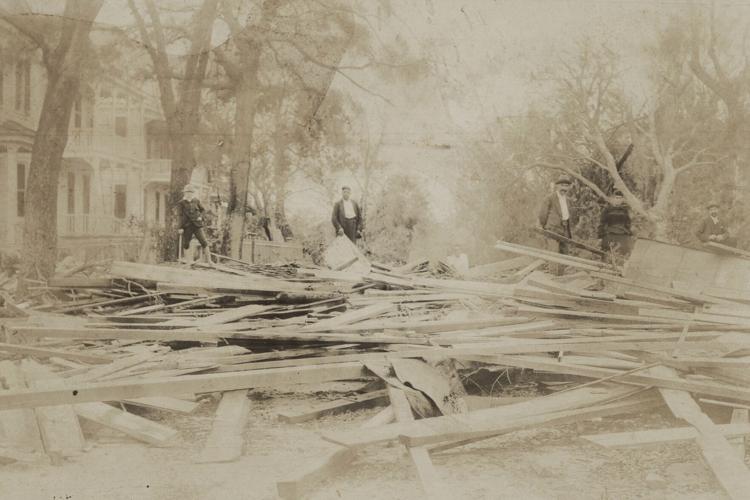
Buildings damaged by the Sea Island Hurricane of 1893. Beaufort County Library/Provided
The storm surge inundated many of the the Sea Islands and sent 20-foot waves up the Beaufort River. Survivors in Beaufort described the tide coming in like a tidal wave with astonishing speed and force.
Hunting Island was covered in 10 feet of water, though some reports said it was nearly double that. Survivors from St. Helena Island reported they needed to swim to higher ground because the water was too deep to wade through. Half of Hilton Head was reportedly under water.
Wind speeds reached approximately 120 mph, which would today be a Category 3 storm.
Rowland called the night of Aug. 27 into early morning of Aug. 28 one of "incalculable terror."
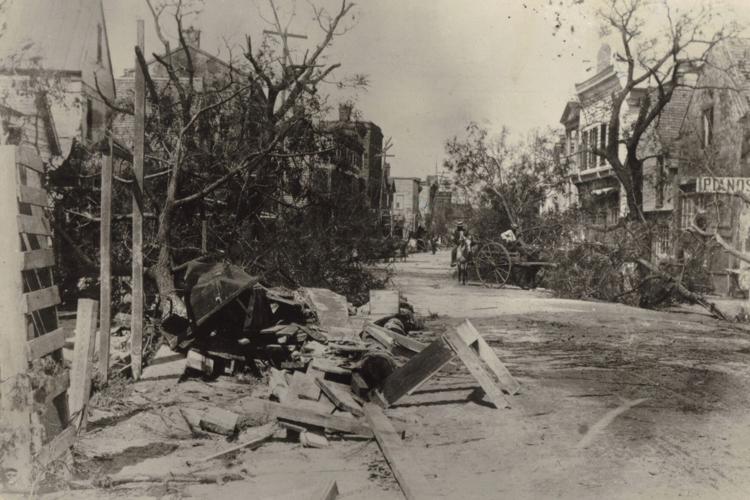
Home were washed off their foundation, often with entire families inside. Docks, wharves and businesses of all types were reduced to flotsam.
Those who did managed to reach high ground often did so through deep water in the dark and with winds blowing at more than 100 mph. Families trying to make their escape sometimes had young children or older family members in tow.
"It was about as dire circumstances as you can imagine," Grego said.

The epicenter of destruction
The 1893 Hurricane was a monster, measuring approximately 1,000 miles across. It impacted much of the country's east coast, but the Sea Islands were the focal point of the storm's damage.
"Beaufort County was absolutely the epicenter of the greatest destruction from this hurricane," Grego said.
Around dawn, the worst of the storm was past, and those who survived began to emerge from whatever shelter they had found. What they saw was an unmitigated disaster of staggering proportions.
Estimates of the number of dead vary from 1,500 to 5,000, though both Rowland and Grego believes the number was closer to 2,000.
"You can get to 5,000 if you count the people who died in the weeks and months after from sickness, hunger and exposure," Grego said.
What's more, the problems for the survivors were only beginning.
An untold number of homes and businesses were destroyed. Wells for were filled with sea water. Any crops that hadn't been washed away were killed by the salt water that inundated fields up and down the coast. The threat of disease was immediate.
An advance team from the American Red Cross estimated that 30,000 people in Beaufort County were in need of food, water, clothing, shelter or medical attention.
On Hilton Head Island, the town of Mitchelville, the first self-governing community of formerly enslaved people in the country, was literally wiped off the map.
"The reason that there are no standing structures in the park now is because of the Hurricane of 1893," explained Ahmad Ward, executive director of Historic Mitchelville Freedom Park. "That's what legitimately ended Mitchelville as a community."

Relief, Reconstruction, Jim Crow and the American Red Cross
Relief and recovery efforts in the Lowcountry were complicated by a wide variety of circumstances.
Much of the infrastructure that had existed was wiped away be the storm. There were no bridges to the Sea Islands and many of the boats capable of ferrying relief supplies had been destroyed.
Local relief committees formed in the immediate aftermath of the hurricane to collect and distribute food, clothing and money as donations poured in from across the nation.
There was no Federal Emergency Management Agency in 1893 and the federal government provided negligible assistance. Aside from delaying tax collection, the South Carolina legislature wasn't any more helpful.
Racist ideology suppressed what little governmental support may have been available.
According to Grego, South Carolina Gov. Benjamin Tillman was "infamously racist" with no love for the Black community and no love for the Lowcountry. At the time of the 1893 Hurricane, Beaufort County's population was more than 90 percent Black.
"There wasn't a sense of governmental obligation to victims and survivors of these disasters, but also certainly, many politicians did not want to extend assistance to Black South Carolinians," Grego said.

Damage from the Sea Island Hurricane of 1893.
Beaufort County was one of the last bastions of Black political power left in the South, and Black land ownership rates in the county were unsurpassed in the South. Some White South Carolinians, Grego said, viewed the recovery effort as an opportunity to challenge the power of the Black community.
"They looked at the destruction of the hurricane as an opportunity to crush the Black population and take away the autonomy that they had cultivated since the Civil War," said Grego.
Six weeks after the hurricane, Clara Barton, founder of the American Red Cross, arrived in Beaufort to face a different kind of storm.
The Red Cross was still a fairly new organization, and according to Grego, Barton took on the Lowcountry relief effort with some trepidation. She was unsure whether her organization was up to the task.
With its long history of providing aid when its needed most, it can be difficult to imagine that the Red Cross was ever anything other than the trusted organization it is today. But when Barton set up shop on Bay Street in Beaufort, not everyone was welcoming despite the dire conditions that the entire community continued to face after the storm.
"Many White South Carolinians looked upon the Red Cross disapprovingly for helping the Black communities rebuild," Grego said.
Barton's relationship with the Black community was also, at times, uneasy due to Barton's attitude that Grego described as overly paternalistic.
Despite the many challenges, the Red Cross provided critical assistance that fueled the region's recovery.
The relief effort continued for 10 months, and in the summer of 1894 the 72-year-old Barton, exhausted from working 12 to 16 hours day for months on end, departed for Charleston and a much need recuperation.


The economy
In 1893, around 80 percent of the phosphate, a component of fertilizer, used in the U.S. was produced in Beaufort County. Additionally, much of the phosphate mined in the county was shipped to international markets. Phosphate was, without a doubt, a critical component of the local economy.
The industry was nearly completely wiped out by the Great Sea Island Hurricane. According to Rowland, much of the industry's capital was floating on rivers and and bays when the hurricane struck and disappeared into those waters as the storm roared through.
After the loss of life, the destruction of the phosphate mining industry was the most serious lingering effect of the storm.
"In fact, the largest industry in Beaufort's 500-year history never fully recovered from the effects of the Great Storm," Rowland wrote.
Beyond phosphate mining, Grego notes that the storm accelerated the already ongoing decline in rice production and seriously damaged to the Sea Island cotton industry.
"This hurricane is so important because it profoundly rearranged the entire economic, social and political landscape of the Lowcountry," Grego said.