
Daily news, dev blogs, and stories from Game Developer straight to your inbox

GDC Festival of Gaming (March 1-4, 2027)
Keep up with the latest news, interviews, talk coverage, and other game dev insights from GDC right here on Game Developer. Read More
How voxels enabled a juicy gameplay loop in Donkey Kong Bananza
'Oh, Banana.'
schedule6 Min Read

Image via Nintendo
At a Glance
- Donkey Kong Bananza uses voxel-based terrain to power its destructible environments.
- That technology isn't just for show. It creates new opportunities for designers to explore new fields of game design.
What does it mean when we say advances in video game technology enable new kinds of gameplay?
The phrase conjures images of beefier and beefier GPUs allowing computers to render larger and more detailed 3D worlds. But those don't automatically translate into something "fun." Consider how many new technological trends have come and gone in the game industry that were supposed to redefine gameplay, but constantly struggled to justify their own existence.
Fortunately one recent game—Nintendo's Donkey Kong: Bananza—offers game developers a clear case study in how investing in new technology can unlock new game design possibilities.
This case study comes from a 2026 GDC Festival of Gaming talk by Nintendo producer Kenta Motokura and programmer Tatsuya Kurihara. The pair traveled across the Pacific Ocean to present a technical breakdown of Bananza's destructible voxel-based environments, which were first introduced in portions of Super Mario Odyssey (which both men worked on).
In the packed session, the duo explained how investing in that technology allowed the team to produce "new types of gameplay" themed around, in Motokura's words, "Destruction. Destruction. Destruction."
A skeptic might ask what, precisely, is so "new" about destructible environments? Nintendo's previous tentpole title The Legend of Zelda: Tears of the Kingdom allowed players to smash through boulders and breakable rocks, and environmental destruction in 3D spaces dates at least as far back as the Red Faction series.
Fortunately, Motokura and Kurihara had a clear answer for attendees in the how Bananza's gameplay loop pivots between combat and exploration.
In a traditional 3D action platformer, players generally treat combat and exploration as two distinct experiences. But thanks to Nintendo's new voxel tech, Bananza blends the two together in a way that clearly illustrates the relationship between technology and design.
Combat begets exploring begets combat
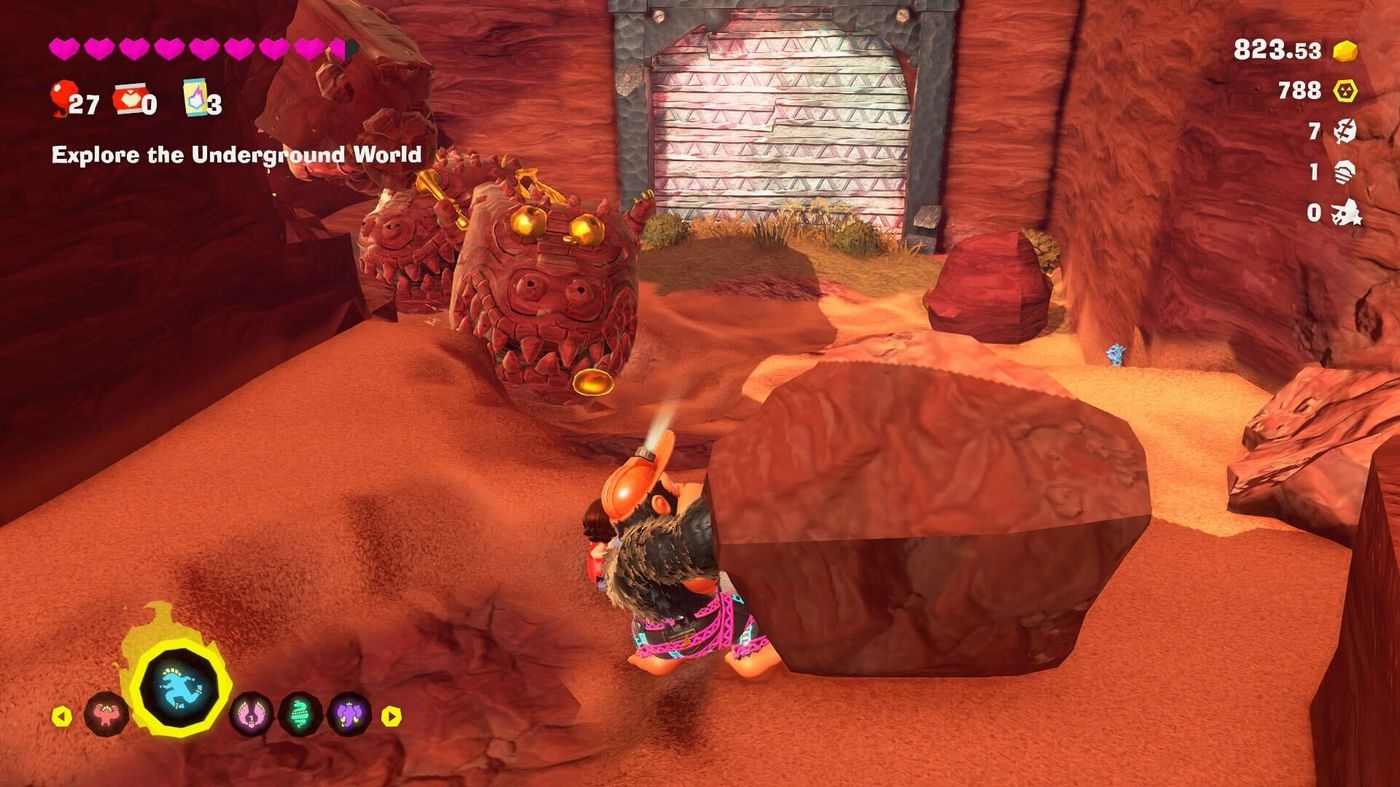
In Donkey Kong Bananza, combat takes place in destructible environments (sometimes as large as 347,070,464 voxels) stuffed to the gills with hidden areas and secret items. An obsessive player will immediately set about smashing through terrain to find every interesting nook and cranny. A less-experienced player (like say, a child) needs guidance to navigate this space.
"Destruction. Destruction. Destruction" then becomes the tool to teach them navigation, as implemented through the lens of the "3D action platformer" genre. According to Motokura, Nintendo generically defines "action platformer" as a game where the player character exists in two (or more) states: an unpowered state and a powered-up state.
To illustrate this, he flashed an image of Super Mario Bros. showing the classic loop of the player starting as Mario, acquiring a power-up like a Fire Flower or Mushroom, then losing that power when being hit by an enemy. A "3D Action Platformer" takes this concept to 3D spaces, dialing back precisely-tuned jumping in favor of broader combat scenarios.
Do not assume however, that the equivalent transition in Bananza is the player's ability to activate "Bananza Mode," where Donkey Kong morphs into other animal-inspired forms and gains new abilities. Instead, Donkey Kong's "powered up" mode occurs when the player picks up a piece of terrain, destroying a small piece of the voxel-made environment.
The "powered-up" state is not defined by raw power, but by the player seeking out upgrades in the environment, spending them, then hunting for another one to continue their task.
Once the player has done so, they have a weapon that can deal extra damage to enemies (and is sometimes the only weapon that will work on select foes). With a boulder in hand, Donkey Kong can jump into combat and begin smashing enemies. As Motokura explained, that's where the magic happens.
In many combat scenarios, the following loop occurs:
The player approaches an enemy in a space designed for combat.
The player grabs a rock from the terrain.
The player attacks an enemy. Depending on the enemy and environment, both characters will take out chunks of terrain as their strikes connect with the walls and ground.
Once the enemy's health reaches zero, they are sent flying—often into a destructible wall. The velocity damages the wall and, depending on its design, expose what was hidden on the other side.
The player proceeds through the destroyed wall, discovering treasure, more enemies, or other fun secrets.
Rinse and repeat.
"We call this the chain of destruction, and it became an important cycle in the game's level design," Motokura said.
New game technology should create "opportunities" for developers and players
The craft of game design can be nebulous and ethereal, so it's welcoming to have such a clear path from technology to technique through the lens of a Nintendo game. In a follow-up interview with Motokura and Kurihara, the pair discussed how these underlying tools can stretch so far as to influence game difficulty.
While much of Bananza's design was built on the foundations of Super Mario Odyssey, it was worth comparing the game's relationship to older Donkey Kong titles, even those made by Rare and Retro Studios. The 2D sidescrolling Donkey Kong games require exceptionally precise timing from players, and are far more challenging than the mostly easygoing Bananza.
Motokura first nodded to the design of the Super Mario series when describing these changes in gameplay.
"There's quite a difference between the feel of gameplay in a 2D Mario [game] versus a 3D Mario [game]. In a 2D Mario, you're probably looking at more of the specific timing of jumps for a fun game experience, whereas with 3D Mario games, you can open it up a little bit more," he said.
Screenshot by the author/Image via Nintendo
"If you look at the historic trend over time of how gameplay experiences change, I think some of that comes along with how much more you can do now. We're doing entirely new gameplay experiences using voxel technology, and overall we've seen that trend of play horizons broadening over time."
It was also worth observing when the team's gameplay goals bumped up against the limitations of the voxel technology. In the talk, Kurihara acknowledged that because of the way the voxel environment works, players will sometimes see objects or enemies clip through terrain unrealistically (sometimes coinciding with those objects destroying the terrain). This is because collision detection is not based on "voxel to voxel" interaction.
Objects and characters in Bananza have collision meshes that are the same shape as the voxels, but to measure collision, all moving objects have a "primitive shape" used to detect impacts. This method helps the player consistently land hits on enemies even as their bodies change shape—and enemies with pieces removed from them will still make an impact on terrain when sent flying.
But this method creates moments where "bodies" (including weapons) will unrealistically overlap with walls. The team decided this was "acceptable," said Kurihara.
How does any developer decide when such a potentially immersion-breaking moment is "acceptable?" Motokura said they think about if these moments will be to the player's "benefit," or their "loss."
"If there is something that happens to the players benefit, like it's fun or it's a happy experience for them, then in my mind, some of that artifice is okay," he said. "If it's a matter of player loss, like the types of gameplay that the player could experience in that moment would be narrower, then that's something that we would choose to address and adjust."
Ultimately, one could view the relationship between technology and design as one where programmers are seeking to create opportunity for players and developers alike.
As Motokura put it, "for us, we always approach this as a problem of, 'are we giving the player enough opportunities as opposed to frustrating them from what they would like to do?'"
Game Developer and GDC Festival of Gaming are sibling companies under Informa Festivals.
Read more about: