

Gaudi’s architectural vision comes alive in Seoul
Gaudi’s architectural vision comes alive in Seoul
Posted September. 08, 2026 08:47,
Updated September. 08, 2026 08:47
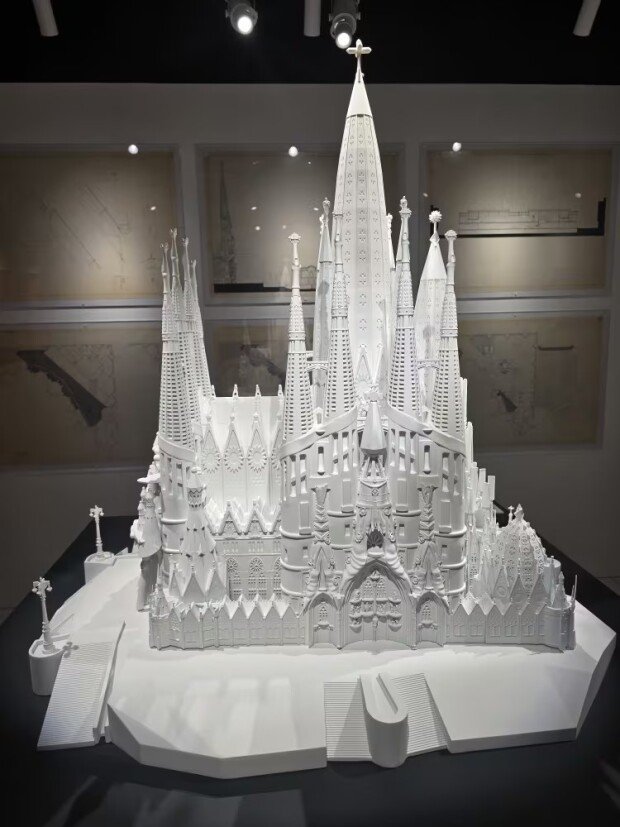
On June 10 local time, Pope Leo XIV celebrated Mass at Barcelona’s Sagrada Familia to commemorate the 100th anniversary of Antoni Gaudi’s death and consecrate the basilica. Gaudi (1852-1926) designed the landmark church, which began construction in 1882 and has been under construction for more than 144 years. Now, “Gaudi: Reborn in Seoul,” a special exhibition tracing the life and artistic vision of the architect known as the “architect of God,” has opened at Sinsa House in Seoul’s Gangnam district.
The exhibition coincides with the centennial of Gaudi’s death and the completion in February of the Tower of Jesus Christ, the basilica’s central tower. It is the official world tour of the Gaudi Foundation of Spain. Earlier stops in Tokyo and Osaka drew about 330,000 visitors.
The exhibition spans seven themes, including “The Beginning of the Journey,” “Barcelona: The Crucible of Creation,” “Sagrada Familia: The Eternal Basilica” and “Gaudi’s Atelier.” Visitors can see about 30 original pieces, including handwritten manuscripts, architectural drawings and notes, original tile models and artifacts used in construction. More than 40 reproductions officially approved by the foundation are also on display.
The exhibition’s highlights include original Sagrada Familia design drawings, detailed models of its spires and a model showing how the unfinished facade, the building’s principal exterior wall, will look once completed. Another meticulously crafted model depicts the basilica with the Tower of Jesus Christ in place. The exhibition also shows how Gaudi drew on nature, turning forms such as mushrooms, garlic and ears of wheat into elements of his architecture.
“Gaudi grew up in the countryside and brought what he saw in nature into his architecture,” said Cho Yoon-ji, the exhibition’s director. “Few people probably realize that the shapes at the tops of Gaudi’s spires were inspired by things such as mushrooms.” Much of the Sagrada Familia’s original drawings, sketches and models were destroyed in a fire during the Spanish Civil War in 1936. The plans guiding the basilica’s ongoing construction were reconstructed from surviving drawings and fragments of models, as well as the recollections of people who worked with Gaudi and subsequent research.
An experimental space featuring a polyfunicular, a mechanical model that uses weights, chains and gravity, shows how Gaudi arrived at the distinctive forms of his buildings. The model consists of multiple chains suspended from fixed points. Chains with weights attached are first hung from predetermined points on the ceiling, after which points along the sagging chains are connected to additional chains. Gravity pulls the chains into stable, downward-curving shapes. Turned upside down, those curves resemble the arches seen in Gaudi’s architecture, including the Sagrada Familia.
“Gaudi drew inspiration from the laws and forms of nature and sought to bring the beauty and order hidden within them into his architecture,” Cho said. “Once you understand what he was thinking and what he wanted to express, the experience of seeing works such as the Sagrada Familia becomes much more powerful.” The exhibition runs through October 31.
Chin-Ku Lee sys1201@donga.com






 About Dong-A Ilbo