Chinese researchers are pairing 6G with robot training and validation at a dedicated test facility in Beijing, aiming to make smart robots more reliable and affordable as they move from lab prototypes toward real-world deployment.
At a specialized test site in Hangzhou City, east China's Zhejiang Province, a four-legged robot flips, jumps and climbs its way through punishing obstacle courses. The goal is not just to show what it can do, but to see how well it performs under real-world conditions.
"We are testing its motion‑control stability across multiple scenarios and complex terrains, including slopes, rubble‑strewn surfaces and other rugged environments," said Zhang Tianyi, product manager of Zhejiang Humanoid Robot Pilot Test Platform.
The difficulty is that real-world environments are unpredictable. For AI to control robots reliably, it must adapt to physical surroundings - an approach known as physical AI. That is why a dedicated test facility at Beijing 6G Laboratory has been set up to pair 6G with robot training and validation.
"A complete closed loop of 'sensing‑decision‑execution' must be fully functional. Every link imposes extremely high requirements on latency and stability, a delay of just a fraction of a second can trigger critical errors," said Liu Guangyi, chief expert of China Mobile Group and also chief scientist of ZGC-XNET.
Existing networks, including 5G-A, hit hard limits. Slow signal response cannot sustain robots' long-hour, high-precision operations.
6G changes that by delivering near-instant latency, massive device connectivity and ultra-stable signals.
The test site at Beijing 6G Laboratory replicates real-life working conditions, helping robots move more smoothly from lab prototypes to field deployment.
"It enables the cloud‑based AI brain to govern physical robots within milliseconds," said Liu.
6G-powered cloud computing also frees robots from bulky on-board hardware, making them lighter, less costly and longer-lasting.
That shift is already showing results in the market.
"Our robot has secured orders for nearly 100 units so far, and mass delivery is expected by the end of this year," said Ling Lei, product manager of WUBA Intelligence Humanoid Robot.
Beyond individual robots, the facility offers end-to-end support for local companies, covering research, training and certification. The test site is projected to push local intelligent robot industry output above 10 billion yuan by 2027. "Even when hundreds of devices connect simultaneously, data transmission and command synchronization remain stable," said Liu.
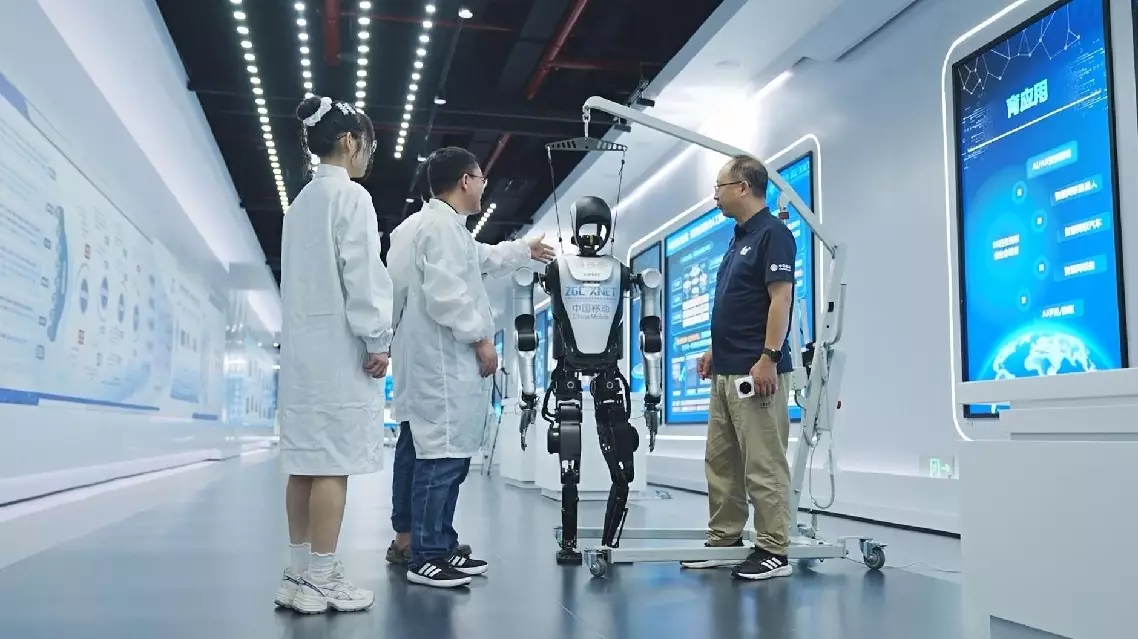
Chinese researchers use 6G to boost smart robots' real-world performance
Icelandic Foreign Minister Thorgerdur Katrin Gunnarsdottir has hailed the launch of the new direct air service between China and Iceland as a "milestone" in bilateral relations, saying the route opens up vast new opportunities in trade, business and tourism.
The new passenger service began on Oct. 26, with the flight operated by Air China three times per week and taking approximately 15 hours from Beijing to the Keflavik International Airport nearby the Icelandic capital Reykjavík, after a brief stopover in Denmark's Copenhagen.
Coinciding with the launch of the new route, Gunnarsdottir recently wrapped up a five-day visit to China from Oct 26 to 31, durign which she held talks with Chinese Foreign Minister Wang Yi.
In an interview with China Central Television (CCTV) during her stay in Beijing, Gunnarsdottir noted how the new flight comes as the two sides are celebrating the 55th anniversary of the establishment diplomatic ties.
"Now,when we are facing this new flight from China to Iceland and vice versa, there are huge opportunities for trade, for business, for tourism. I know myself a lot of Chinese tourists are now already in Iceland and it's so marvelous to follow how they are experiencing Icelandic culture, Icelandic nature. It's again a kind of milestone in our cooperation and relationship between our two countries. So, I'm very optimistic and looking forward to take this flight back home," she said.
Reflecting on the developments which have taken place in recent decades, the Icelandic foreign minister noted the remarkable progress both countries have achieved and sees considerable room for further growth.
"If you think about it, Iceland was back in 1975 described as a developing country. Since then, since Iceland and China made these diplomatic relations official 55 years ago, we can see and notice how, both China and Iceland, our countries have developed due to [improved] economic terms, (better) quality of life and prosperity. What I take with me is that we can collaborate. We are different in many ways, but we also share similar interests. And that's why I [have] hope and I will strive for that," she said.
Looking ahead, Gunnarsdottir said Iceland aims to further facilitate trade and business with China and is looking to upgrade the bilateral Free Trade Agreement (FTA) while exploring cooperation across multiple sectors.
"We are going to facilitate more when it comes to trade and business. We are looking into our FTA. We are going to look into many other aspects. But not least, I see us collaborating in enhancing and supporting the multilateral system. We have to be aware that all nations should respect international law, use our voices in that regard and that's why I see a lot of opportunities to cooperate with China in various fields. And, of course yes, again the flight gives us a lot of opportunities, but [having more] conversations, reaching out between politicians but also between the people of our countries -- there are also enormous possibilities," she said.

Launch of direct flight to bring new opportunities to Iceland-China bilateral ties: Icelandic FM