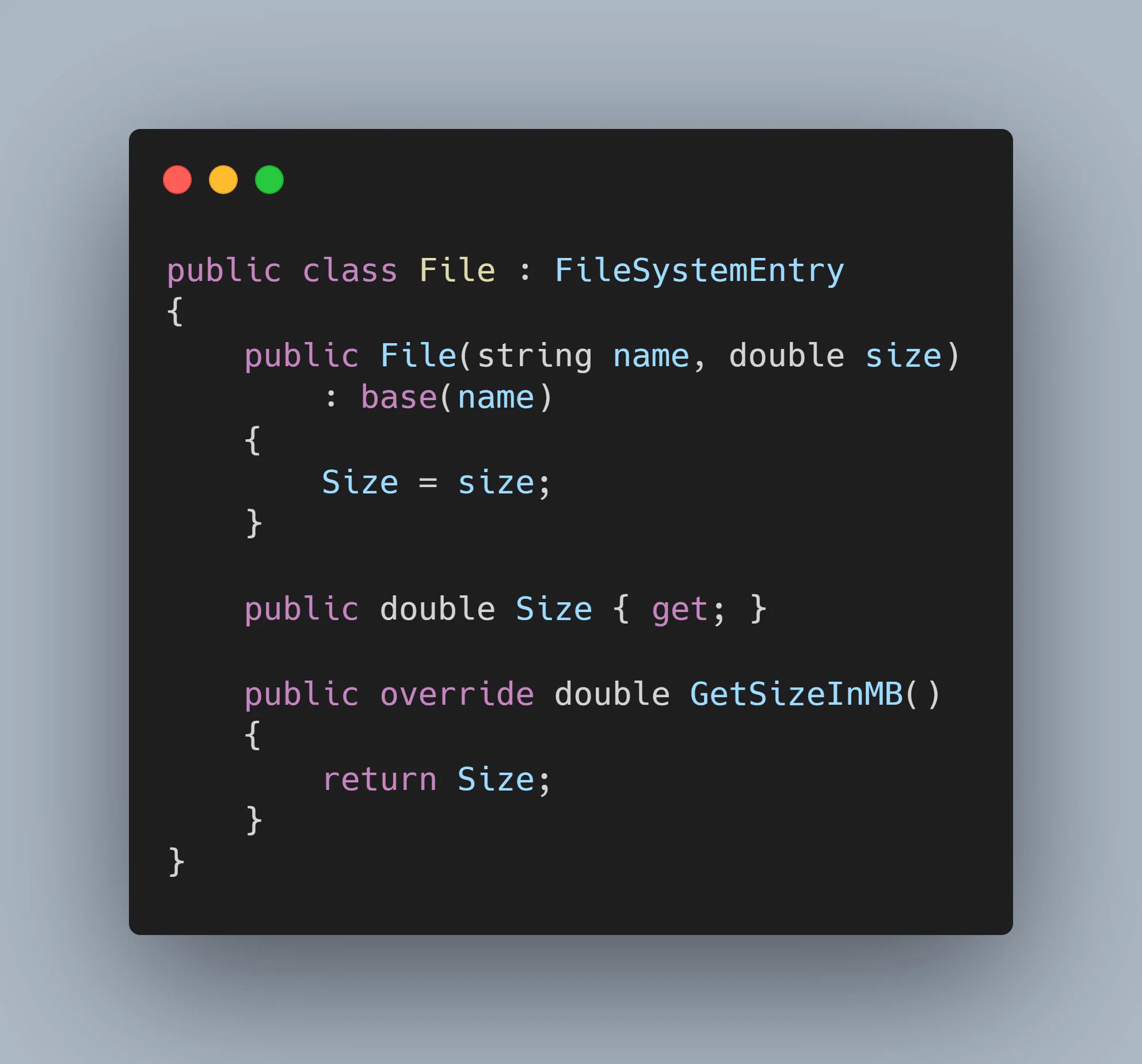
Composite design pattern lets you compose objects into tree structures and then work with these structures as if they were individual objects. It lets clients treat individual objects and compositions of objects uniformly
Brief introduction + demo code ↓
#designpatterns #dotnet

- Composite design pattern lets you compose objects into tree structures and then work with these structures as if they were individual objects. It lets clients treat individual objects and compositions of objects uniformly Brief introduction + demo code ↓ #designpatterns #dotnet
 We can use a file system to demonstrate the Composite design pattern. In the simplest case, the file system consists of files and folders. We will use FileSystemEntry class to describe operations that are common to both simple (file) and complex (folder) elements of the tree.File is a really simple class used to represent an individual object. The file only knows about its own name and size. The file is a simple leaf component. Leaf components usually end up doing most of the real work, since they don’t have anyone to delegate the work to.Folder class is a little bit more complicated since it can contain files as well as additional folders (compositions of objects). The folder represents a complex composite component.It is important to understand that a composite component doesn’t know the concrete classes of its children. It works with all sub-elements only via the component interface.Upon receiving a request, a composite delegates the work to its sub-elements, processes intermediate results and then returns the final result to the client.The client code is pretty straight-forward. In order to determine the size of the root folder, we just need to ask the root folder for its size, and it will delegate work to appropriate components in order to give a final answer.Use the Composite pattern when you have to implement a tree-like object structure.The Composite pattern provides you with two basic element types that share a common interface: simple leaves and complex containers. A container can be composed of both leaves and other containers. This lets you construct a nested recursive object structure that resembles a treeWhen dealing with Tree-structured data, programmers often have to discriminate between a leaf-node and a branch. This makes code more complex, and therefore, error-prone. The solution is an interface that allows treating complex and primitive objects uniformly.Use the pattern when you want the client code to treat both simple and complex elements uniformly. All elements defined by the Composite pattern share a common interface. Using this interface, the client doesn’t have to worry about the concrete class of the objects it works with+ You can work with complex tree structures more conveniently: use polymorphism and recursion to your advantage + You can introduce new element types into the app without breaking the existing code, which now works with the object tree (Open/Closed Principle)- It might be difficult to provide a common interface for classes whose functionality differs too much. In certain scenarios, you’d need to overgeneralize the component interface, making it harder to comprehendFull implementation with a few additional usage examples can be found on