new

Get trending papers in your email inbox!

Subscribe

Trending Papers

byAK and the research community

Trending Papers
Submitted by
bupalinyu

The Other Half of the Memory Wall: Serving 35B MoEs from SSD with Trained Routing Prediction

Mixture-of-experts (MoE) inference on consumer hardware is bounded by weight memory: a 35B-class model is 19.5GB at 4-bit, and sparsity shrinks the compute per token, not the bytes that must be held. Naive offloading to SSD does not help on its own, because layer N+1's experts must be chosen before layer N's output exists, so the reads cannot start early enough to hide behind compute. We present Edge0, a streaming MoE inference engine that closes the gap with a prerouter: a per-layer head predicts the next layer's routing one token ahead, and the prediction is consumed as the routing itself, so the staged expert set equals the routed set and nothing is dropped. An unmerged recovery LoRA, trained on the student path, pays back the quality lost to int4 quantization and routing replacement. On a single 24GB machine, Edge0 serves a 35B MoE at 20tok/s inside 3GiB of peak active memory, within a few points of its fp16 teacher on average across five public benchmarks. An 8B tier runs on the same framework, and the framework, checkpoints, and adapters are open source.


Edge0 Edge0 · Sep 16, 2026
Submitted by
lgy0404

nanoMuse: An Open-Source Personal Agent for Every Device You Own

Assistants from 2011 answered and waited, and agents from 2023 did a task and stopped. In September 2026 Meta's Muse showed an agent for one person, with accounts, devices, memory and a conversation that lasts, closed, in a vendor's cloud, in one country. Such an agent is expected to act on a person's accounts and devices, remember them across weeks, speak first when it is worth it, and answer for what it did. It is a kind of software, not a model, and until now had no open counterpart. This report defines the personal agent in five questions and three horizons. It reads how Muse is built from Meta's public record and a copy of its production prompt, each statement marked by its source. It then presents nanoMuse, the open-source counterpart under the GPL-3.0, one agent on every device a person owns, with hands on the phone's screen and the computer's. They share one conversation over a relay anyone can run; every action goes through a Sentinel, memory is files the person can read, and the model is their choice. Its size and cost are given as estimates. What is open, memory with provenance, an evaluation suite for the hands and an open model for them, is set out as a roadmap.

zju Zhejiang University · Oct 6, 2026

TradingAgents: Multi-Agents LLM Financial Trading Framework

A multi-agent framework using large language models for stock trading simulates real-world trading firms, improving performance metrics like cumulative returns and Sharpe ratio.

  • 4 authors
· Dec 28, 2024
Submitted by
vvasilev

Kandinsky 6.0 Video: Foundation Models for Synchronized Video and Audio Generation

We present Kandinsky 6.0 Video, a family of foundation diffusion models for synchronized text-to-audio-video generation, comprising Kandinsky 6.0 Video Lite (3B parameters) and Kandinsky 6.0 Video Pro (29B parameters). Both models generate 5-second video clips with synchronized 44 kHz audio, including lip-sync, in text-to-audio-video (T2AV) and image-to-audio-video (I2AV) modes; a built-in super-resolution model raises the output resolution to Full-HD (1920times1080). Building on the video generation capabilities of Kandinsky 5.0, Kandinsky 6.0 Video employs a dual-stream CrossDiT architecture that connects a pretrained video stream and a newly trained audio stream through bidirectional cross-attention for temporal and semantic alignment. Our continuous pretraining strategy first trains the audio stream from scratch on large-scale audio corpora and then trains both streams jointly on paired audio-video data while preserving unimodal fidelity; pretraining is followed by supervised fine-tuning, reinforcement-learning-based post-training, and distillation. In side-by-side human evaluation, Kandinsky 6.0 Video Pro clearly outperforms its predecessor, Kandinsky 5.0 Video Pro, and remains competitive with leading audio-video generation models, particularly in speech quality. To accelerate open research and deployment in multimedia generation, we release the code, model checkpoints, and diffusers integration under the MIT license.

kandinskylab Kandinsky Lab · Oct 4, 2026
Submitted by
PSRben

VisionHOPE: Visual Backbones as Self-Modifying Learning Systems

Visual backbones have evolved from Convolutional Neural Networks (CNNs) with local aggregation to Vision Transformers (ViTs) with global interactions, State-Space Models (SSMs) with input-dependent state transitions, and Test-Time Training (TTT) layers that adapt an inner learner while processing an image. Across this progression, visual computation has become increasingly adaptive to each input, yet the rules governing that adaptation remain largely prescribed by the trained backbone. We introduce VisionHOPE, the first generic visual backbone formulated as a self-modifying learning system, in which what the model remembers and how it learns co-evolve within an image. Building on the self-referential construction of Nested Learning (NL), VisionHOPE realizes this co-evolution through five coupled memories that store content, generate key and value representations, and govern learning rate and retention. These memories evolve jointly as visual context accumulates along each scan. However, directly applying the unconstrained self-referential update to a visual backbone leads to instability. We therefore derive a stability-matched step-size control scheme that combines a soft cap on self-referential injection with a spectral clamp on the retained memory transition, and prove that the resulting memory dynamics are non-expansive along each scan. For two-dimensional feature maps, we adapt NL's chunk formulation by aligning chunks with image rows and columns across four directional scans. The proposed VisionHOPE achieves competitive results on ImageNet-1K, COCO, and ADE20K, establishing self-modifying learning systems as a practical foundation for general-purpose visual backbones. The code is available at https://github.com/PSRben/VisionHOPE.

Mininglamp-2718 Mininglamp Technology · Sep 27, 2026
Submitted by
chijw

AgentGarten: Code Worlds for Evolving Agents

Interactive virtual worlds allow agents to learn through exploration and interaction. What agents can learn is bounded by the environments they practice in, which must be faithful, with consistent state, rules, and dynamics, and realistic, with observations that follow the real-world visual distributions. Achieving both across diverse worlds remains a bottleneck. We introduce AgentGarten, a framework that couples simulators and game engines with a shared neural renderer to build real-time interactive environments. Its simulation backends maintain persistent world state and execute program-defined interaction rules, while the renderer generates visual observations from structured conditions exported through a common interface. To build the neural renderer, we adapt a pretrained video model to geometry conditions, distill it with our proposed Adversarial Forcing, and optimize inference for real-time interaction. Adversarial Forcing makes history prefilling differentiable through exact replay, so that losses on later predictions update how the renderer encodes prior observations, and adds real-data adversarial supervision to improve its visual quality. In AgentGarten, agents perceive the world through visual observations, interact with it in real time, and improve by distilling each round of experience into playbooks that subsequent agents inherit and refine. Our empirical study demonstrates a substantial gain in learning efficiency, with agents learning from just 4 rounds compared with millions for a conventional reinforcement learning counterpart. As new worlds can be written as code and rendered through the same interface, environments can scale in both number and difficulty alongside their agents, a step toward agents that keep evolving through interactive experience.

MirroS-Lab MirroS · Oct 8, 2026
Submitted by
yyh929

SuperNav: An Agentic Navigation System for Any Task in Any Scene

General-purpose service robots need navigation systems that can handle diverse human requests in unfamiliar environments, combining task generality with scene generality. Some existing methods fine-tune multimodal large language models (MLLMs) to predict navigation actions, making their behavior dependent on the coverage of navigation training data and potentially limiting generalization to new requests and environments. Our key insight is to let the MLLM focus on interpreting requests, understanding scenes, and making decisions while preserving its general-purpose capabilities and delegating motion execution to navigation tools. To realize this idea, we introduce SuperNav, which equips a pretrained MLLM with a specialized agent harness without navigation-specific fine-tuning of the MLLM. Our harness supports these decisions with Navigation Skills, agent-oriented Tools for physical interaction, and task-progress and context management. A unified visual-point interface connects decision-making to motion by allowing the model to specify destinations directly in images and revise its decisions from execution feedback. Together, these components support sustained navigation across different task requirements and environments. SuperNav outperforms four evaluated baselines on instance-level, multi-object, and demand-driven tasks. Category-level evaluation on HM3D and deployment on a real quadruped robot further demonstrate its applicability across environments. Project Page: https://zju3dv.github.io/SuperNav/

zju3dv zju3dv · Oct 8, 2026
Submitted by
akhaliq

OpenDevin: An Open Platform for AI Software Developers as Generalist Agents

OpenDevin is a platform for developing AI agents that interact with the world by writing code, using command lines, and browsing the web, with support for multiple agents and evaluation benchmarks.

  • 24 authors
· Jul 23, 2024
Submitted by
chgara

Iris-3B: Going Beyond the Latent with Pixel-Space Diffusion Training, Conversion and Fine-Tuning

Pixel-space diffusion models avoid the lossy VAE of latent models, which suggests an advantage on downstream tasks where fine-grained detail matters. We test this claim along both routes to a pixel-space backbone. We pretrain Iris-3B, a 3B-parameter pixel-space text-to-image transformer, from scratch through a 256to512to1024 curriculum, after first ablating the prediction target and representation alignment at 256^2 to decide what to scale. We also convert a pretrained latent model, FLUX.2 Klein base 4B, to pixel space. We fine-tune both families for monocular depth estimation and for image restoration/super-resolution. We find no significant improvement from using a pixel-space generative prior. Fine-tuned for depth with one matched direct-regression recipe, Iris-3B is level with the latent FLUX.2 Klein and the converted pixel FLUX.2 Klein falls behind it, and on 4times DIV2K restoration neither pixel model beats a latent FLUX.2 Klein fine-tune, the converted one trailing it slightly. We document the recipes, the failure modes and the remaining confounds behind this negative result. Nevertheless, Iris-3B shows that pixel-space pretraining with the pixel-transformer (PiT) head of PixelDiT scales to 3B parameters and to text-to-image quality competitive with latent models, matching Qwen-Image on OneIG under the official evaluators at 1024^2. We release its weights and training code in the hope that they help pave the way for further work on pixel-space generation.

speridlabs speridlabs · Oct 7, 2026
Submitted by
akhaliq

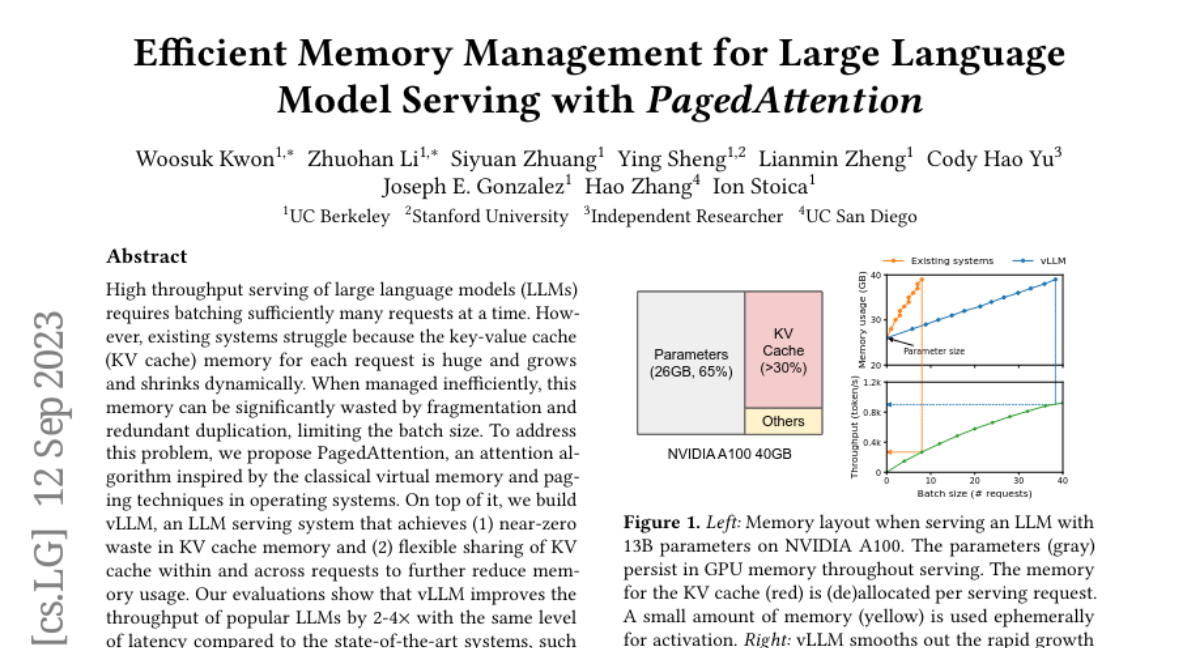
Efficient Memory Management for Large Language Model Serving with PagedAttention

PagedAttention algorithm and vLLM system enhance the throughput of large language models by efficiently managing memory and reducing waste in the key-value cache.

  • 9 authors
· Sep 12, 2023
Submitted by
Wenxuan123

UniWAM: Unified World-Action Model

Vision-language-action models benefit from the understanding and reasoning capabilities of pretrained vision-language models, but action-only supervision provides limited grounding in world dynamics. Conversely, world-action models inherit spatiotemporal priors from video generation models, yet remain limited in semantic understanding and reasoning under distribution shifts. We introduce UniWAM, a unified architecture that integrates a physical reasoner, a world generator, and an action predictor to jointly learn semantic understanding of the physical world, visual generation, and action prediction. To ensure the quality of the training data, we developed a rigorous data cleaning and annotation pipeline for both human egocentric data and robot data. To adapt the vision-language component to embodied tasks while preserving its inherited language capabilities, we represent low-level actions in natural language and introduce a pre-training recipe that assigns complementary supervision from visual question answering (VQA) data, human egocentric data, and robot demonstrations to the appropriate model components. During post-training, future visual noise augmentation reduces reliance on precise future predictions, while history-conditioned flow matching uses encoded action history to initialize action generation. Together, these designs significantly reduce denoising steps while maintaining performance. UniWAM achieves state-of-the-art (SOTA) performance across multiple evaluations, including in-distribution performance, robustness, generalization, instruction following, and long-horizon task execution. Furthermore, we uncover a log-linear scaling law of unified human-robot co-training, demonstrating the effectiveness of large-scale pre-training on a mixture of human and robot data.

HKUSTGZ HKUSTGZ · Oct 1, 2026

Kronos: A Foundation Model for the Language of Financial Markets

Kronos, a specialized pre-training framework for financial K-line data, outperforms existing models in forecasting and synthetic data generation through a unique tokenizer and autoregressive pre-training on a large dataset.

  • 7 authors
· Aug 2, 2025
Submitted by
Zeyue7

WorldSonus: Bringing Sound to Worlds

Recent advances in world models have enabled increasingly realistic visual synthesis. However, these generated environments remain largely silent. Bringing sound to world models poses three core challenges: real-time generation to keep pace with interactive video streams, interactive control to respond to mid-stream sound instructions, and spatially aligned stereo to reflect scene geometry and camera motion. To address these demands, we introduce WorldSonus, an interactive video-to-audio framework designed for real-time spatial sound synthesis in world models. For real-time generation, WorldSonus employs a streaming causal autoregressive diffusion architecture that synthesizes audio chunks at a low real-time factor (RTF) of 0.41. For interactive control, we incorporate an audio-centric captioning pipeline with chunk-indexed prompt scheduling, enabling dynamic manipulation of sound events during generation. For spatial alignment, we leverage high-quality stereo supervision curated from diverse stereo and ambisonic data. Extensive experiments demonstrate that while tailored for world models, WorldSonus generalizes effectively to open-domain video-to-audio benchmarks, matching or outperforming state-of-the-art bidirectional models in both acoustic quality and spatial alignment. Project page: https://noizai.github.io/WorldSonus/

NoizAI NoizAI · Oct 6, 2026
Submitted by
nielsr

Geometric Context Transformer for Streaming 3D Reconstruction

LingBot-Map is a feed-forward 3D foundation model that reconstructs scenes from video streams using a geometric context transformer architecture with specialized attention mechanisms for coordinate grounding, dense geometric cues, and long-range drift correction, achieving stable real-time performance at 20 FPS.

robbyant Robbyant · Apr 15, 2026
Submitted by
Linzhan

UniMate: One Unified Model to Animate Diverse Skeletons

UniMate is a unified diffusion transformer that generates articulated motion for arbitrary skeletons from text and rigged 3D assets without per-skeleton retraining, using topology-aware attention and a large curated motion dataset.

princetonu Princeton University · Sep 4, 2026
Submitted by
akhaliq

Mem0: Building Production-Ready AI Agents with Scalable Long-Term Memory

Mem0, a memory-centric architecture with graph-based memory, enhances long-term conversational coherence in LLMs by efficiently extracting, consolidating, and retrieving information, outperforming existing memory systems in terms of accuracy and computational efficiency.

  • 5 authors
· Apr 28, 2025
Submitted by
ZihanSu

SGF+: Decoupling Gradient Flows for Autoregressive Video Generation

Autoregressive video generation requires denoising the current frames while writing their key-value representations as context for future predictions. However, these two roles typically share parameters, and we find that their gradients exhibit distinct patterns and systematic negative alignment, hindering the joint optimization of visual quality and temporal consistency. We introduce Self Gradient Forcing Plus (SGF+), which assigns separate parameters to context writing and denoising while preserving their interaction through causal attention. Both roles are jointly optimized using the original generation objective without auxiliary losses, with context writing supervised through its contribution to future predictions. This simple change improves visual quality and long-horizon consistency over the evaluated baselines in both framewise and chunkwise generation, without additional video training data or a longer training horizon. Trained on only 5s rollouts, SGF+ supports continuous generation for up to 24 hours without long-video fine-tuning. These results highlight role-specific parameterization as an effective design principle for high-quality autoregressive video generation and native long-horizon extrapolation.

  • 13 authors
· Oct 7, 2026
Submitted by
taesiri

LongCat-Video Technical Report

LongCat-Video, a 13.6B parameter video generation model based on the Diffusion Transformer framework, excels in efficient and high-quality long video generation across multiple tasks using unified architecture, coarse-to-fine generation, and block sparse attention.

meituan-longcat LongCat · Oct 25, 2025
Submitted by
taesiri

MinerU2.5: A Decoupled Vision-Language Model for Efficient High-Resolution Document Parsing

MinerU2.5, a 1.2B-parameter document parsing vision-language model, achieves state-of-the-art recognition accuracy with computational efficiency through a coarse-to-fine parsing strategy.

  • 61 authors
· Sep 26, 2025

LittleBit: Ultra Low-Bit Quantization via Latent Factorization

LittleBit is a novel method for extreme compression of large language models using low-rank factorization and multi-scale compensation, achieving significant memory reduction and performance in sub-1-bit quantization.

  • 4 authors
· May 30, 2025

PyTorch Distributed: Experiences on Accelerating Data Parallel Training

The PyTorch distributed data parallel module optimizes large-scale model training using techniques like gradient bucketing, computation-communication overlap, and selective synchronization to achieve near-linear scalability.

  • 11 authors
· Jun 28, 2020
Submitted by
a43992899

YuE2: Unifying Symbolic and Audio Music Generation at Frontier Quality

Symbolic models make melody, harmony, rhythm, and form explicit but typically stop before a finished recording; audio models produce complete songs while leaving composition implicit. We introduce YuE2, which unifies symbolic and audio music generation at frontier quality through symbolic planning. A single AR-NAR Mixture-of-Transformers (MoT) first writes a readable score specifying melody and harmony, expands it into semantic music tokens, and realizes it as full-song audio. In comparisons using the same checkpoint, experts prefer symbolic planning for overall quality and musicality, with 49.3% of overall preferences versus 34.6% without planning. Experts also favor the unified model over a separate language model and diffusion Transformer. On WildSongBench, YuE2 scores 6.73 on SongBench Global Avg, exceeding all evaluated public baselines. Selecting from eight candidates (best-of-8), YuE2 reaches 6.96, the highest observed mean among all evaluated systems. Expert listening further establishes its competitiveness with proprietary song generators, favoring best-of-8 over Suno v4.5 and yielding nearly balanced preferences against Suno v5. To learn this generation process from recordings without aligned scores, we introduce MERT2 and SheetSage2 to supply semantic and symbolic supervision. MERT2 sets a new state of the art in music representation learning, surpassing previous best results on 14 of 15 MARBLE metrics; SheetSage2 leads 12 of 15 benchmark-metric pairs in our lead-sheet transcription comparison. The same checkpoint follows score edits while largely preserving unedited musical content and generates zero-shot covers without cover-specific training. Its readable score also enables agentic music editing, with external language models translating user feedback into revisions of the composition.

Submitted by
ChengCui

PaddleOCR-VL-1.6: Expanding the Frontier of Document Parsing with Under-Optimized Region Refinement and Progressive Post-Training

PaddleOCR-VL-1.6 enhances document parsing performance through targeted data optimization and progressive post-training techniques, achieving state-of-the-art results on OmniDocBench v1.6.

PaddlePaddle PaddlePaddle · Jun 2, 2026
Submitted by
AaronHuangWei

Long-WAM: Scaling the Context of World-Action Models

Real-time robot control demands enough visual history to infer motion and task progress, but processing that history can delay action. We present Long-WAM, a model-system framework for scaling the context of causal world-action models under real-time control constraints. Our central finding is that access to history is not the same as using it: longer histories pay off far more when the video foundation is pretrained autoregressively (AR). We first learn causal prediction from robot and egocentric videos without action labels, then preserve this history-to-future structure during world-action adaptation. On RoboCasa GR-1, increasing context from 0.0 to 19.2 seconds raises success from 63.3% to 78.7%, whereas a bidirectionally pretrained initialization shows no net gain; robot-domain AR pretraining further raises peak success on GR-1 and LIBERO-Long. Long-WAM also achieves the best results among compared methods on LIBERO-Long, RoboTwin 2.0, and DOMINO. Streaming observation encoding, asynchronous execution, and hardware-specific acceleration enable deployment on RTX 5090, DGX Spark, and Jetson AGX Thor without dropping future prediction; on RTX 5090, each action chunk, including future-video latent prediction, takes 107.4 ms. Real-time deployment on Unitree G1 and YAM supports dynamic and long-horizon manipulation, including 95% success on dynamic cup stacking, where Pi0.5 and Fast-WAM succeed in none of 20 trials. As a memory-informed executor, Long-WAM also complements higher-level planning in composite tasks.

nvidia NVIDIA · Oct 7, 2026
Submitted by
akhaliq

Very Large-Scale Multi-Agent Simulation in AgentScope

Enhancements to the AgentScope platform improve scalability, efficiency, and ease of use for large-scale multi-agent simulations through distributed mechanisms, flexible environments, and user-friendly tools.

  • 8 authors
· Jul 25, 2024
Submitted by
taesiri

AgentScope 1.0: A Developer-Centric Framework for Building Agentic Applications

AgentScope enhances agentic applications by providing flexible tool-based interactions, unified interfaces, and advanced infrastructure based on the ReAct paradigm, supporting efficient and safe development and deployment.

  • 23 authors
· Aug 22, 2025
Submitted by
richardxp888

RRSI: Regularized Recursive Self-Improvement of Agent Harnesses

An LLM agent's capability is largely magnified by its harness, namely the prompts, control flow, tooling, memory, and context management surrounding the frozen backbone model. Recent methods increasingly automate this process by iteratively proposing and selecting component-wise edits of an agent harness, practically establishing a form of recursive self-improvement (RSI) at the agent-system level. However, such recursive evolution may overfit by memorizing the training tasks, showing large in-distribution gains that shrink or even vanish on out-of-distribution benchmarks. We introduce Regularized Recursive Self-Improvement of Agent Harnesses (RRSI), which incorporates the principles of regularizations into harness self-improvement by constraining the evolution candidate proposal and selection. The proposer operates with a temporally annealed budget, limiting how many edits a candidate can bundle, and it encourages unexplored trajectories based on evolution history. The selector is equipped with a critic and a pruner: the critic screens benchmark-specific proposals, while the pruner, removes changes that are too small, too expensive, or no longer useful. Together these constraints favor reusable agent mechanisms over benchmark-specific ones or even noises. Across eight benchmarks spanning coding, agentic workspace and engineering design tasks, RRSI gains up to 14.1 points on the split it evolves against and up to 4.7 points on the five out-of-distribution benchmarks, while producing a harness that runs on 30% fewer policy tokens than the unregularized evolution. Code is available at https://github.com/google-research/rrsi and project page is https://regularized-rsi.com/.

google Google · Sep 21, 2026
Submitted by
andito

SmolDocling: An ultra-compact vision-language model for end-to-end multi-modal document conversion

SmolDocling is a compact vision-language model that performs end-to-end document conversion with robust performance across various document types using 256M parameters and a new markup format.

ibm-granite IBM Granite · Mar 14, 2025
Submitted by
LivXue

Raven: The Harness of Harnesses for Composable Agentic Intelligence

As large language models advance, AI agents are moving beyond isolated, domain-specific tasks toward long-horizon, cross-domain workflows. This transition exposes two challenges: increasing harness complexity makes manual design difficult to scale, while tighter coupling to specific domains limits the generality of a single harness. The central question thus shifts from how to engineer a stronger harness for one domain to how to autonomously construct specialized harnesses, improve them through experience, and orchestrate them across domains. We introduce Raven, The Harness of Harnesses, an open-source multi-agent ecosystem that automatically constructs and evolves modular harnesses for specific models and domains, treating each executable model--harness pair as a composable unit of intelligence. To support an All-Domain Collaboration Network, its Host Agent decomposes goals, matches subtasks to specialized agents, coordinates execution dependencies, and integrates results, while a host archive and EverOS preserve experience across tasks and Skill Forge makes that experience available as reusable procedures. Our theory establishes sufficient conditions for such composition to expand reliable task coverage beyond that of the available individual agents under a shared resource budget. On complex and long-horizon tasks, Raven significantly outperforms the state-of-the-art agent systems, pushing the frontier of composable agentic intelligence.

EverMindAI EverMind · Sep 27, 2026
Submitted by
RuofengYang

ARIS: Autonomous Research via Adversarial Multi-Agent Collaboration

ARIS is an open-source research harness that uses cross-model adversarial collaboration to ensure reliable long-term research outcomes through coordinated execution, orchestration, and assurance layers.

A Lightweight Instrument-Agnostic Model for Polyphonic Note Transcription and Multipitch Estimation

A lightweight neural network for musical instrument transcription achieves high frame-level note accuracy across multiple instruments and is more memory-efficient than specialized systems.

  • 5 authors
· Mar 18, 2022
Submitted by
FrancisRing

Prism: Dynamic Sparse Attention for Native 2K Joint Video-Audio Generation Model Training

Natively training joint video-audio generation models at higher resolutions empowers them to learn richer visual details and sharper motion dynamics. However, full attention incurs quadratic cost and, as resolution increases, spreads attention over increasingly redundant tokens, diluting learning signals for informative content and disrupting pretrained priors. Existing sparse attention methods either target training-free acceleration or overlook the unique structure of joint video-audio data, where cross-modal interactions are inherently concentrated around sound-producing regions. To address this, we propose Prism, a dynamic sparse attention framework for natively training joint video-audio generation models at 2K. In particular, Prism organizes the token sequence into spatiotemporal macro-zones, enabling the attention structure to adapt to local content. For each zone, it estimates local information structure via video feature variance along the channel and feature norms from the audio-to-video cross-attention, jointly capturing how visual content varies directionally and how strongly audio influences each visual region. Based on these signals, Prism dynamically assigns a tailored block shape to each zone, applying finer partitioning along axes of rapid visual content variation and strong audio-visual coupling. This encourages tokens within each block to remain semantically coherent, allowing block-level features to capture both visual content and joint video-audio interaction patterns. Prism further adopts a hybrid block selection strategy to dynamically determine per-query sparsity. Experiments show that Prism achieves 2.5times training speedup compared to full attention, while surpassing it in generation quality.

Tencent-Hunyuan Tencent Hunyuan · Oct 4, 2026
Submitted by
wangzx1994

OuroWorld: Bringing Any 3D World Alive as Diverse, Endlessly Looping 3D Cinemagraphs

Recent 3D world models generate photorealistic, explorable scenes that remain frozen in time. OuroWorld is a mask-free framework that turns any static 3D Gaussian Splatting scene into a 3D cinemagraph: a dynamic scene with vivid, diverse motion looping seamlessly from any viewpoint. A vision-language model infers plausible dynamics and guides a video model to synthesize a reference video, which we lift and complete into multi-view videos. To learn from this imperfect supervision, we propose Inconsistency-Robust Periodic 4DGS: a Fourier-series deformation field guarantees looping by construction, while a Grounded Drift Field anchored at the reference view absorbs cross-view inconsistency. Unlike prior Eulerian methods limited to fluid-like motion, we capture general deformation, object motion, and illumination change. We introduce a ground-truth-free evaluation covering vividness, naturalness, loop seam coherence, and scene quality. On 39 reconstructed and generated scenes, OuroWorld outperforms all baselines and wins 70.8%-99.0% of user-study comparisons. Project page: https://ouroworld.userwei.com

AlayaLab Alaya Lab · Oct 8, 2026
Submitted by
IMBALDYY

Recursive Game Creator: An Agentic Product-Level Experience-Oriented Game Harness

Recent game design agents have made substantial progress in generating playable games. However, program correctness does not ensure an enjoyable experience for players. We present Recursive Game Creator, an experience-oriented harness to advance agentic game development from rough game prototypes into entertaining games. Recursive Game Creator organizes recursive development around four components: Designer, Builder, Player, and Reviewer. The Designer translates user instructions and Reviewer's feedback into detailed plans. The Builder turns these plans into candidate games. The coding-native Player creates and executes reusable policies through programmatic interfaces to efficiently collect diverse gameplay trajectories, mitigating evaluation bias caused by slow GUI-based collection. The Reviewer uses carefully designed trajectory-based metrics to induce player preferences, integrating with visual evidence and explicit textual preferences to evaluate games against game-specific criteria. Finally, the Reviewer accepts the better version and provides improvement reviews for the next round, closing the recursive loop. Our method achieves state-of-the-art overall performance of 77.89 on GameCraft-Bench. On GameASG-Bench, it achieves a strict task success rate of 53.2%, a 34.1% improvement over the same-model baseline, and the highest mean runtime-check pass rate at 93.4% among compared methods. A user study shows longer playtime and higher ratings. Code is coming soon.

Submitted by
rulins

Context Language Models

We introduce Context Language Models (CLMs), language models that natively manage their own context. We implement this by treating the context as a file and allowing the model to make unrestricted updates to this file. This allows the model to learn what is most important to maintain in context, and naturally extends to multi-agent systems where multiple agent contexts coexist as files. Building CLMs zero-shot with existing models outperforms SOTA context management strategies across a variety of tasks: 11.4% higher accuracy with 21.5% fewer FLOPs on BrowseComp-Plus, 5% higher scores with 59% fewer FLOPs on 12-hour EdgeBench, and 65% greater improvement with the same compute on a 24-hour multi-repository agent-swarm task. Moreover, by shifting context management from external harness control to intrinsic model behavior, CLMs naturally enable both in-context and parametric learning of context-management strategies. We show that CLMs can be steered with natural-language instructions evolved through a standard skill-optimization loop, improving held-out accuracy by up to 35.9 points on a context-management task while reducing compute. We also introduce an online reinforcement learning method for CLMs, improving Qwen3.5-9B performance on BrowseComp-Plus by 47.6% while using 12% fewer FLOPs. Finally, we co-design Suffix Cache Reuse for CLM serving, further reducing server-side compute by 35% relative to standard SGLang at matched performance.

meta Meta · Sep 29, 2026
Submitted by
ruihong04

4DCodeBench: Benchmarking Agents on Inverse Graphics of Dynamic Scenes

We introduce 4DCodeBench, a benchmark for 4D inverse graphics through code generation, in which agents reconstruct dynamic scenes from video as executable graphics programs. To accomplish this, agents must translate visual observations into compact representations of scene structure and dynamics, by implementing abstractions such as physical simulations to reproduce complex behavior. To evaluate this capability, we curate a set of real-world videos and construct synthetic scenes spanning diverse physical phenomena, including deformation, fluid flow, and fracture. We perform extensive benchmarking of frontier models, finding that strong static reconstruction capabilities do not yet translate into reliable reconstruction of complex dynamics. 4DCodeBench provides a testbed for tracking progress toward agents that can interpret the dynamics of the world through code. Our benchmark is available at https://github.com/4DCodeBench/4DCodeBench

4DCodeBench 4DCodeBench · Oct 2, 2026
Submitted by
fuvty

TokenRouter: Efficient Serving System for Token-Level LLM Routing

Large language model (LLM) routing distributes inference work across different models, advancing the cost-quality Pareto frontier of LLM serving. While coarse-grained routing at the session or query level has been widely adopted in production systems, recent algorithmic work shows that fine-grained token-level routing can yield substantial efficiency and quality gains. However, efficiently serving token-level routed inference poses significant challenges to existing systems. Built on single-LLM assumptions, current systems suffer from severe step desynchronization and frequent batch admission delays under token-level routing, and they also impose high implementation complexity on developers. To address these challenges, we design TokenRouter, an efficient and developer-friendly serving system for token-level routed LLM inference. TokenRouter follows the principle of request-centric programming, model-centric execution: developers describe routing logic from the perspective of a single request, while the runtime launches a subserver for each LLM and dispatches requests asynchronously. Each subserver employs a delayed-batching scheduler, whose optimal hyperparameters are derived from a mathematical throughput model of the system. Across diverse routing algorithms, workloads, and model pairs, TokenRouter achieves 2.01-64.15x higher decoding throughput than existing systems, substantially advancing the serving efficiency of token-level LLM routing. Our code is available at https://github.com/thu-nics/TokenRouter.

nics-efc Tsinghua-NICS-EFC · Oct 8, 2026

AutoDev: Automated AI-Driven Development

AutoDev is an AI-driven software development framework that automates complex engineering tasks within a secure Docker environment, achieving high performance in code and test generation.

  • 5 authors
· Mar 13, 2024
Submitted by
andy-yang

FreeToken: Efficient Edge-Native MoE Serving with Bandwidth-Adaptive Execution

FreeToken is an edge-native Mixture-of-Experts serving system that dynamically maps computation and model state onto heterogeneous local hardware to run large open-weight models on personal machines.

Submitted by
JarvisPei

NeoHorse-1: Towards Recursive Self-Improvement via Agentic Post-Training with Routing Harness

NeoHorse-1 uses agentic post-training with intelligent routing, structured feedback loops, and curriculum-based distillation to improve model capabilities across agent benchmarks.

TokenRhythm TokenRhythm · Sep 8, 2026

Zep: A Temporal Knowledge Graph Architecture for Agent Memory

Zep, a memory layer service, outperforms MemGPT in the DMR benchmark and LongMemEval by excelling in dynamic knowledge integration and temporal reasoning, critical for enterprise use cases.

  • 5 authors
· Jan 20, 2025
Submitted by
henry-y1

MC-Sparse: Deconstructing and Closing the Dense-Sparse Attention Gap in Diffusion Transformers

Sparse attention is a primary approach to reducing the latency of diffusion transformers in long-sequence generation tasks, such as video and high-resolution 3D asset generation. However, existing methods can degrade generation quality and fidelity at high sparsity levels. Through controlled oracle comparisons, we trace this degradation to three sources: constraints imposed by token grouping, inaccurate interaction selection, and the attention contributions lost when tokens are discarded. Guided by this analysis, we propose Meta-Cached Sparse Attention (MC-Sparse), a training-free framework that selects individual key-value (KV) tokens while organizing similar queries into tile-aligned groups for efficient GPU execution. MC-Sparse caches metadata comprising query groups, KV indices selected using exact attention probabilities, and residuals between dense and sparse attention outputs, and reuses them across subsequent denoising steps. Across video and 3D generation models, MC-Sparse achieves higher fidelity to dense-attention outputs and larger denoising speedups than existing sparse-attention baselines, without visible quality degradation. Relative to dense attention, it delivers a 1.80times denoising speedup on Minimax-H3-Base and a 2.32times speedup on 3D asset generation, both with negligible quality loss.

Tencent-Hunyuan Tencent Hunyuan · Oct 5, 2026
Submitted by
jasonrqh

COLLEAGUE.SKILL: Automated AI Skill Generation via Expert Knowledge Distillation

Person-grounded AI skills are automatically distilled from heterogeneous traces into inspectable, correctable packages that capture both capabilities and behavioral patterns.

ShanghaiAiLab shanghai ailab · May 29, 2026
Submitted by
taesiri

SkillOpt: Executive Strategy for Self-Evolving Agent Skills

SkillOpt introduces a systematic text-space optimizer for agent skills that trains skills as external agent state with stable updates and zero deployment inference overhead, achieving superior performance across multiple benchmarks and execution environments.

MicrosoftResearch Microsoft Research · May 22, 2026
Submitted by
taesiri

Unlimited OCR Works

Unlimited OCR introduces Reference Sliding Window Attention to eliminate growing memory consumption during long-sequence OCR tasks, enabling efficient transcription of multiple pages in a single forward pass.

baidu BAIDU · Jun 22, 2026
Submitted by
Gtime666

LoopVL: Recurrent Visual Intelligence

We introduce LoopVL to study whether Loop Transformers can be effectively extended to vision- language models. LoopVL combines Module-Loop and Model-Loop computation to iteratively update a unified vision-language state through shared modules. We train LoopVL from scratch through language pre-training, multimodal training, and post-training. LoopVL outperforms a range of similarly sized and larger non-recurrent models on multimodal understanding and visual reasoning benchmarks. We also observe Visual Aha Moments in LoopVL, characterized by pronounced shifts in visual attention across loops. LoopVL provides practical evidence for recurrent vision-language modeling and offers an intuitive perspective on how shared parameters can support deeper multimodal computation over continuously evolving visual-language states.

Submitted by
ankanmbz

WorldGuide: Goal-Directed Video World Model for Procedural Task Execution

Video generators and video-based world models can synthesize plausible visual trajectories, but long-horizon procedural tasks require generation to adapt to what has actually been produced. A model must determine the next action from its generated state, execute that action, and recognize when the task is complete. Open-loop generation cannot adapt to execution outcomes, while existing closed-loop systems often rely on pretrained executors or indirect verification. This leaves a gap between deciding an action and successfully realizing it. We formulate procedural video generation as closed-loop task execution in visual world space and introduce WorldGuide. Given only an initial image and a task goal, WorldGuide predicts an atomic action, generates its corresponding video clip, and uses the generated result to select the next action or terminate. The Planner and Executor are trained on the same step-level procedural demonstrations: the Planner learns to predict the next atomic action or task completion from visual progress, while the Executor is directly trained to realize the predicted actions. Hierarchical visual memory maintains state across long-horizon execution with bounded history token cost. Due to the lack of step-level action-video supervision for joint planner-executor training, we introduce WorldGuide Bench: approximately 59K step-annotated videos across 245 tasks and 27 procedural categories. WorldGuide achieves a 33.33\% Task Success on WorldGuide-Bench, compared with 29.90\% for the strong recent video model MiniMax-H3, even though MiniMax-H3 receives reference action plans, and achieves 47.69\% on VideoCraft-Bench compared with 32.73\% for MiniMax-H3 under goal-only conditioning. These results demonstrate the importance of coupling planning with learned execution for goal-directed procedural video generation.

Submitted by
oriuta

Apodex 1.1: Scaling Agentic Intelligence for Complex Work

Apodex 1.1 improves sustained, verifiable progress on complex real-world tasks by scaling executable environments and training agents to coordinate long-horizon work with state maintenance and recovery.

apodex Apodex · Aug 24, 2026
Submitted by
nielsr

Ultralytics YOLO26: Unified Real-Time End-to-End Vision Models

YOLO26 addresses real-time vision challenges through a unified model family with NMS-free inference, improved training strategies, and multi-task capabilities spanning detection, segmentation, and pose estimation.

Ultralytics Ultralytics · Jun 2, 2026
Submitted by
xcjthu

MiniCPM4: Ultra-Efficient LLMs on End Devices

MiniCPM4, a highly efficient large language model for end-side devices, achieves superior performance using innovations in sparse attention, pre-training datasets, training algorithms, and inference systems.

openbmb OpenBMB · Jun 9, 2025