Build AI-Powered Workflows and Intelligent Agents Without Coding from JHU
Certificate Program in Agentic AI
 Application closes on
7th Nov 2026

 Speak with our expert
+14104988288




Receive Your Brochure Copy
Get details on syllabus, projects, tools, and more

Certificate Program in Agentic AI
Application closes 7th Nov 2026
Why should you join this program?
-

Build Agentic AI Workflows Using Visual, No-Code Platforms
Move from prompting to goal-driven agents: design workflows, ground AI in company documents, and orchestrate multi-agent systems in n8n and Claude, with governance built in.
-
Learn from JHU, a Leading US Research University
Ranked #9 National University, #17 Best Global University, #2 in Computer Information Technology, reflecting JHU's leadership in research and innovation. (2027 Rankings)


PROGRAM OUTCOMES
What will you learn to build and apply?
Through a structured learning journey, you will build the capability to:
-
Understand Agentic AI, apply prompt engineering, and learn RAG concepts and workflow design thinking
-
Create intelligent automated processes from single-step to multi-agent workflows with proper hand-offs
-
Build agentic workflows in n8n and Claude Cowork, integrating CRM, spreadsheets, and email without coding
-
Measure workflow success with business metrics, quality gates, and A/B testing across AI models
-
Ensure data privacy, mitigate bias, implement audit trails, and safeguard against unauthorized AI actions
-
Create end-to-end agentic workflows integrating prompting, data grounding, orchestration, and governance
Earn a Certificate of Completion from Johns Hopkins University
-
#9 National University Rankings
U.S. News & World Report, 2027
-
#2 Computer Information Technology
U.S. News & World Report, 2027
-
#11 Most Innovative Schools
US News and World Report, 2027
-
#17 Best Global University
U.S. News & World Report, 2027
-
#1 Biomedical Engineering Program
US News and World Report, 2027


KEY PROGRAM HIGHLIGHTS
Why choose this program?
-
Learn from Johns Hopkins University Faculty
Learn through recorded lectures and attend faculty-led masterclasses covering Generative AI, Agentic AI, AI governance, emerging AI trends, etc.
-
Interactive Mentorship by Industry Experts
Learn from AI experts through mentorship sessions focused on practical applications, implementation challenges, and industry best practices.
-
No-Code AI Curriculum
Build proficiency in prompt engineering, RAG, agent design, responsible AI governance, multi-agent orchestration, and evaluation without any prior programming experience.
-
Real-World Projects & Case Studies
Work through hands-on projects and real-world business case studies using visual no-code tools and platforms like n8n, Claude, ChatGPT, Gemini, and Gemini Notebook.
-
Earn a Recognized Credential from Johns Hopkins University
Earn a Certificate of Completion and 10 CEUs from Johns Hopkins University upon successful completion of the program.
-
Personalized Program Support
Receive guidance from a dedicated Program Support Team and academic support from subject matter experts.


Skills you will learn
Prompt Engineering
Workflow Design
Agent Design
Business Automation
Multi-Agent Orchestration
Retrieval Augmented Generation
AI Evaluation
Human-in-the-Loop Design
Responsible AI
AI Governance
Prompt Engineering
Workflow Design
Agent Design
Business Automation
Multi-Agent Orchestration
Retrieval Augmented Generation
AI Evaluation
Human-in-the-Loop Design
Responsible AI
AI Governance
view more
- Overview
- Learning Journey
- Curriculum
- Projects
- Tools
- Certificate
- Faculty
- Mentors
- Fees
Who is the program for?
Professionals aiming to automate workflows and drive business impact with GenAI & Agentic AI via no-code tools
-
Professionals across business and management
Professionals from functions such as Sales, Marketing, Operations, Finance, Legal, Product, and beyond.
-
Technical Professionals accelerating AI delivery
Professionals who work in a technical role and need to prototype and integrate Agentic AI systems without the constraints of full development cycles.
-
Management and technology consultants
Consultants advising clients on how to use AI, who need to show results, not just recommendations.
How is the program learning experience?
Our pedagogy is designed to ensure a holistic learning experience
-
Learn from Experts
Learn from JHU faculty and industry experts to build skills in Generative AI and Agentic AI
-
Learn By Doing
Apply Generative AI and Agentic AI concepts through hands-on projects and case studies
-
Earn a University Credential
Earn a certificate of completion and 10 CEUs from Johns Hopkins University
-
Get Support Throughout the Learning Journey
A program support team will help you stay on track, and navigate key program milestones.




What will you learn in the program?
The Agentic AI program curriculum, designed by the expert faculty at Johns Hopkins University and leading industry practitioners, covers everything from Generative AI foundations and prompt engineering to grounding AI in company data, agent design, responsible AI governance, multi-agent orchestration, and evaluation using a no-code approach.
-
Masterclasses
By JHU Faculty
-
Live Mentorship
By Industry Experts
-
Self-Paced
Claude Module
Pre-Work
This module prepares learners for the program with tool setup and a foundation in Agentic AI concepts and evolution, familiarizing them with the platforms used.
Concepts Covered
- The AI and Agentic AI Landscape
- Applications of AI and Agentic AI (Live Session)
- Tool Setup Session (Live Session)
Module 01: Generative AI Foundations
This module covers Large Language Model concepts, prompt engineering techniques, and Retrieval-Augmented Generation (RAG) to ground AI in real data. Learners apply evaluation frameworks to measure and improve system quality, culminating in Project 1, a functional GenAI application solving a real business problem.
Week 01: LLMs and Prompt Engineering
- Understand how Large Language Models work at a conceptual level and explain how different prompting techniques influence LLM outputs.
- Apply the Intern Analogy and Persona-Context-Task framework to design clear, effective prompts that consistently produce high-quality results.
- Assess Natural Language Processing (NLP) business applications, including summarisation, classification, extraction, translation, and sentiment analysis, and craft prompts for each.
- Demonstrate the ability to generate structured outputs (tables, CSV, JSON), control AI voice, tone, and style, and build iterative prompt refinement loops for business tasks.
Week 02: Retrieval-Augmented Generation (RAG)
- Understand how AI “reads” and comprehends proprietary company documents, and explain why grounding AI in real data reduces hallucinations.
- Apply no-code RAG platforms (Gemini Notebook, Claude Cowork, n8n) to build “Chat with Your Documents” systems and organize business knowledge bases.
- Assess business data integration, including connecting CRMs, spreadsheets, databases, and document repositories, for optimal AI retrieval performance.
- Demonstrate the ability to create knowledge management systems that ground AI in live company data and measure retrieval accuracy.
Week 03: Prompt Optimization and Evaluation
- Understand hallucination risks in customer-facing workflows and explain how to identify and mitigate false or inaccurate AI outputs.
- Apply quality scorecards to measure workflow effectiveness, including success rates, accuracy, speed, and cost, and establish baseline performance metrics.
- Assess A/B testing approaches to compare AI models (ChatGPT vs. Claude vs. Gemini) and determine which performs best for a given business use case.
- Demonstrate the ability to set up approval gates for high-risk outputs, create audit trails for compliance, and establish success metrics for automation workflows.
Week 04: Project 1
Week 05: Learning Break
Module 02: Introduction to Agentic AI Design
This module transitions from responsive to autonomous AI, exploring agent concepts and building agentic workflows. Learners design agents that pursue goals, use tools, and take action using no-code platforms. The module embeds safety, ethics, and responsible AI practices throughout, culminating in Project 2, a coordinated agentic workflow solving a complex business challenge.
Week 06: Core Concepts of Agentic AI
- Understand what makes an agent autonomous and explain how agents differ from chatbots and traditional automation.
- Transition from “ask a question” to “give a goal” thinking, designing workflows where agents pursue objectives independently.
- Assess how agents use tools, including web search, calendars, APIs, and databases, to interact with the world and take action.
- Demonstrate the ability to design multi-step agent workflows using n8n and Claude Cowork, and map out reasoning and action sequences.
Week 07: Ethics, Safety, Alignment, and Responsible AI
- Understand ethical risks in automated workflows, including bias in decision-making, data privacy violations, unintended consequences, and lack of transparency.
- Apply responsible AI practices to workflow design, including auditing for shadow bias, ensuring data security, implementing compliance checks, and establishing human approval gates.
- Assess workflow governance requirements for a given industry, and design guardrails to prevent unauthorized AI actions and ensure ethical automation.
- Demonstrate the ability to implement audit logging, set up approval workflows for sensitive decisions, and document compliance considerations for automated systems.
Week 08: Project 2
Week 09: Learning Break
Module 03: Building Agentic AI Systems
This module covers multi-agent orchestration and evaluation for no-code workflows. Learners design comprehensive monitoring systems, implement governance, and validate workflow performance end-to-end, culminating in Project 3, an end-to-end agentic solution addressing a complex organizational challenge.
Week 10: Multi-Agent Systems
- Understand how multi-agent systems work, including teams of specialized agents collaborating, with each agent having clear roles and responsibilities.
- Design “virtual departments” using n8n workflows, assigning Manager and Worker roles, creating hand-offs between specialized agents, and orchestrating complex collaboration.
- Assess multi-agent communication patterns, including how agents share information, resolve conflicts, and coordinate across business processes.
- Demonstrate the ability to build multi-step orchestrations where agents delegate, approve, and hand off work to other agents, and track data flow and dependencies.
Week 11: Evaluation of Agentic AI Systems
- Understand evaluation dimensions for workflows, including task completion rate, accuracy, speed, cost efficiency, and user satisfaction metrics.
- Apply business metrics and monitoring dashboards to measure multi-agent workflow performance.
- Design human-in-the-loop approval gates for critical decisions and exception handling, and identify where human oversight is required.
- Demonstrate the ability to monitor workflow health, identify bottlenecks and failure points, and optimize for cost and efficiency.
Week 12: Project 3
Self-Paced Module: Claude-Based AI Workflows
This module is designed to build practical capability in applying Generative AI and Agentic AI using the Claude ecosystem in real-world contexts. Learners build the ability to design, execute, and evaluate AI-driven workflows for real-world applications, supported by ~5 hours of structured learning. *Disclaimer: Claude API access is not included as part of the program. Learners may explore advanced usage independently.
Design and Execute AI Workflows
- Model selection and Prompt Engineering using Claude Chat
- Agentic workflow design and orchestration using Claude CoWork
- Plan → Approve → Execute → Iterate framework
- Designing workflows with reasoning, tools, and multi-step execution
- Applying concepts through real-world case studies
Anthropic Masterclass
This masterclass covers the Anthropic AI landscape, exploring Claude models, Constitutional AI, and key safety and alignment principles. Learners apply effective prompt engineering techniques, use the Claude API for tasks and integrations, generate structured outputs, build simple applications, compare Claude with other AI models, and evaluate ethical considerations for deploying AI systems.
Note: The curriculum listed above is indicative and subject to updates as technology evolves.
What sample activities will you work on?
Work on real-world case studies and hands-on projects from across industries.

Sample Project | CUSTOMER SUPPORT
Support Call Intelligence Assistant
Description
Build a no-code AI pipeline that transforms raw customer support call transcripts into structured tickets, policy-checked email replies, and leadership insights briefs. The system extracts structured summaries, classifies tickets by urgency and churn risk, drafts policy-verified responses, and generates evidence-grounded executive briefings, all without writing code.
Skills you will learn
- ChatGPT
- Google AI Studio
- Google Gemini
- Prompt Engineering
- RAG
- LLM-as-a-Judge
- Gemini Notebook

Sample Project | FINANCE
AI-Driven Mortgage Underwriting Orchestration System
Description
Build a no-code, multi-agent AI orchestration pipeline designed to automate specialist risk reviews, detect compliance bias, perform quality control checks, and manage human-in-the-loop decisions. The system extracts application data, enforces PII masking, runs sequential assessment across specialist agents with policy RAG stores, performs bias audits, and routes high-risk cases to human underwriters.
Skills you will learn
- n8n
- Multi-Agent Systems
- Vector Store
- RAG
- OpenAI LLM
- Bias Auditing
- Human-in-the-Loop
- Compliance Checks
- Email Notifications

SAMPLE PROJECT | MEDTECH
Medical Device Compliant Handling Assistant
Description
Build a no-code, multi-agent AI workflow that turns incoming customer complaints and service requests into structured, audit-ready cases. The system extracts key details, classifies severity, matches each case against a quality manual and known-issue library using RAG, drafts a regulator-ready case summary, and escalates potential safety events to a quality officer for approval.
Skills you will learn
- n8n
- Gemini Notebook
- Gemini
- Multi-Agent Systems
- RAG
- Human-in-the-Loop

Sample Project | Legal
Contract Risk Review Assistant
Description
Build a no-code, multi-agent AI workflow that reviews vendor contracts against a company’s clause playbook. The system extracts key clauses, flags deviations and risk levels with citations to the contract text, suggests alternative wording, and routes high-risk or ambiguous clauses to a human lawyer, who makes the final decision.
Skills you will learn
- Gemini Notebook
- n8n
- Multi-Agent Systems
- RAG
- Human-in-the-Loop
- Compliance Checks
- Audit Trails Show less


Note: The projects and case studies listed above are indicative and subject to updates to the curriculum.
Which tools will you learn and apply?
Learn no code tools like Claude, Gemini, and n8n to build AI workflows and intelligent agents
-
n8n
-
Claude
-
ChatGPT
-
Gemini
-
Gemini Notebook
-
Google AI Studio






Note: The tools listed above are indicative and subject to updates as technology evolves.
Earn a Certificate of Completion from Johns Hopkins University
Stand out in a competitive market with a Certificate of Completion for the Certificate Program in Agentic AI that validates the expertise developed through rigorous, practical assessments.
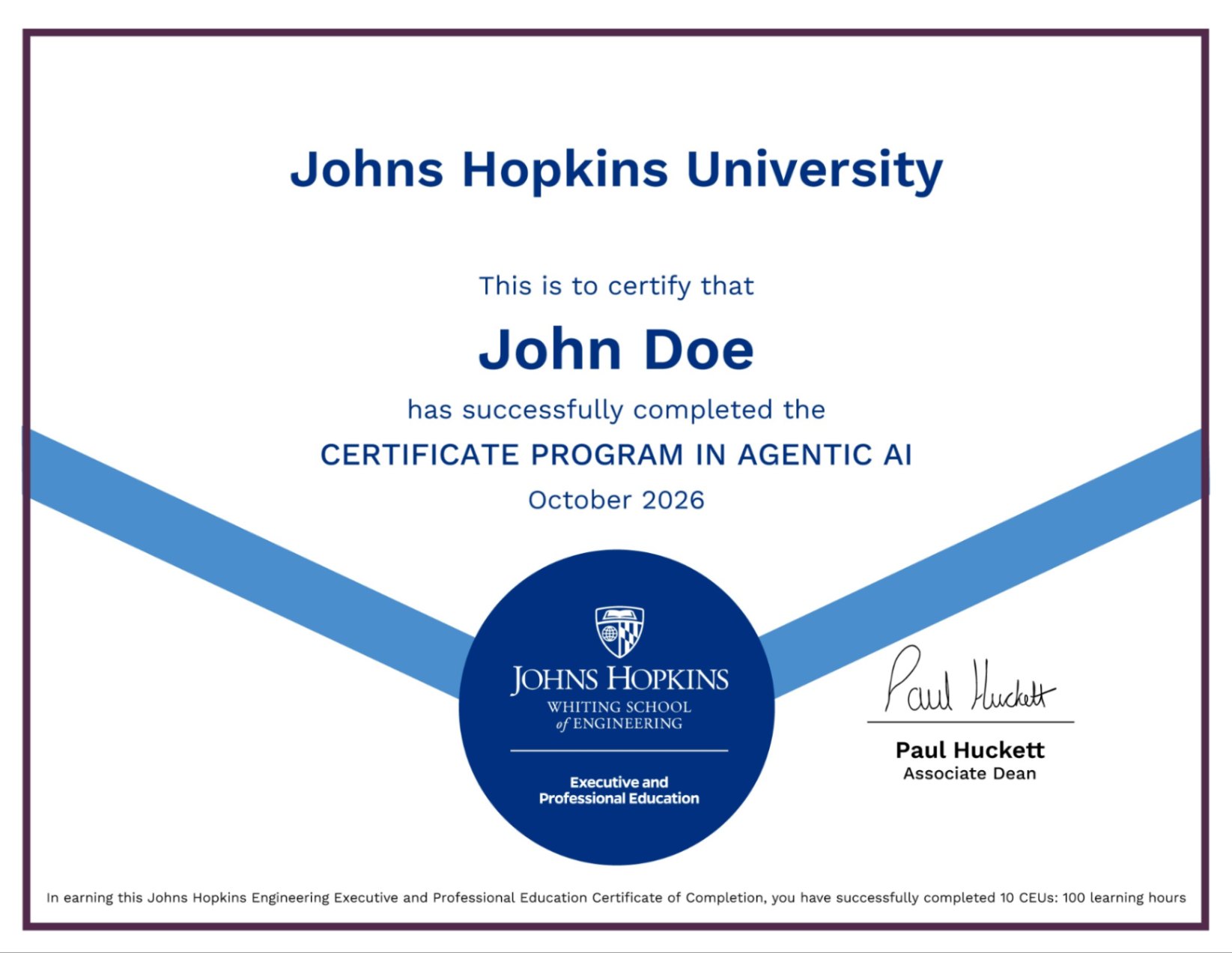
* Image for illustration only. Certificate subject to change.
Who are the faculty for the program?
Learn from renowned JHU faculty and build the expertise to implement and scale AI solutions across functions
-
Dr. Christophe Morin
Co-Founder and Chief Persuasion Scientist, SalesBrain
Author of The Persuasion Code and expert in AI-driven marketing.
Developed the NeuroMap™ model and persuasion tools used globally.
Know More
-
Dr. Jane Pinelis
Expert in artificial intelligence assurance and governance
Chief AI Engineer at Johns Hopkins University's APL
AI specialist in high-stakes ethical deployment systems
Know More
-
Ian McCulloh, Ph.D.
Director, AI Executive & Professional Education, Johns Hopkins University
Served as Chief Data Scientist & MD of AI, Accenture Federal Services
Author of three books and over 100 peer-reviewed papers
Know More
-
Dr. William Gray-Roncal
Principal Research Scientist - Johns Hopkins University Applied Physics Laboratory
Expert in data science, neuroscience, AI, and precision medicine.
Leads cutting-edge research in brain network mapping and analysis.
Know More
-
Dr. Shelby Wilson
Senior Data Scientist - The Johns Hopkins University Applied Physics Laboratory
Expert in applied mathematics, computational epidemiology, and ML.
Over a decade of experience solving real-world problems with mathematical and AI tools.
Know More
-
Dr. Iain Cruickshank
Faculty Member, Johns Hopkins University
ML expert applying AI to intelligence, cybersecurity, and social data
Ph.D., Carnegie Mellon University School of Computer Science
Know More






.png "Dr. William Gray-Roncal")





 LinkedIn Profile
 University Link
Who are the mentors for weekly live sessions?
Learn from seasoned AI and data science industry mentors to apply concepts and build practical skills
-
Bhaskarjit Sarmah
Head of AI Research for Financial Services, Domyn
-
Kalle Bylin
Data Engineer, Workday
-
Tanya Glozman
Applied Science - AI/ML, Apple
-
Bridget Huang-Gregor
GenAI/ML Engineer at Amazon Web Services (AWS)
-
Vinicio Desola Jr
Staff Data Scientist, Newmark
.jpeg "Bhaskarjit Sarmah - Mentor")



.png "Tanya Glozman - Mentor")

.png "Bridget Huang-Gregor - Mentor")


Note: The mentors listed above are indicative and subject to change based on availability and scheduling.
Course Fees
The course fee is USD 3,050
Invest in your career
-
Build hands-on proficiency in prompt engineering, workflow design, business automation, and governance
-
Dedicate 8-10 hours weekly to faculty-led learning, industry mentorship, projects, and case studies
-
Learn from AI experts in weekly live online sessions focused on real-world implementation and business impact
-
Receive a Certificate of Completion and 10 CEUs from Johns Hopkins University


Application process
Applications close once the required number of participants enroll. Apply early to secure your spot
-
Fill the application form
Apply by completing the online application form.
-
Application screening
A panel from Great Learning will review your application to determine your fit for the program.
-
Join the program
Receive an offer for a seat in the upcoming cohort of the program after a final review


Batch Start Date
-
Online · 21st Nov 2026
Admission closing soon
Delivered in collaboration with:

Johns Hopkins University is collaborating with online education provider Great Learning to offer the Certificate Program in Agentic AI. Great Learning is a professional learning company with a global footprint in 170+ countries. Its mission is to make professionals around the globe proficient and future-ready. This program leverages JHU's leadership in innovation, science, engineering, and technical disciplines developed over years of research, teaching, and practice. Great Learning manages the enrollments and provides industry experts, student counselors, course support, and guidance to ensure students get hands-on training and live personalized mentorship on the application of concepts taught by the JHU faculty.
 Application closes
7th Nov 2026