Announcing the fastest WebAssembly runtime for Go: wasmer
This is a copy of an article I wrote for Wasmer.
WebAssembly is a portable binary format. That means the same file can run anywhere.
To uphold this bold statement, each language, platform and system must be able to run WebAssembly — as fast and safely as possible.
Wasmer is a WebAssembly runtime written in Rust. It goes without saying that the runtime can be used in any Rust application. We have also successfully embedded the runtime in other languages:
- Using C and C++ bindings
- In PHP, using
php-ext-wasm - In Python, using
python-ext-wasm— wasmer package on PyPI - In Ruby, using
ruby-ext-wasm— wasmer gem on RubyGems - It is now time to hang around Go 🐹!
We are super happy to announce github.com/wasmerio/go-ext-wasm/wasmer,
a Go library to run WebAssembly binaries,
fast.
Calling a WebAssembly Function from Go#
First, let’s install wasmer in your go environment (with cgo
support).
$ export CGO_ENABLED=1; export CC=gcc; go install github.com/wasmerio/go-ext-wasm/wasmerLet’s jump immediately into some
examples.github.com/wasmerio/go-ext-wasm/wasmer is a regular Go
library. The installation is automated with
import "github.com/wasmerio/go-ext-wasm/wasmer".
Let’s get our hands dirty. We will write a program that compiles to WebAssembly easily, using Rust for instance:
#[no_mangle]
pub extern fn sum(x: i32, y: i32) -> i32 {
    x + y
}
After compilation to WebAssembly, we get a file like
this one,
named simple.wasm.
The following Go program executes the sum function by passing 5 and
37 as arguments:
package main

import (
    "fmt"
    wasm "github.com/wasmerio/go-ext-wasm/wasmer"
)

func main() {
    // Reads the WebAssembly module as bytes.
    bytes, _ := wasm.ReadBytes("simple.wasm")

    // Instantiates the WebAssembly module.
    instance, _ := wasm.NewInstance(bytes)
    defer instance.Close()

    // Gets the `sum` exported function from the WebAssembly instance.
    sum := instance.Exports["sum"]

    // Calls that exported function with Go standard values. The WebAssembly
    // types are inferred and values are casted automatically.
    result, _ := sum(5, 37)

    fmt.Println(result) // 42!
}
Great! We have successfully executed a WebAssembly file inside Go.
Note: Go values passed to the WebAssembly exported function are automatically cast to WebAssembly values. Types are inferred and casting is done automatically. Thus, a WebAssembly function acts as any regular Go function.
WebAssembly Calling Go Funtions#
A WebAssembly module exports some functions, so that they can be called from the outside world. This is the entry point to execute WebAssembly.
Nonetheless, a WebAssembly module can also have imported functions. Let’s consider the following Rust program:
extern {
    fn sum(x: i32, y: i32) -> i32;
}

#[no_mangle]
pub extern fn add1(x: i32, y: i32) -> i32 {
    unsafe { sum(x, y) } + 1
}
The exported function add1 calls the sum function. Its
implementation is absent, only its signature is defined. This is an
“extern function”, and for WebAssembly, this is an imported function,
because its implementation must be imported.
Let’s implement the sum function in Go! To do so, need to use
cgo:
- The
sumfunction signature is defined in C (see the comment aboveimport "C"), - The
sumimplementation is defined in Go. Notice the//exportwhich is the way cgo uses to map Go code to C code, NewImportsis an API used to create WebAssembly imports. In this code"sum"is the WebAssembly imported function name,sumis the Go function pointer, andC.sumis the cgo function pointer,- Finally,
NewInstanceWithImportsis the constructor to use to instantiate the WebAssembly module with imports. That’s it.
Let’s see the complete program:
package main

// // 1️⃣ Declare the `sum` function signature (see cgo).
//
// #include <stdlib.h>
//
// extern int32_t sum(void *context, int32_t x, int32_t y);
import "C"

import (
    "fmt"
    wasm "github.com/wasmerio/go-ext-wasm/wasmer"
    "unsafe"
)

// 2️⃣ Write the implementation of the `sum` function, and export it (for cgo).
//export sum
func sum(context unsafe.Pointer, x int32, y int32) int32 {
    return x + y
}

func main() {
    // Reads the WebAssembly module as bytes.
    bytes, _ := wasm.ReadBytes("import.wasm")

    // 3️⃣ Declares the imported functions for WebAssembly.
    imports, _ := wasm.NewImports().Append("sum", sum, C.sum)

    // 4️⃣ Instantiates the WebAssembly module with imports.
    instance, _ := wasm.NewInstanceWithImports(bytes, imports)

    // Close the WebAssembly instance later.
    defer instance.Close()

    // Gets the `add1` exported function from the WebAssembly instance.
    add1 := instance.Exports["add1"]

    // Calls that exported function.
    result, _ := add1(1, 2)

    fmt.Println(result)
    //   add1(1, 2)
    // = sum(1 + 2) + 1
    // = 1 + 2 + 1
    // = 4
    // QED
}
Reading the Memory#
A WebAssembly instance has a linear memory. Let’s see how to read it. Consider the following Rust program:
#[no_mangle]
pub extern fn return_hello() -> *const u8 {
    b"Hello, World!\0".as_ptr()
}
The return_hello function returns a pointer to a string. The string
terminates by a null byte, à la C. Let’s jump on the Go side:
bytes, _ := wasm.ReadBytes("memory.wasm")
instance, _ := wasm.NewInstance(bytes)
defer instance.Close()

// Calls the `return_hello` exported function.
// This function returns a pointer to a string.
result, _ := instance.Exports["return_hello"]()

// Gets the pointer value as an integer.
pointer := result.ToI32()

// Reads the memory.
memory := instance.Memory.Data()

fmt.Println(string(memory[pointer : pointer+13])) // Hello, World!
The return_hello function returns a pointer as an i32 value. We get
its value by calling ToI32. Then, we fetch the memory data with
instance.Memory.Data().
This function returns a slice over the WebAssembly instance memory. It can be used as any regular Go slice.
Fortunately for us, we already know the length of the string we want to
read, so memory[pointer : pointer+13] is enough to read the bytes,
that are then cast to a string. Et voilà !
You can read the Greet Example to see a more advanced usage of the memory API.
Benchmarks#
So far, github.com/wasmerio/go-ext-wasm/wasmer has a nice API, but
…is it fast?
Contrary to PHP or Ruby, there are already existing runtimes in the Go world to execute WebAssembly. The main candidates are:
- Life, from Perlin Network, a WebAssembly interpreter
- Wagon, from Go Interpreter, a WebAssembly interpreter and toolkit.
In
our blog post about the PHP extension,
we have used
the n-body algorithm
to benchmark the performance. Life provides more benchmarks:
the Fibonacci algorithm (the
recursive version),
the Pollard’s rho algorithm,
and the Snappy Compress operation. The latter works successfully with
github.com/wasmerio/go-ext-wasm/wasmer but not with Life or Wagon. We have
removed it from the benchmark suites.
Benchmark sources
are online.
We use Life 20190521143330–57f3819c2df0, and Wagon 0.4.0, i.e. the latest versions to date.
The benchmark numbers represent the average result for 10 runs each. The computer that ran these benchmarks is a MacBook Pro 15" from 2016, 2.9Ghz Core i7 with 16Gb of memory.
Results are grouped by benchmark algorithm on the X axis. The Y axis represents the time used to run the algorithm, expressed in milliseconds. The lower, the better.
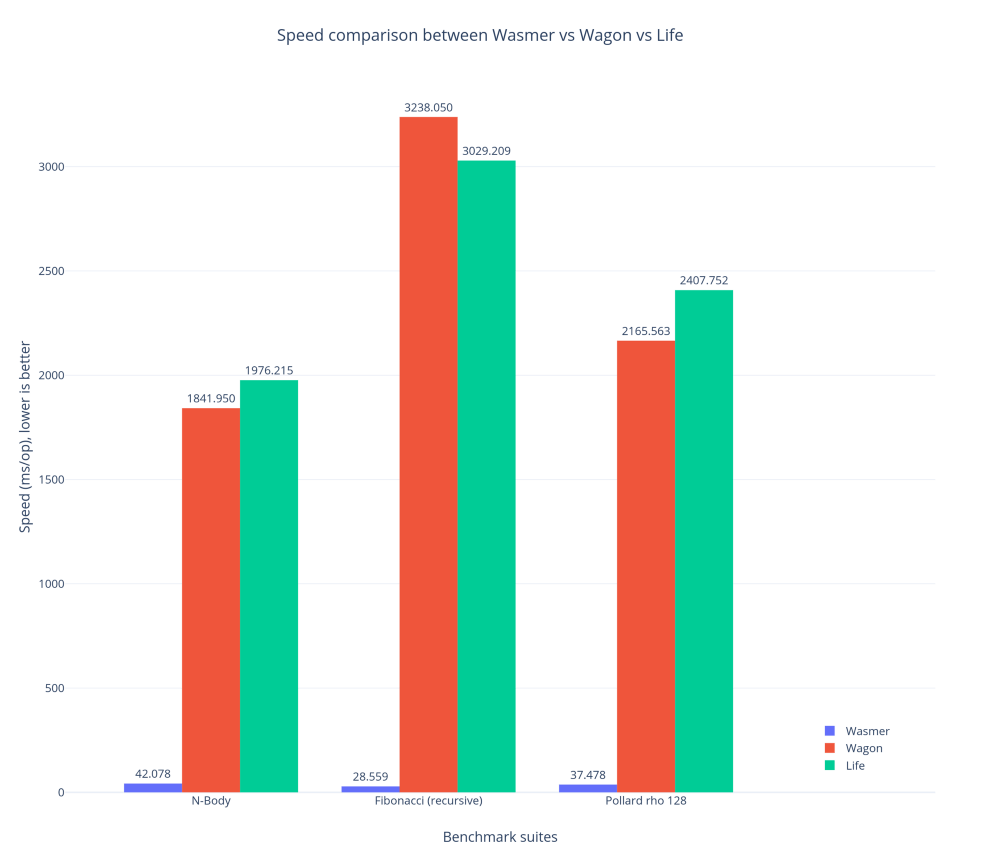
Speed comparison between Wasmer, Wagon and Life. Benchmark suites are the n-body, Fibonacci, and Pollard’s rho algorithms. Speed is expressed in ms. Lower is better.
While both Life and Wagon provide on average the same speed, Wasmer
(github.com/wasmerio/go-ext/wasmer) is on average 72 times faster
🎉.
It is important to know that Wasmer comes with 3 backends: Singlepass, Cranelift, and LLVM. The default backend that is used by the Go library is Cranelift (learn more about Cranelift). Using LLVM will provide performance close to native, but we decided to start with Cranelift as it offers the best tradeoff between compilation-time and execution-time (learn more about the different backends, when to use them, pros and cons etc.).
Conclusion#
[github.com/wasmerio/go-ext-wasm/wasmer](https://github.com/wasmerio/go-ext-wasm)
is a new Go library to execute WebAssembly binaries. It embeds the
Wasmer runtime. The first version supports
all the required API for the most common usages.
The current benchmarks (a mix from our benchmark suites and from Life suites) show that Wasmer is — on average — 72 times faster than Life and Wagon, the two major existing WebAssembly runtimes in the Go world.
If you want to follow the development, take a look at @wasmerio and @mnt_io on Twitter, or @wasmer@webassembly.social on Mastodon.
And of course, everything is open source at wasmerio/go-ext-wasm.
Thank you for your time, we can’t wait to see what you build with us!