Repository navigation
How to use the reflection module? #249
Description
Activity
The reflection factor returned consists of the positive frequencies. You could indeed do a convolution if you create an impulse response out of the spectrum. Using
np.fft.irfftshould give you a usable impulse response. Alternatively, when stacking positive and negative frequencies you can usenp.fft.iffthttps://github.com/FRidh/auraliser/blob/master/auraliser/propagation.py#L38.Thanks for the feedback.
I have several comments.
-
Isn't
ir_reflectionfunction you mentioned equivalent toimpulse_responsefor anyspectrum? I mean, since you assume that the frequencies are mirrored, they should give identical results. -
Boundayshould not accept a zero frequency or? Therefore, I cannot usenp.fft.rfftfreq(ntaps, d=1. / Fs)as the input, because it starts with zero. How to alleviate this? Currently, I set a very small number, say1e-10, as the first frequency component. -
reflection_factor_spherical_waveis numerically unstable for large frequencies.b = Boundary(np.arange(1, 20_000), flow_resistivity=2e5, angle=np.deg2rad(60), reflection_model='spherical', distance=10) b.plot_reflection_factor()
The issue is in this line
python-acoustics/acoustics/reflection.py
Line 338 in fbc8745
I'll come up with a PR that substitutes
np.exp(-w**2.0) * erfc(1j * w)by its numerical stable equivalenterfcx(1j * w). -
What to do with the phase information? I guess, my current script accounts for the amplitude change only.
import matplotlib.pyplot as plt
import numpy as np

from acoustics.reflection import Boundary
from acoustics.signal import impulse_response_real_even


def friedlanderMW(t_interval, ta, amplitude, tau=0.05):
    """
    Friedlander model to calculate a muzzle blast wave.

    Parameters
    ----------
    ta -- Arrival time, s (float)
    tau -- Positive phase duration, s (float)
    """
    x = (t_interval - ta) / tau
    Pmb = amplitude * (1 - x) * np.exp(-x)
    Pmb[t_interval <= ta] = 0
    return Pmb


Fs = 96000
duration = 0.5  # s
distance = 1000  # m
t_interval = np.linspace(0, duration, int(Fs * duration))
pmb = friedlanderMW(t_interval, ta=0.1, amplitude=300, tau=0.05)
plt.plot(t_interval, pmb, label='orig')

freq = np.fft.rfftfreq(len(pmb), d=1. / Fs)
freq[0] = 1e-10  # avoid zero
b = Boundary(freq, flow_resistivity=2e5, angle=np.deg2rad(60), reflection_model='spherical', distance=1)
rf = b.reflection_factor.squeeze()  # why is it 2d?
ir = impulse_response_real_even(rf, ntaps=len(pmb))

pmb = np.convolve(pmb, ir, mode='same')
plt.plot(t_interval, pmb, label='reflected')
plt.legend()
plt.show()
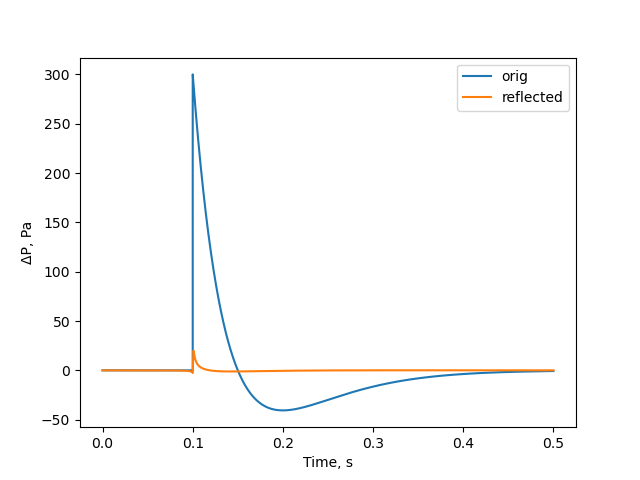
-


atmosphere.pyhas an impulse response function that I can convolve with the signal to obtain an attenuated signal.How to use the
reflection.pymodule?Thank you.
Best,
Danylo