Repository navigation
Implement peer-discovery interface #222
Description

As per https://github.com/libp2p/interface-peer-discovery
This interface would be implemented by:
- mdns
- bootstrap
- random walk (does this currently exist in go-libp2p?)
- in the future: webrtc, ...
Activity
vyzo commentedon Aug 29, 2017
do we want this to be dht based?
It could be the solution to the generalized rendezvous problem, and be usable for pubsub, relay, etc
Kubuxu commentedon Aug 29, 2017
Additional provider of peer-discovery is "old peers". This way we could make the network independent from the bootstrap nodes after first run.
daviddias commentedon Aug 29, 2017
DHT is Peer Routing + Content Routing. Read:
Peer Discovery is things like MulticastDNS or Bootstrap. Read:
Yeah, we can have a resurrect Peer Discovery that knows how to store to disk old peers and then brings them back on node boot. 👍 👍
deckbsd commentedon Feb 22, 2018
Hello everybody,
If i understand correctly, does that mean that actually from a go-libp2p peer i can't try to find some other peers ? that's why i was wondering how, when i start a host i can't make that host to connect to any other nodes. Because actually in the examples, each nodes are created like in client/server basic model (the client know the ip of the "server"(an other node that it can communicate with). m i wrong ?
Kubuxu commentedon Feb 23, 2018
No, finding peers works (it is sometimes difficult in case of complicated/layered NATs).
This issue is about internal go-libp2p interface allowing better code structure when it comes to peer discovery.
agahEbrahimi commentedon Apr 15, 2018
@Kubuxu Are there any examples of the peer discovery? I've been wandering around for 2-3 days trying to find an example and only found one in JS https://github.com/libp2p/js-libp2p/tree/master/examples/discovery-mechanisms which was also mentioned above, but none in go.
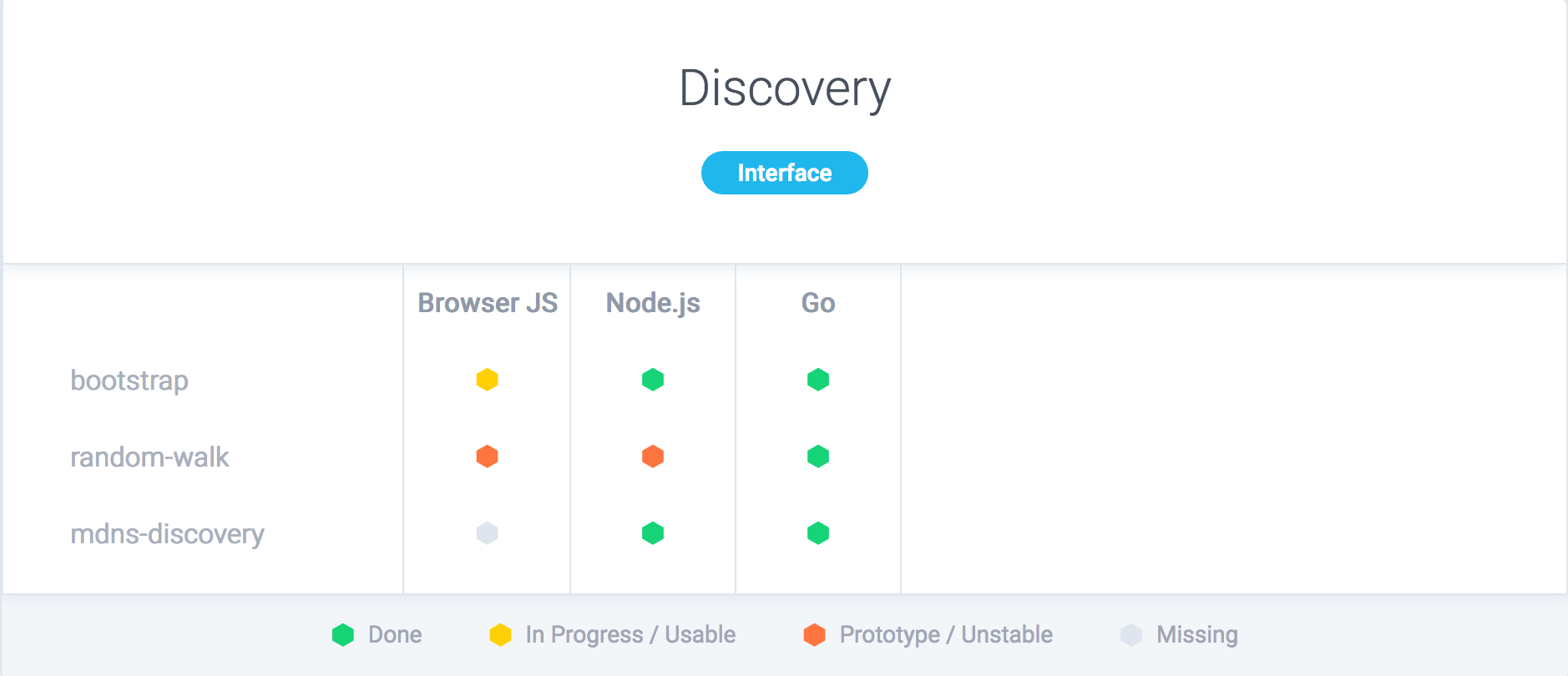
Even though the website says that they are all complete in go.
Thank you
Kubuxu commentedon Apr 17, 2018
@agahEbrahimi most of them should work by default. We are working on clearing up the bootstraping but for an example you can look here: #302
Random walk (DHT) should work by default and so should mdns AFAIK.
daviddias commentedon Nov 5, 2019
Can someone point me to an up to date example of how to enable/disable random-walk in go-libp2p?
daviddias commentedon Nov 5, 2019
Just did a quick "chase the PR" exercised and discovered that:
Still looking for random-walk
aschmahmann commentedon Nov 5, 2019
@daviddias Would the
DisableAutoBootstrapkad option help?https://github.com/libp2p/go-libp2p-kad-dht/blob/4fd64988b55d6e93405eceffeb3037da46d1848b/opts/options.go#L155
daviddias commentedon Nov 5, 2019
@aschmahmann I would say no but given that there is a bunch of terms that are overloaded, the best is for me to clarify my intent: What I want to achieve is to enable/disable the routine that searches the DHT for a random peer (most likely that doesn't exist) with the purpose of refreshing the routing tables. Is there a way to enable/disable this (known in the P2P literature as random-walk)?
aschmahmann commentedon Nov 5, 2019
Why do you think that it's not enough? The comments at https://github.com/libp2p/go-libp2p-kad-dht/blob/4fd64988b55d6e93405eceffeb3037da46d1848b/dht_bootstrap.go#L48 seem to imply that it's exactly what you're asking for.
yusefnapora commentedon Nov 5, 2019
@daviddias I think from reading through the kad bootstrap code a bit, that "bootstrap" in the context of the libp2p kad DHT does mean random-walk.
It looks like by default it does a query for a random peer id in each bucket that hasn't been refreshed within some interval, plus a periodic query for our own id.
If you set the
DisableAutoBootstrapoption that @aschmahmann mentioned, it looks like it won't do the bootstrapping on a periodic timer, but it would still be possible to manually trigger the bootstrap process by calling theBootstrapmethod.daviddias commentedon Nov 5, 2019
Aaaaaaah!!! Ok, so in go-libp2p bootstrap gets used for:
How does it actually achieve this? Given that we sha2-256 the peerIds for the Kad Routing Table in our DHT implementation, one would actually have to brute force to find another PeerId that would fall within a specific k-bucket.
Anyhow, given that random-walking is walking randomly over new ways, most k-buckets will get somewhat refreshed along the way.
Thank you! This is exactly what I needed. ❤️ @aschmahmann @yusefnapora
aschmahmann commentedon Nov 5, 2019
Sooo.... funny story about that we basically pre-brute force 1 per bucket for the first 16 buckets.
Precomputed buckets: https://github.com/libp2p/go-libp2p-kbucket/blob/8b77351e0f784a5f71749d23000897c8aee71a76/bucket_prefixmap.go#L4
Reasoning: https://github.com/libp2p/go-libp2p-kbucket/pull/38/files#r309983750
daviddias commentedon Nov 5, 2019
🤯
Clever though!
daviddias commentedon Nov 5, 2019
@aschmahmann @yusefnapora your tips worked like a charm testground/testground@c874df0 . Thank you! ❤️
aarshkshah1992 commentedon Nov 6, 2019
For posterity:
@aschmahmann's suggestion is bang on. Please refer to this writeup for a good explanation on how to use the "Dht random walk"/"Dht refresh" feature.
melroy89 commentedon Mar 9, 2025
These very old issues from 2019 can be closed, right? Are these all still relevant?