Repository navigation
Dependency graph design #1566
Description

I want to capture here some thoughts about the Dependency graph (see #1409).
One of the main challenges is the dynamic aspects of a query (type conditions).
For exampel for this schema:
type Query{
    node: Node
}
interface Animal {
    name: String
    friends: [Friend]
}

union Pet = Dog | Cat

type Friend {
    name: String
    isBirdOwner: Bool
    isCatOwner: Bool
    pets: [Pet]
}

type Bird implements Animal {
   name: String
   friends: [Friend]
}

type Cat implements Animal{
   name: String
   friends: [Friend]
   breed: CatBreed
}

type Dog implements Animal{
   name: String
   breed: DogBreed
   friends: [Friend]
}

scalar DogBreed
scalar CatBreed
one can imagine this query:
{
  node
  ... on Cat {
    friends {
      isCatOwner
      name
      pets {
        name
        ... on Cat {
          breed
        }
      }
    }
  }
  ... on Bird {
    name
    friends {
      isBirdOwner
      name
      pets {
        name
        ... on Dog {
          breed
        }
      }
    }
  }
  ... on Dog {
    name
  }
}
The question is now how the dependency graph should capture these dynamic type conditions.
One possible way could be this:

But the value of this kind of dependency graph maybe limited because it doesn't uphold to one fundamental expectation that every field is only present once.
The /node/friends/pets/name field is duplicated because it will only be executed if we have a Bird or a Cat, but not for a Dog.
Same is true for /node/friends/pets and /node/friends/name.
The alternative could maybe look like this:

It doesn't duplicate any fields anymore but now there are complex conditions associated with some nodes. For example /node/friends/pets/breed will only be evaluated if the original node is a Cat and the pet is a Dog.
Activity
andimarek commentedon Jun 10, 2019
@gkesler @exbe I would appreciate your thoughts ... thanks
gkesler commentedon Jun 10, 2019
@andimarek
Here is yet another alternative to executing query above.
For the convenience I have color coded nodes that have some condition/predicate in yellow and the nodes without conditions in blue.
When yellow nodes are being resolved, i.e. when these nodes are being visited after all their dependencies have been resolved, the node's result is obtained by applying node's predicate to the source data. This is different from the blue nodes that obtain their result by invoking externally provided
resolvemethod.PS. It is possible, I think, to optimize the graph to look like your case #2 by combining yellow nodes predicates using boolean operations. However, that optimization wouldn't change the topological ordering mechanism, wile, probably, reduce number of elements in the sequence.
Topological ordering produces a sequence in which nodes need to be evaluated.
Here is simplified pseudo-code. I've made it in 2 nested loops for simplicity. In reality there shall be a breadth-first walk over adjacency sets of source nodes (whose dependencies have been resolved) in order to achieve the maximum efficiency in the query execution.
Let's see how topological sorting (that's why we need dependency graph here) applies to the example query:
isInstanceOf("Cat")on [Cat("Lola"), Bird("Coco"), Dog("Molly")])isInstanceOf("Bird")on [Cat("Lola"), Bird("Coco"), Dog("Molly")])isInstanceOf("Dog")on [Cat("Lola"), Bird("Coco"), Dog("Molly")])isInstanceOf("Cat")on [Cat("Lola"), Dog("Molly")])isInstanceOf("Dog")on [])Auto resolve mechanism allows to obtain node's result without going after the associated resolver or data fetcher, directly from the data already resolved/cached in the graph.
gkesler commentedon Jun 10, 2019
and ah, I've forgotten to answer the question about field duplication. I think inclusion of "conditional" nodes into the graph will disambiguate what seem to be field duplications.
I would argue that in your example with
/node/friends/pets/nameduplication, there is no duplication at all, since the paths are different:/node/on Cat/friends/pets/name/node/on Bird/friends/pets/nameexbe commentedon Jun 11, 2019
@andimarek Do you have some particular resolvers on your mind for this example?
I might be overthinking, but dependency graph with resolvers for
Dog,CatandBirdmight look different from dependency graph with just two resolvers. One forAnimaland another one forAnimalwith breed. Yes, I am throwing in yet another use case about query optimization. I don't have a good answer whenever generating fully-blown super generic dependency graph (to serve ALL use cases) is better than generating specialized and reduced graph which would consider runtime/execution behaviour during resolution of a given request.Also, pardon my knowledge for GraphQ SDL, but following schema looks slightly off (spec). Is it or it just my misunderstanding?
gkesler commentedon Jun 11, 2019
I guess I have after all slightly modified the original requirement and provided solution to the query where
nodefield is resolved to array ofAnimals:)That's how all 3 variants come together in 1 query.
In case "node" query is resolved to a single object, that result is just converted into a
singletonListand in step 1. and the rest of steps are executed as they are described above.andimarek commentedon Jun 29, 2019
@exbe you are right about the Schema, I fixed it.
andimarek commentedon Jun 29, 2019
After giving it some thought I think we have two different dependencies: one dependency is the
sourceinput which means another field/node is required to be resolved before and then we have another dependencytypewhich acts as predicate (similar to the yellow nodes above).The first dependency is something that can be optimized/changed by the engine. The second dependency can't be changed because it is an external observable property, which can't be changed.
Example:
schema:
query:
{ issues {
	author {
	   name
   		... on User {
   			createdIssues {
	   			id
				}
		}
	}
}}
This modeling allows us to do the following optimization:
gkesler commentedon Jun 30, 2019
I am with you on the different kind of dependencies and the optimization scenarios.
Not sure I yet follow the example, perhaps because the schema and the query do not match.
Issuetype needs to have a fieldauthor : User, doesn't it?Could you please elaborate on how have you come up with the
createdIssueshaving happens-before (source) dependency onissues?Indeed, dependencies are different:
happens-before(source) dependencies are known at the graph building time and depend only on the schema semantics, i.e. relationships between objects, ID fields, etc.conditionaldependencies have predicates that are evaluated at the execution time based on the results of previous executions. They are built into the graph ashappens-beforebut evaluated conditionally.PS. One can treat
happens-beforedependencies asconditionalones with always true predicate.I've been also thinking that expressing dependencies between fields in a form of graph would allow not only the engine to perform optimizations, but also it will let the client to optimize the execution, if for instance the pre-built dependency graph is provided as an argument to the
Instrumentationbefore the execution starts, the client can optimized it according to his or her knowledge of the schema semantics.andimarek commentedon Jun 30, 2019
@gkesler you are right: I fixed the schema.
The reason why
createdIssuescould only depend onissuesis: lets imagine you query allissuesby making one external call (DB, service, whatever). You get back a list ofissueswith each Issue having anauthorId.To get an actual
authoryou need to make an extra call, but you could get the list of issues for anauthorbefore that because you only need theauthorId, not the fullUserobject. This is why you could indicate to the engine (in the example above via directive in the schema) thatcreatedIssuesonly need anIssueas input (because it contains theauthorId, which is all you need). Does that makes sense?gkesler commentedon Jul 1, 2019
@andimarek yes, it does. I just think that this is exactly a semantic aspect of the schema, without client's help we won't be able to make this kind of optimizations. Directives will certainly help. The more scenarios like this we can think of and provide directions for, the more automatic optimizations we can make without the client to modify/optimize the graph manually.
Similar scenario would be this:
Regular and optimized queries look this way:
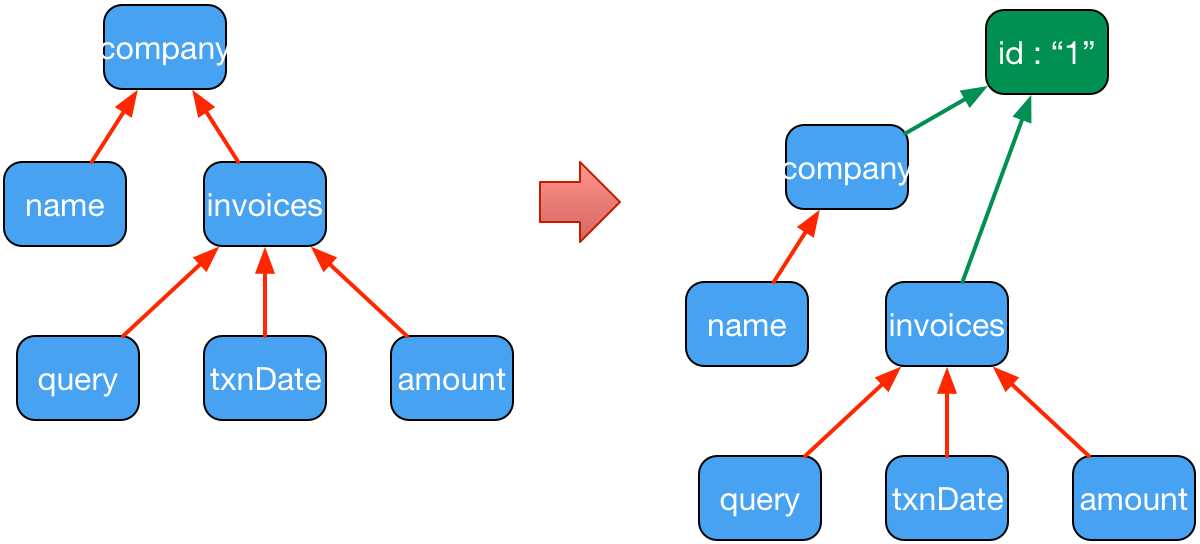
The regular query causes 2 sequential remote calls:
In order to fetch Invoices all we need to have is foreign key to the Company, which is actually provided as the
idargument to thecompanyfield. Therefore we should be able to optimize overall query performance by making these 2 remote calls in parallel."green" node represents a graph node created for the argument
id. Fieldcompanycertainly depends on it, that argument must be provided with the query. Sinceinvoicesdepends on sourcecompanyand in particular its fieldid(foreign key),companyargument with matching name could be used to change dependency frominvoices->companytoinvoices->id=1.andimarek commentedon Jul 8, 2019
After giving it some more thought and actually implementing it/spiking it, I come up with a design where each node represents always a field of an object type. Fragments/type condition/field on interfaces are all resolved to fields on object types. At execution time only object types matter and which interfaces/union is implemented by which object is statically known by the schema definition.
I created also a small interactive page to play around/visualize this: https://www.graphql-analyzer.com/
A PR which adds this dependency graph to GraphQL Java will follow.
gkesler commentedon Jul 8, 2019
@andimarek absolutely, thanks!
please, let me know if I can contribute to your PR.
Are you still waiting for the DependencyGraph itself?
A quick question on the visualizer.
in query
{
  pets {
    name
    ... on Dog {
      dogFriends {
        name
      }
    }
  }
}
field
nameis declared on the interfacePet. Therefore I would expect that nodesCat.nameandDog.namehad unconditional dependencies onQuery.petsrather than conditional ones. The only true conditional dependency I think isDog.dogFriendsonQuery.pets.andimarek commentedon Jul 9, 2019
@gkesler maybe the explanation is not really clear, what I mean is:
Whether
Dog.name,Dog.dogFriendsorCat.namewill be resolved depends on the actual type returned byQuery.pets. IfQuery.petscontains aDogthenDog.nameandDog.friendswill be resolved. If it contains aCat,Cat.namewill be resolved.On the other hand we know that
Dog.dogFriendsalways returnsDog, soDog.namewill always be resolved for that (except of course null values, which is not relevant regarding conditional or not).gkesler commentedon Jul 9, 2019
Thanks for the quick response, @andimarek
I think checking conditions
Dog.nameorCat.namedepending on the returned pet type is quite redundant, especially if they are all checked at the runtime. Imagine there are more types that implement interfacePetand for each of them the similar condition is checked. I think this redundancy could be removed if instead of nodesDog.nameandCat.namethere was a nodePet.namethat would be resolved if the source type isPet, which is always true in this case.This way node
Query.petscould have only two dependents:Pet.namewithalways truepredicate since the source is always instance of interfacePetDog.dogFriendswith predicate that returnstrueonly if the source is instance of typeDogandimarek commentedon Jul 10, 2019
@gkesler I made the explicit decision to only represent object types fields in the dependency graph.
For once because at the end you have to determine the type anyway: Even if you have an Interface like
Petyou still need to determine the object at execution time to get theDataFetcherfrom the object type.Also because it is overall simpler to reason about. (for humans at least)
Not saying it is perfect or it must be alway this way. I am sure there are variations of the graph, maybe depending on the use case.
andimarek commentedon Jul 10, 2019
@gkesler as another side note: I would suggest that we close this issue and continue on the PR #1594 once it progressed a bit. Because it is kinda hard to think about all the edge cases without actual code.
gkesler commentedon Jul 10, 2019
@andimarek
I have no objections, let's move on.
andimarek commentedon Jul 11, 2019
closing this now ... thanks a lot @gkesler @exbe for the valuable discussion!