| comments | true | |||||
|---|---|---|---|---|---|---|
| difficulty | Medium | |||||
| edit_url | https://github.com/doocs/leetcode/edit/main/solution/0800-0899/0865.Smallest%20Subtree%20with%20all%20the%20Deepest%20Nodes/README_EN.md | |||||
| tags |
|
Given the root of a binary tree, the depth of each node is the shortest distance to the root.
Return the smallest subtree such that it contains all the deepest nodes in the original tree.
A node is called the deepest if it has the largest depth possible among any node in the entire tree.
The subtree of a node is a tree consisting of that node, plus the set of all descendants of that node.
Example 1:
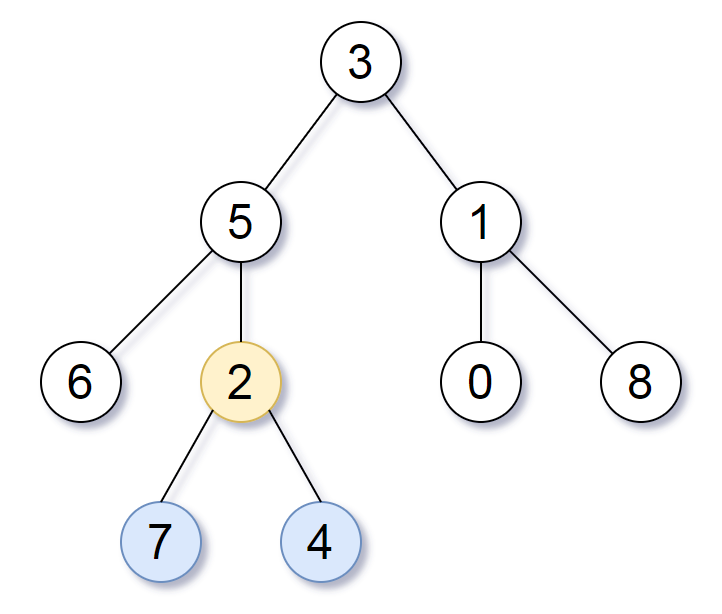
Input: root = [3,5,1,6,2,0,8,null,null,7,4]
Output: [2,7,4]
Explanation: We return the node with value 2, colored in yellow in the diagram.
The nodes coloured in blue are the deepest nodes of the tree.
Notice that nodes 5, 3 and 2 contain the deepest nodes in the tree but node 2 is the smallest subtree among them, so we return it.
Example 2:
Input: root = [1]
Output: [1]
Explanation: The root is the deepest node in the tree.
Example 3:
Input: root = [0,1,3,null,2]
Output: [2]
Explanation: The deepest node in the tree is 2, the valid subtrees are the subtrees of nodes 2, 1 and 0 but the subtree of node 2 is the smallest.
Constraints:
- The number of nodes in the tree will be in the range
[1, 500]. 0 <= Node.val <= 500- The values of the nodes in the tree are unique.
Note: This question is the same as 1123: https://leetcode.com/problems/lowest-common-ancestor-of-deepest-leaves/
We design a function
The execution process of the function
- If
$\textit{root}$ is null, return$\text{null}$ and$0$ . - Otherwise, recursively calculate the smallest subtree and depth of the left and right subtrees of
$\textit{root}$ , denoted as$l$ and$l_d$ , and$r$ and$r_d$ , respectively. If$l_d > r_d$ , then the smallest subtree containing all the deepest nodes in the subtree rooted at the left child of$\textit{root}$ is$l$ , with a depth of$l_d + 1$ . If$l_d < r_d$ , then the smallest subtree containing all the deepest nodes in the subtree rooted at the right child of$\textit{root}$ is$r$ , with a depth of$r_d + 1$ . If$l_d = r_d$ , then$\textit{root}$ is the smallest subtree containing all the deepest nodes, with a depth of$l_d + 1$ .
Finally, return the first element of the result of
The time complexity is
# Definition for a binary tree node.
# class TreeNode:
#     def __init__(self, val=0, left=None, right=None):
#         self.val = val
#         self.left = left
#         self.right = right
class Solution:
    def subtreeWithAllDeepest(self, root: Optional[TreeNode]) -> Optional[TreeNode]:
        def dfs(root: Optional[TreeNode]) -> Tuple[Optional[TreeNode], int]:
            if root is None:
                return None, 0
            l, ld = dfs(root.left)
            r, rd = dfs(root.right)
            if ld > rd:
                return l, ld + 1
            if ld < rd:
                return r, rd + 1
            return root, ld + 1

return dfs(root)[0]/**
* Definition for a binary tree node.
* public class TreeNode {
* int val;
* TreeNode left;
* TreeNode right;
* TreeNode() {}
* TreeNode(int val) { this.val = val; }
* TreeNode(int val, TreeNode left, TreeNode right) {
* this.val = val;
* this.left = left;
* this.right = right;
* }
* }
*/
class Solution {
public TreeNode subtreeWithAllDeepest(TreeNode root) {
return dfs(root).getKey();
}
private Pair<TreeNode, Integer> dfs(TreeNode root) {
if (root == null) {
return new Pair<>(null, 0);
}
var l = dfs(root.left);
var r = dfs(root.right);
int ld = l.getValue(), rd = r.getValue();
if (ld > rd) {
return new Pair<>(l.getKey(), ld + 1);
}
if (ld < rd) {
return new Pair<>(r.getKey(), rd + 1);
}
return new Pair<>(root, ld + 1);
}
}/**
* Definition for a binary tree node.
* struct TreeNode {
* int val;
* TreeNode *left;
* TreeNode *right;
* TreeNode() : val(0), left(nullptr), right(nullptr) {}
* TreeNode(int x) : val(x), left(nullptr), right(nullptr) {}
* TreeNode(int x, TreeNode *left, TreeNode *right) : val(x), left(left), right(right) {}
* };
*/
class Solution {
public:
TreeNode* subtreeWithAllDeepest(TreeNode* root) {
using pti = pair<TreeNode*, int>;
auto dfs = [&](this auto&& dfs, TreeNode* root) -> pti {
if (!root) {
return {nullptr, 0};
}
auto [l, ld] = dfs(root->left);
auto [r, rd] = dfs(root->right);
if (ld > rd) {
return {l, ld + 1};
}
if (ld < rd) {
return {r, rd + 1};
}
return {root, ld + 1};
};
return dfs(root).first;
}
};/**
* Definition for a binary tree node.
* type TreeNode struct {
* Val int
* Left *TreeNode
* Right *TreeNode
* }
*/
func subtreeWithAllDeepest(root *TreeNode) *TreeNode {
type pair struct {
node *TreeNode
depth int
}
var dfs func(*TreeNode) pair
dfs = func(root *TreeNode) pair {
if root == nil {
return pair{nil, 0}
}
l, r := dfs(root.Left), dfs(root.Right)
ld, rd := l.depth, r.depth
if ld > rd {
return pair{l.node, ld + 1}
}
if ld < rd {
return pair{r.node, rd + 1}
}
return pair{root, ld + 1}
}
return dfs(root).node
}/**
* Definition for a binary tree node.
* class TreeNode {
* val: number
* left: TreeNode | null
* right: TreeNode | null
* constructor(val?: number, left?: TreeNode | null, right?: TreeNode | null) {
* this.val = (val===undefined ? 0 : val)
* this.left = (left===undefined ? null : left)
* this.right = (right===undefined ? null : right)
* }
* }
*/
function subtreeWithAllDeepest(root: TreeNode | null): TreeNode | null {
const dfs = (root: TreeNode | null): [TreeNode, number] => {
if (!root) {
return [null, 0];
}
const [l, ld] = dfs(root.left);
const [r, rd] = dfs(root.right);
if (ld > rd) {
return [l, ld + 1];
}
if (ld < rd) {
return [r, rd + 1];
}
return [root, ld + 1];
};
return dfs(root)[0];
}