| list | ziplist (压缩列表) |
|---|---|
| quicklist (快速列表) |
在低版本的Redis 中, 链表 和 压缩列表 是 Redis list对象的底层实现方式,但是考虑到链表的附加空间相对很高,prev和next指针 就要占去16个字节(64bit系统的指针是8bytes), 另外每个节点的内存都是单独分配,会加剧内存的碎片化,影响内存管理效率。因此Redis 3.2 版本开始对列表数据结构进行了改造,使用 quicklist 代替了 ziplist 和 linkedlist.
双向链表
typedef struct listNode {
    struct listNode *prev;
    struct listNode *next;
    void *value;
} listNode;

typedef struct listIter {
    listNode *next;
    int direction;
} listIter;

typedef struct list {
    listNode *head;
    listNode *tail;
    void *(*dup)(void *ptr);
    void (*free)(void *ptr);
    int (*match)(void *ptr, void *key);
    unsigned long len;
} list;
Redis链表结构其主要特性如下:
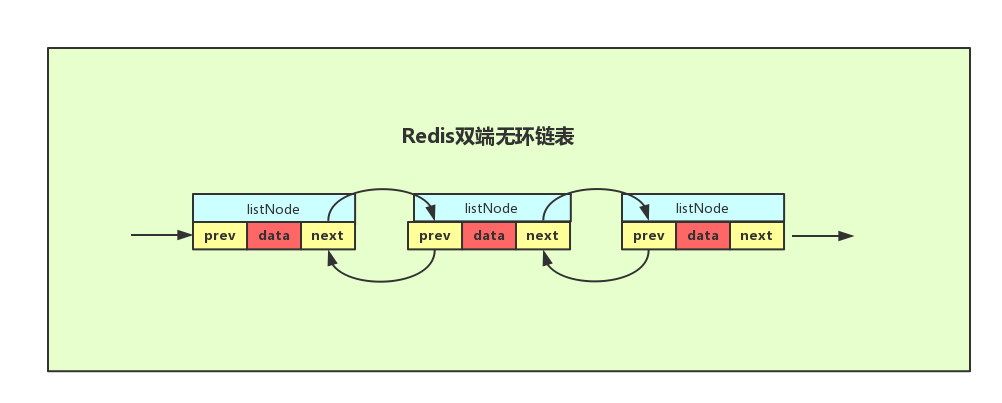
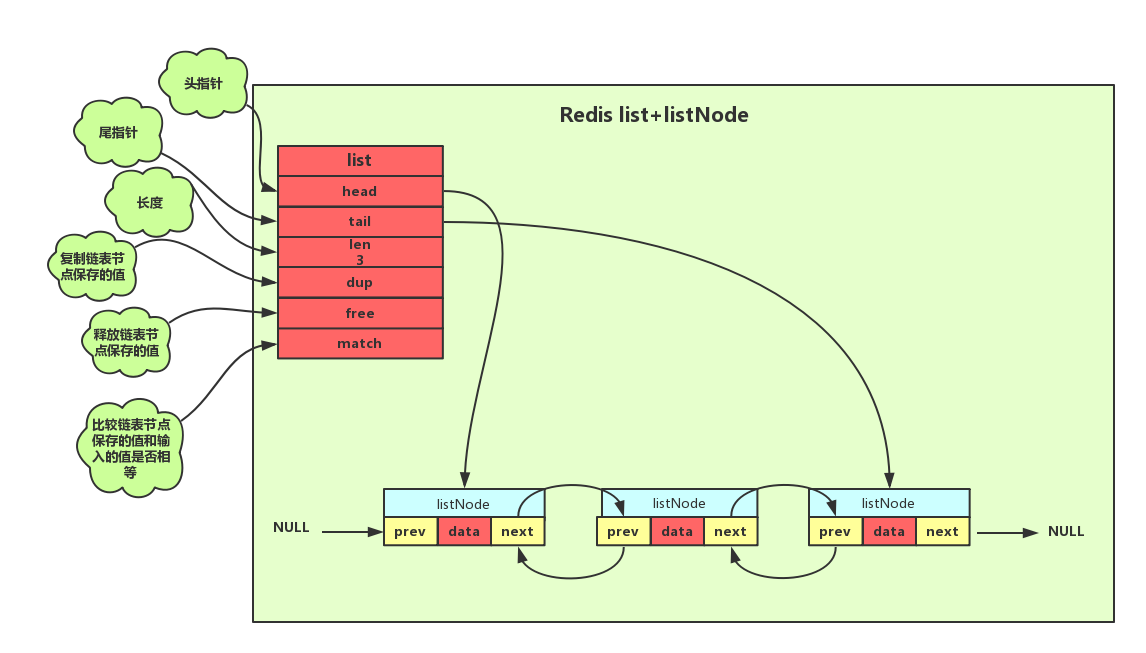
- 双向:链表节点带有前驱、后继指针获取某个节点的前驱、后继节点的时间复杂度为0(1)。
- 无环: 链表为非循环链表表头节点的前驱指针和表尾节点的后继指针都指向NULL,对链表的访问以NULL为终点。
- 带表头指针和表尾指针:通过list结构中的head和tail指针,获取表头和表尾节点的时间复杂度都为O(1)。
- 带链表长度计数器:通过list结构的len属性获取节点数量的时间复杂度为O(1)。
- 多态:链表节点使用void*指针保存节点的值,并且可以通过list结构的dup、free、match三个属性为节点值设置类型特定函数,所以链表可以用来保存各种不同类型的值。
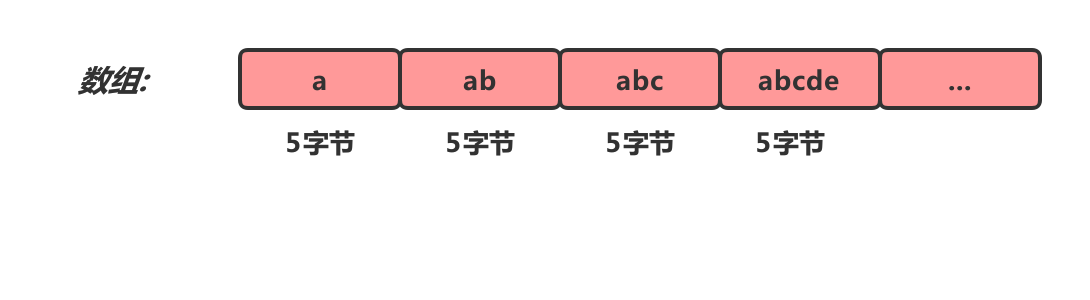
听到“压缩”两个字,直观的反应就是节省内存。之所以说这种存储结构节省内存,是相较于数组的存储思路而言的。我们知道,数组要求每个元素的大小相同,如果我们要存储不同长度的字符串,那我们就需要用最大长度的字符串大小作为元素的大小(假设是20个字节)。存储小于 20 个字节长度的字符串的时候,便会浪费部分存储空间。
数组的优势占用一片连续的空间可以很好的利用CPU缓存访问数据。如果我们想要保留这种优势,又想节省存储空间我们可以对数组进行压缩。
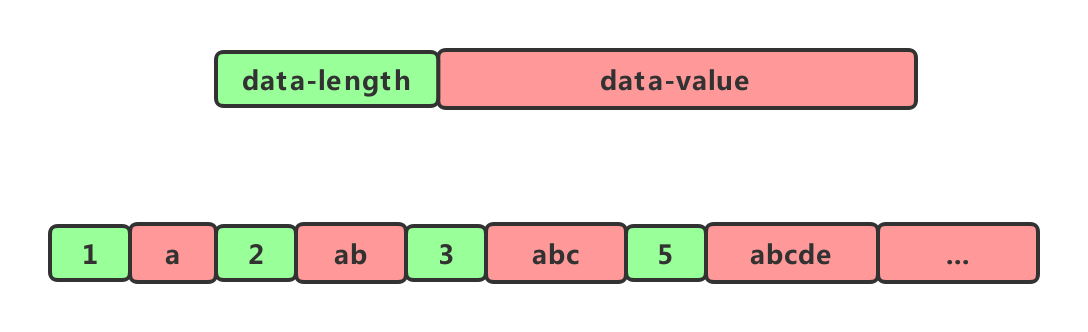
但是这样有一个问题,我们在遍历它的时候由于不知道每个元素的大小是多少,因此也就无法计算出下一个节点的具体位置。这个时候我们可以给每个节点增加一个lenght的属性。
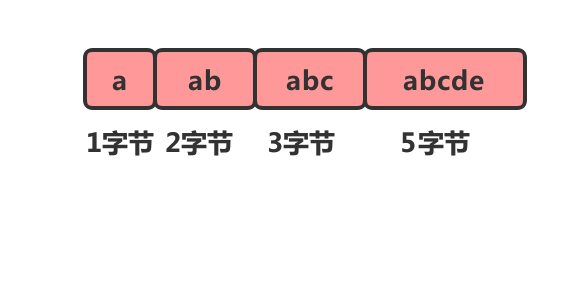
如此。我们在遍历节点的之后就知道每个节点的长度(占用内存的大小),就可以很容易计算出下一个节点再内存中的位置。这种结构就像一个简单的压缩列表了。
当一个列表只包含少量列表项,并且每个列表项要么就是小整数值,要么就是长度比较短的字符串,那么Redis就会使用压缩列表来做列表的底层实现;
/* Return total bytes a ziplist is composed of. */
#define ZIPLIST_BYTES(zl)       (*((uint32_t*)(zl)))

/* Return the offset of the last item inside the ziplist. */
#define ZIPLIST_TAIL_OFFSET(zl) (*((uint32_t*)((zl)+sizeof(uint32_t))))

/* Return the length of a ziplist, or UINT16_MAX if the length cannot be
 * determined without scanning the whole ziplist. */
#define ZIPLIST_LENGTH(zl)      (*((uint16_t*)((zl)+sizeof(uint32_t)*2)))

/* The size of a ziplist header: two 32 bit integers for the total
 * bytes count and last item offset. One 16 bit integer for the number
 * of items field. */
#define ZIPLIST_HEADER_SIZE     (sizeof(uint32_t)*2+sizeof(uint16_t))

/* Size of the "end of ziplist" entry. Just one byte. */
#define ZIPLIST_END_SIZE        (sizeof(uint8_t))

/* Return the pointer to the first entry of a ziplist. */
#define ZIPLIST_ENTRY_HEAD(zl)  ((zl)+ZIPLIST_HEADER_SIZE)

/* Return the pointer to the last entry of a ziplist, using the
 * last entry offset inside the ziplist header. */
#define ZIPLIST_ENTRY_TAIL(zl)  ((zl)+intrev32ifbe(ZIPLIST_TAIL_OFFSET(zl)))

/* Return the pointer to the last byte of a ziplist, which is, the
 * end of ziplist FF entry. */
#define ZIPLIST_ENTRY_END(zl)   ((zl)+intrev32ifbe(ZIPLIST_BYTES(zl))-1)

/* Increment the number of items field in the ziplist header. Note that this
 * macro should never overflow the unsigned 16 bit integer, since entries are
 * always pushed one at a time. When UINT16_MAX is reached we want the count
 * to stay there to signal that a full scan is needed to get the number of
 * items inside the ziplist. */
#define ZIPLIST_INCR_LENGTH(zl,incr) { \
    if (ZIPLIST_LENGTH(zl) < UINT16_MAX) \
        ZIPLIST_LENGTH(zl) = intrev16ifbe(intrev16ifbe(ZIPLIST_LENGTH(zl))+incr); \
}

/* We use this function to receive information about a ziplist entry.
 * Note that this is not how the data is actually encoded, is just what we
 * get filled by a function in order to operate more easily. */
typedef struct zlentry {
    //prevrawlen 前驱节点的长度
    //prevrawlensize 编码前驱节点的长度prevrawlen所需要的字节大小
    unsigned int prevrawlensize; /* Bytes used to encode the previous entry len*/
    unsigned int prevrawlen;     /* Previous entry len. */

    //len 当前节点值长度
    //lensize 编码当前节点长度len所需的字节数
    unsigned int lensize;        /* Bytes used to encode this entry type/len.
                                    For example strings have a 1, 2 or 5 bytes
                                    header. Integers always use a single byte.*/
    unsigned int len;            /* Bytes used to represent the actual entry.
                                    For strings this is just the string length
                                    while for integers it is 1, 2, 3, 4, 8 or
                                    0 (for 4 bit immediate) depending on the
                                    number range. */
    //当前节点header的大小 = lensize + prevrawlensize
    unsigned int headersize;     /* prevrawlensize + lensize. */

    //当前节点的编码格式
    unsigned char encoding;      /* Set to ZIP_STR_* or ZIP_INT_* depending on
                                    the entry encoding. However for 4 bits
                                    immediate integers this can assume a range
                                    of values and must be range-checked. */
    unsigned char *p;//指向 开始的entry指针            /* Pointer to the very start of the entry, that
                                    is, this points to prev-entry-len field. */
} zlentry;
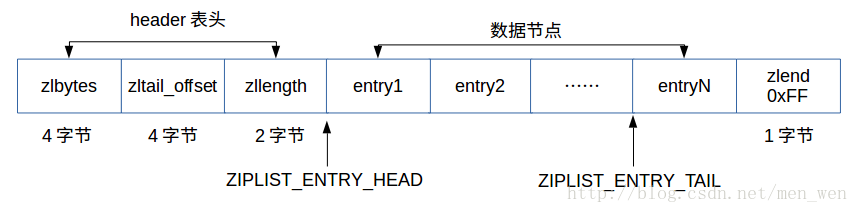
压缩列表是Redis为了节约内存而开发的,是由一系列特殊编码的连续内存块组成的顺序型(sequential)数据结枃。一个压缩列表可以包含任意多个节点(entry),每个节点可以保存一个字节数组或者一个整数值,如下图。
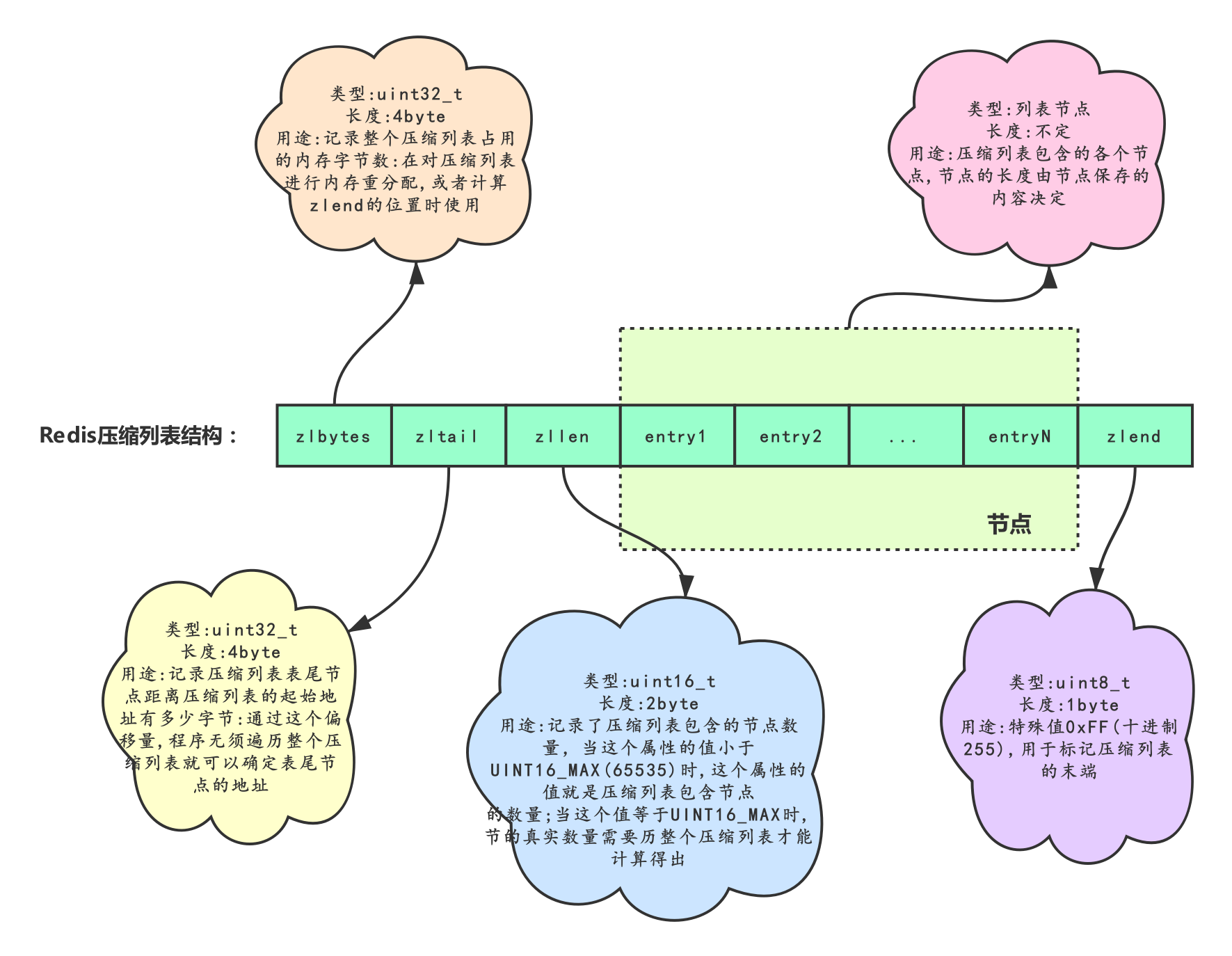
虽然定义了这个zlentry结构体,但是根本就没有使用zlentry结构来作为压缩列表中用来存储数据节点中的结构,但是。因为,这个结构存小整数或短字符串实在是太浪费空间了。这个结构总共在32位机占用了28个字节(32位机),在64位机占用了32个字节。这不符合压缩列表的设计目的:提高内存的利用率。因此,在redis中,并没有定义结构体来进行操作,也是定义了一些宏,压缩列表的节点真正的结构如下图所示:

previous_entry_length__成员实际上就是zlentry结构中prevrawlensize,和prevrawlen这两个成员的压缩版
用于存储上一个节点的长度,因此压缩列表可以从尾部向头部遍历,即当前节点位置减去上一个节点的长度即得到上一个节点的起始位置。
节点的 previous_entry_length属性以字节为单位,记录了压缩列表中前一个节点的长度。 previous_entry_length属性的长度可以是1字节或者5字节。
- 如果前一节点的长度小于254,那么 previous_entry_length属性的长度为1字节(8bits , 2^8=256),前一节点的长度就保存在这一个字节里面。
- 如果前一节点的长度大于等于254,那么 previous_entry_length属性的长度为5字节:其中属性的第一字节会被设置为0xFE(十进制值254),后四个字节才是真正保存前驱节点的长度值。
因为,对于访问的指针都是char 类型,它能访问的范围1个字节,如果这个字节的大小等于0xFE,那么就会继续访问四个字节来获取前驱节点的长度,如果该字节的大小小于0xFE,那么该字节就是要获取的前驱节点的长度。因此这样就使prev_entry_len同时具有了prevrawlen和prevrawlensize的功能,而且更加节约内存。
举例说明下逻辑:(转载:http://redisbook.com/preview/ziplist/node.html)
图 7-5 展示了一个包含一字节长 previous_entry_length 属性的压缩列表节点, 属性的值为 0x05 , 表示前一节点的长度为 5 字节。
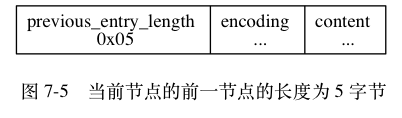
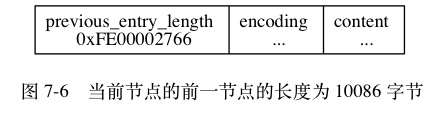
图 7-6 展示了一个包含五字节长 previous_entry_length 属性的压缩节点, 属性的值为 0xFE00002766 , 其中值的最高位字节 0xFE 表示这是一个五字节长的 previous_entry_length 属性, 而之后的四字节 0x00002766 (十进制值 10086 )才是前一节点的实际长度。
每个压缩列表节点可以保存一个字节数组或者一个整数值
- 字节数组可以是以下三种长度中的一种
- 长度小于等于63(2^6-1)字节的字节数组;
- 长度小于等于16383(2^14-1)字节的字节数组
- 长度小于等于4294967295(2^32-1)字节的字节数组
- 整数值可以是以下6种长度中的一种
- 4位长,介于0至12之间的无符号整数
- 1字节长的有符号整数
- 3字节长的有符号整数
- int16_t类型整数
- int32_t类型整数
- int64_t类型整数
http://redisbook.com/preview/ziplist/node.html
https://zhuanlan.zhihu.com/p/71880195
https://blog.csdn.net/men_wen/article/details/70176753