

Easy
Given the root of a binary tree, return its maximum depth.
A binary tree's maximum depth is the number of nodes along the longest path from the root node down to the farthest leaf node.
Example 1:
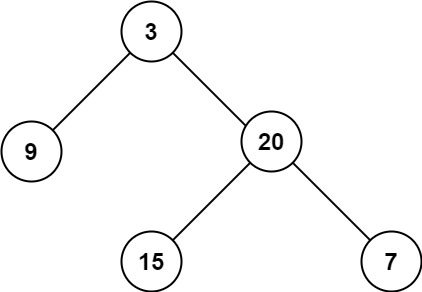
Input: root = [3,9,20,null,null,15,7]
Output: 3
Example 2:
Input: root = [1,null,2]
Output: 2
Example 3:
Input: root = []
Output: 0
Example 4:
Input: root = [0]
Output: 1
Constraints:
- The number of nodes in the tree is in the range
[0, 104]. -100 <= Node.val <= 100
To solve the "Maximum Depth of Binary Tree" problem in Python with a Solution class, we'll perform a depth-first search (DFS) traversal of the binary tree. Below are the steps:
-
Create a
Solutionclass: Define a class namedSolutionto encapsulate our solution methods. -
Create a
maxDepthmethod: This method takes the root node of the binary tree as input and returns its maximum depth. -
Check for null root: Check if the root is null. If it is, return 0 as the depth.
-
Perform DFS traversal: Recursively compute the depth of the left and right subtrees. The maximum depth of the binary tree is the maximum depth of its left and right subtrees, plus 1 for the current node.
-
Return the result: After the DFS traversal is complete, return the maximum depth of the binary tree.
Here's the Python implementation:
# Definition for a binary tree node.
# class TreeNode:
#     def __init__(self, val=0, left=None, right=None):
#         self.val = val
#         self.left = left
#         self.right = right
class Solution:
    def maxDepth(self, root: Optional[TreeNode]) -> int:
        if root is None:
            return 0
        return 1 + max(
            self.maxDepth(root.left),
            self.maxDepth(root.right),
        )
This implementation follows the steps outlined above and efficiently computes the maximum depth of the binary tree in Python using DFS traversal.