I hope this is the right place to open this issue, as it's something that affects all d3-* packages as well as d3 itself. Please redirect me if not!
I've created a repo to provide a playground (where you can for example npm link a copy of d3-dsv with the proposed changes to see it working); this issue is a copy of that repo's README.
As of Node 12 (which is to say all maintained Node versions bar 10, which reaches EOL in April), it's possible for a Node project to use native JavaScript modules by adding the following to package.json:
Let's say you're making such a project, and you want to use (say) d3-dsv, and for extra points you're using TypeScript, so that your package.json looks like this...
{
  "devDependencies": {
    "@types/d3-dsv": "^2.0.1",
    "@types/node": "^14.14.28",
    "typescript": "^4.1.5"
  },
  "dependencies": {
    "d3-dsv": "^2.0.0"
  },
  "type": "module"
}
...and your tsconfig.json looks like this:
{
  "compilerOptions": {
    "allowJs": true,
    "moduleResolution": "node",
    "noEmit": true
  }
}
In a JavaScript file, which has // @ts-check at the top to enable typechecking, you import d3-dsv but discover that TypeScript yells at you:
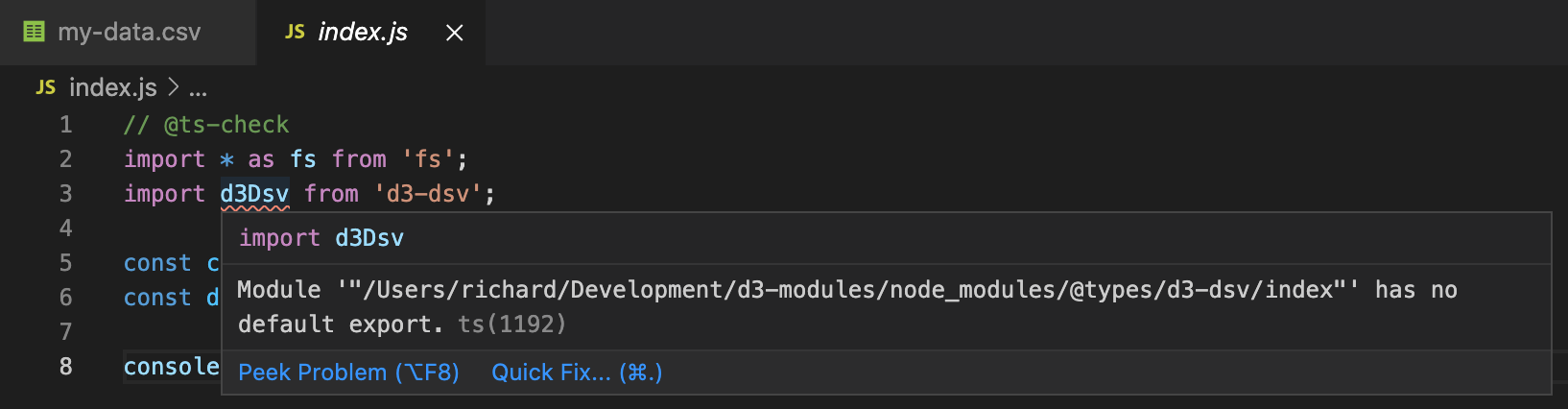
According to @types/d3-dsv, there's no default export — you need to use named imports instead. So we switch to using a * import, and now we get nice autocomplete...
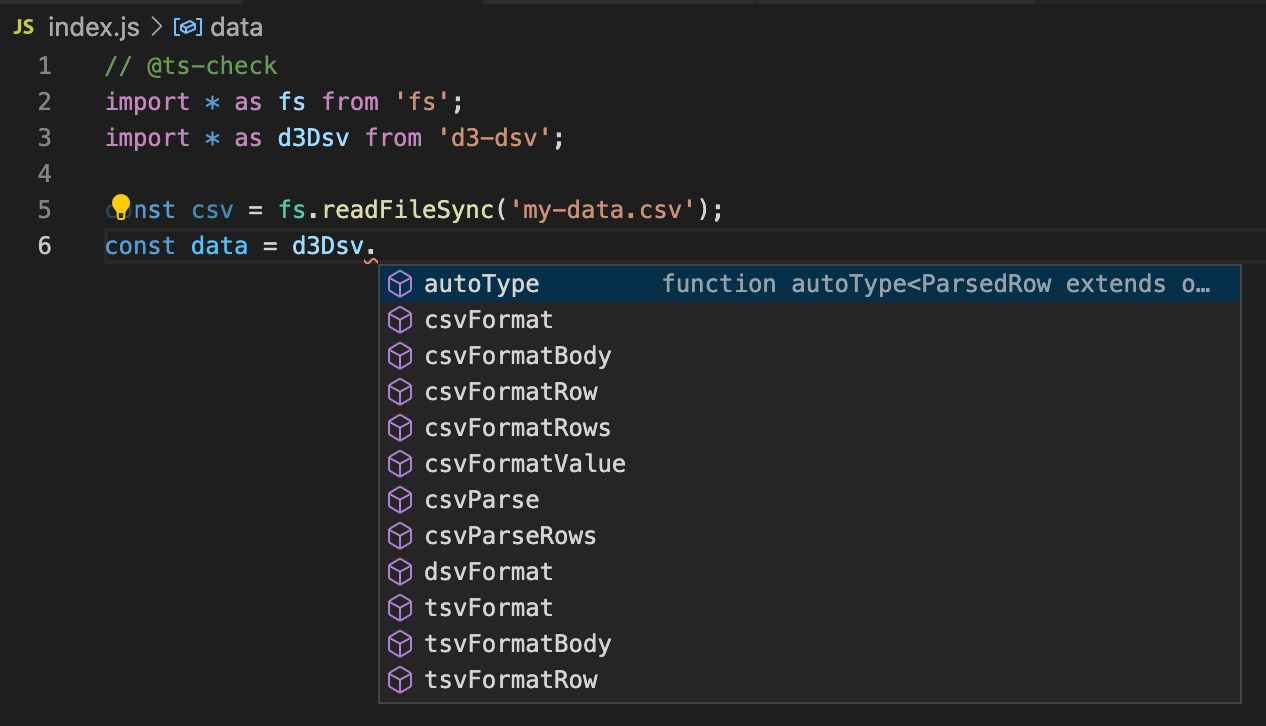
...and typechecking:

But when we run the program, it fails:
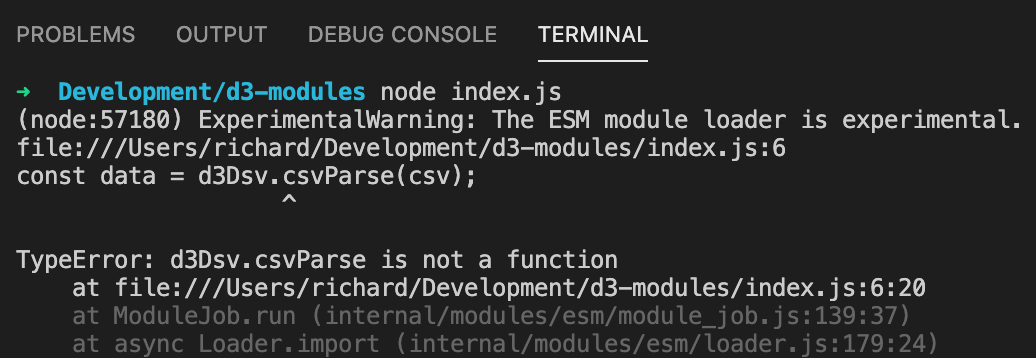
That's because Node believes that d3-dsv is a CommonJS package. When CommonJS is imported from ESM, Node treats module.exports as the default export. In other words, @types/d3-dsv disagrees with d3-dsv itself about what it exports.
It's not just TypeScript though — d3-dsv disagrees with itself about its exports. That's because (like all D3 packages) it follows the well-established convention of providing both pkg.main and pkg.module...
{
  "main": "dist/d3-dsv.js",
  "module": "src/index.js"
}
...which means that Node can ingest the CommonJS distributable version, while bundlers like Rollup ingest the modern source code. These bundlers, like TypeScript, expect to find named exports:
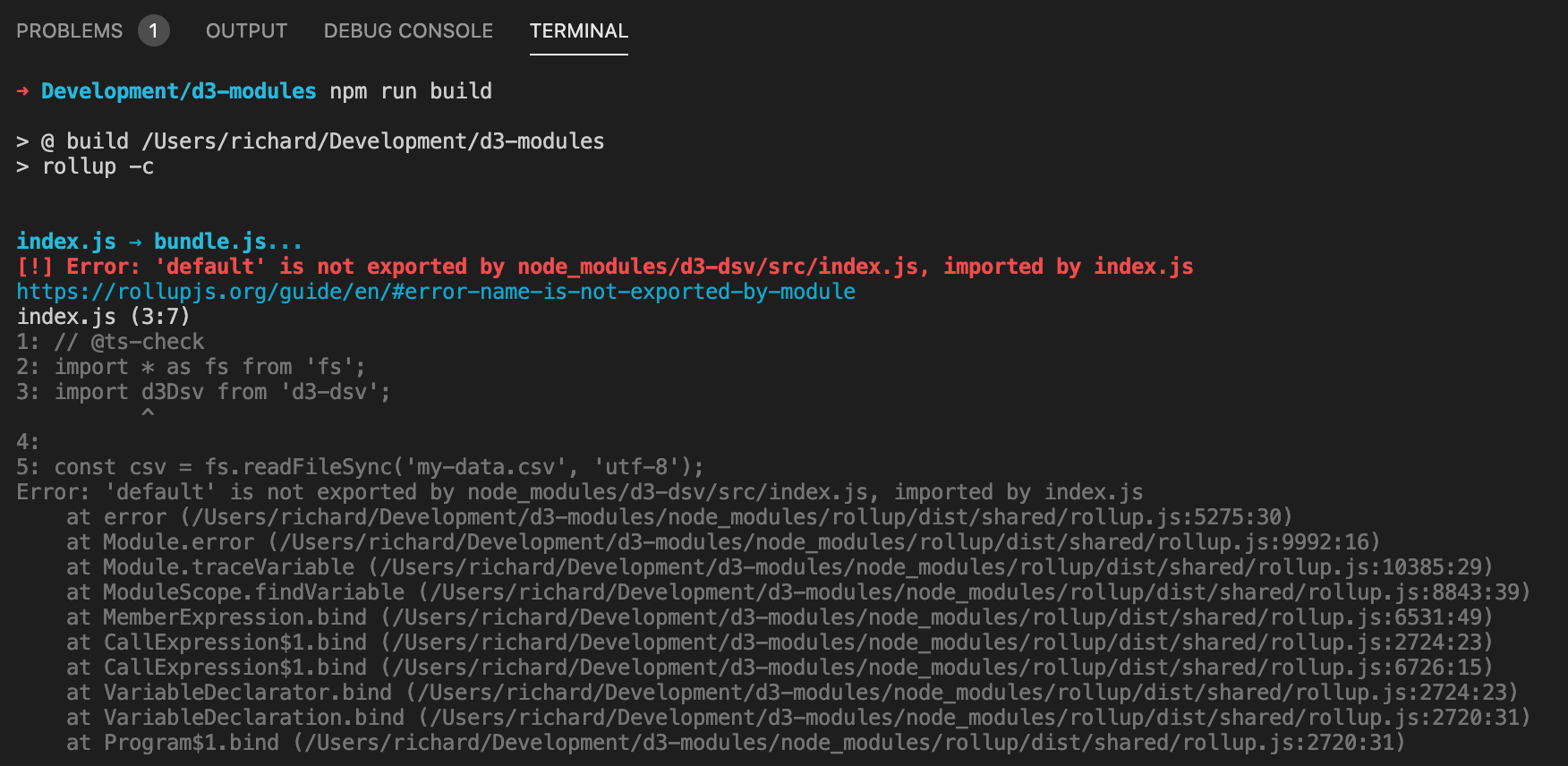
In other words, if you're using native JavaScript modules, you have a choice: you can write D3 programs that run in Node, or you can write D3 programs that typecheck and can be bundled. You can't do both.
We can fix this!
Luckily this is easily solved, with one small caveat: we add "type": "module" to the package.json files in each package, alongside "exports" (which is how Node resolves e.g. d3-dsv to node_modules/d3-dsv/src/index.js):
  "main": "dist/d3-dsv.js",
  "unpkg": "dist/d3-dsv.min.js",
  "jsdelivr": "dist/d3-dsv.min.js",
  "module": "src/index.js",
+ "type": "module",
+ "exports": {
+   "./package.json": "./package.json",
+   "import": "./src/index.js",
+   "require": "./dist/d3-dsv.js"
+ },
  "bin": {
A new file, dist/package.json, allows the existing dist/*.js files to continue being treated as CommonJS (i.e. this cancels out the "type": "module":
(In future, it might even be possible to get rid of the dist folder once native modules are universally adopted alongside import maps etc, but I'm not suggesting that any time soon given how D3 is used in the wild.)
The caveat is that this is technically a breaking change requiring a semver major release, since someone might currently be using these packages via import and would expect to be able to continue using the default import. We're talking about fairly extreme early adopters who can probably adapt very easily, and you could argue that the current behaviour is buggy and therefore can be fixed in a patch version. But if it was deemed necessary to support those users, it could be done in a non-breaking way by adding a default export alongside the named exports. For example:
-export {default as dsvFormat} from "./dsv.js";
-export {csvParse, csvParseRows, csvFormat, csvFormatBody, csvFormatRows, csvFormatRow, csvFormatValue} from "./csv.js";
-export {tsvParse, tsvParseRows, tsvFormat, tsvFormatBody, tsvFormatRows, tsvFormatRow, tsvFormatValue} from "./tsv.js";
-export {default as autoType} from "./autoType.js";
+import {default as dsvFormat} from "./dsv.js";
+import {csvParse, csvParseRows, csvFormat, csvFormatBody, csvFormatRows, csvFormatRow, csvFormatValue} from "./csv.js";
+import {tsvParse, tsvParseRows, tsvFormat, tsvFormatBody, tsvFormatRows, tsvFormatRow, tsvFormatValue} from "./tsv.js";
+import {default as autoType} from "./autoType.js";
+
+export {dsvFormat, csvParse, csvParseRows, csvFormat, csvFormatBody, csvFormatRows, csvFormatRow, csvFormatValue, tsvParse, tsvParseRows, tsvFormat, tsvFormatBody, tsvFormatRows, tsvFormatRow, tsvFormatValue, autoType};
+
+export default {dsvFormat, csvParse, csvParseRows, csvFormat, csvFormatBody, csvFormatRows, csvFormatRow, csvFormatValue, tsvParse, tsvParseRows, tsvFormat, tsvFormatBody, tsvFormatRows, tsvFormatRow, tsvFormatValue, autoType};
Thanks for reading this far! Obsessing over details like these is no-one's idea of a good time. However, now that the shift to a native module ecosystem is well and truly underway, more and more people will start to encounter these issues, and steps like these can minimise the frustration they experience.
D3 has shown impressive leadership in this area in the past and played a crucial role in helping to shift the JS ecosystem towards native modules, so this feels like a natural next step. Onward!
I hope this is the right place to open this issue, as it's something that affects all
d3-*packages as well asd3itself. Please redirect me if not!I've created a repo to provide a playground (where you can for example
npm linka copy ofd3-dsvwith the proposed changes to see it working); this issue is a copy of that repo's README.As of Node 12 (which is to say all maintained Node versions bar 10, which reaches EOL in April), it's possible for a Node project to use native JavaScript modules by adding the following to
package.json:Let's say you're making such a project, and you want to use (say)
d3-dsv, and for extra points you're using TypeScript, so that yourpackage.jsonlooks like this...{ "devDependencies": { "@types/d3-dsv": "^2.0.1", "@types/node": "^14.14.28", "typescript": "^4.1.5" }, "dependencies": { "d3-dsv": "^2.0.0" }, "type": "module" }...and your
tsconfig.jsonlooks like this:{ "compilerOptions": { "allowJs": true, "moduleResolution": "node", "noEmit": true } }In a JavaScript file, which has
// @ts-checkat the top to enable typechecking, you importd3-dsvbut discover that TypeScript yells at you:According to
@types/d3-dsv, there's no default export — you need to use named imports instead. So we switch to using a*import, and now we get nice autocomplete......and typechecking:
But when we run the program, it fails:
That's because Node believes that
d3-dsvis a CommonJS package. When CommonJS is imported from ESM, Node treatsmodule.exportsas the default export. In other words,@types/d3-dsvdisagrees withd3-dsvitself about what it exports.It's not just TypeScript though —
d3-dsvdisagrees with itself about its exports. That's because (like all D3 packages) it follows the well-established convention of providing bothpkg.mainandpkg.module...{ "main": "dist/d3-dsv.js", "module": "src/index.js" }...which means that Node can ingest the CommonJS distributable version, while bundlers like Rollup ingest the modern source code. These bundlers, like TypeScript, expect to find named exports:
In other words, if you're using native JavaScript modules, you have a choice: you can write D3 programs that run in Node, or you can write D3 programs that typecheck and can be bundled. You can't do both.
We can fix this!
Luckily this is easily solved, with one small caveat: we add
"type": "module"to thepackage.jsonfiles in each package, alongside"exports"(which is how Node resolves e.g.d3-dsvtonode_modules/d3-dsv/src/index.js):A new file,
dist/package.json, allows the existingdist/*.jsfiles to continue being treated as CommonJS (i.e. this cancels out the"type": "module":(In future, it might even be possible to get rid of the
distfolder once native modules are universally adopted alongside import maps etc, but I'm not suggesting that any time soon given how D3 is used in the wild.)The caveat is that this is technically a breaking change requiring a semver major release, since someone might currently be using these packages via
importand would expect to be able to continue using the default import. We're talking about fairly extreme early adopters who can probably adapt very easily, and you could argue that the current behaviour is buggy and therefore can be fixed in a patch version. But if it was deemed necessary to support those users, it could be done in a non-breaking way by adding a default export alongside the named exports. For example:Thanks for reading this far! Obsessing over details like these is no-one's idea of a good time. However, now that the shift to a native module ecosystem is well and truly underway, more and more people will start to encounter these issues, and steps like these can minimise the frustration they experience.
D3 has shown impressive leadership in this area in the past and played a crucial role in helping to shift the JS ecosystem towards native modules, so this feels like a natural next step. Onward!