


Brun's theorem

In number theory, Brun's theorem states that the sum of the reciprocals of the twin primes converges to a finite value known as Brun's constant. While its exact value is unknown, it is approximately equal to

Brun's theorem was proved by Viggo Brun in 1919.[1] It has historical importance in the introduction of sieve methods.
Asymptotic bounds on twin primes
[edit]The convergence of the sum of reciprocals of twin primes follows from bounds on the density of the sequence of twin primes. Let denote the number of primes for which is also prime; that is, is the number of twin primes with the smaller at most . Then we have


Essentially, twin primes are less frequent than prime numbers by nearly a logarithmic factor. This bound gives the intuition that the sum of the reciprocals of the twin primes converges, or stated differently, the twin primes form a small set. In explicit terms, the sum

converges: its value is Brun's constant.
This sum diverging would imply that there are infinitely many twin primes. Because the sum instead converges, it is not possible to conclude whether there are finitely many or infinitely many twin primes. Brun's constant is irrational only if there are infinitely many twin primes.
Numerical estimates
[edit]The series converges extremely slowly. Thomas Nicely remarked that after summing the first billion (109) terms, the relative error is still more than 5%.[2]
By calculating the twin primes up to 1014 (and discovering the Pentium FDIV bug along the way), Nicely heuristically estimated Brun's constant to be 1.902160578.[2] Nicely has extended his computation to 1.6×10¹⁵ as of 18 January 2010 but this is not the largest computation of its type.
In 2002, Pascal Sebah and Patrick Demichel used all twin primes up to 1016 to give the estimate[3] that B2 ≈ 1.902160583104. Hence,
| Year | B2 | set of twin primes below # | by |
|---|---|---|---|
| 1976 | 1.902160540 | 1 × 10¹¹ | Brent |
| 1996 | 1.902160578 | 1 × 10¹⁴ | Nicely |
| 2002 | 1.902160583104 | 1 × 10¹⁶ | Sebah and Demichel |
The last is based on extrapolation from the sum 1.830484424658... for the twin primes below 1016. Dominic Klyve showed conditionally (in an unpublished thesis) that B2 < 2.1754, assuming the extended Riemann hypothesis. In 2025, Lachlan Dunn showed B2 < 2.1609, assuming the generalised Riemann hypothesis.[4] Richard Crandall and Carl Pomerance have shown unconditionally that B2 < 2.347.[5]
There is also a Brun's constant for prime quadruplets. A prime quadruplet is a pair of two twin prime pairs, separated by a distance of 4 (the smallest possible distance). The first prime quadruplets are (5, 7, 11, 13), (11, 13, 17, 19), (101, 103, 107, 109). Brun's constant for prime quadruplets, denoted by B4, is the sum of the reciprocals of all prime quadruplets:

with value
- ,

the error range having a 99% confidence level.[2]
This constant should not be confused with the Brun's constant for cousin primes, as prime pairs of the form (p, p + 4), which is also written as . Wolf derived an estimate for the Brun-type sums of .[citation needed]


Further results
[edit]Let (sequence A005597 in the OEIS) be the twin prime constant. Then it is conjectured that

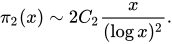
In particular,
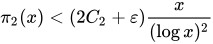
for every and all sufficiently large x.

Many special cases of the above have been proved. Jie Wu proved that for sufficiently large x,

In popular culture
[edit]The digits of Brun's constant were used in a bid of $1,902,160,540 in the Nortel patent auction. The bid was posted by Google and was one of three Google bids based on mathematical constants.[6] Furthermore, academic research on the constant ultimately resulted in the Pentium FDIV bug becoming a notable public relations fiasco for Intel.[7][8]
See also
[edit]Notes
[edit]- ↑ Brun (1919).
- 1 2 3 Nicely, Thomas R. (18 January 2010). "Enumeration to 1.6*10^15 of the twin primes and Brun's constant". Some Results of Computational Research in Prime Numbers (Computational Number Theory). Archived from the original on 8 December 2013. Retrieved 16 February 2010.
- ↑ Sebah, Pascal; Gourdon, Xavier, Introduction to twin primes and Brun's constant computation (PDF)
- ↑ Dunn, Lachlan (2025). "Improved Upper Bound on Brun's Constant Under GRH". arXiv:2504.15658 [math.NT].
- ↑ Klyve, Dominic. "Explicit bounds on twin primes and Brun's Constant". Retrieved 24 May 2021.
- ↑ Damouni, Nadia (1 July 2011). "Dealtalk: Google bid "pi" for Nortel patents and lost". Reuters. Archived from the original on 3 July 2011. Retrieved 6 July 2011.
- ↑ "Pentium FDIV flaw FAQ". www.trnicely.net. Archived from the original on 18 June 2019. Retrieved 22 February 2022.
- ↑ Price, D. (1995). "Pentium FDIV flaw-lessons learned". IEEE Micro. 15 (2): 86–88. doi:10.1109/40.372360.
References
[edit]- Brun, Viggo (1915). "Über das Goldbachsche Gesetz und die Anzahl der Primzahlpaare". Archiv for Mathematik og Naturvidenskab. B34 (8).
- Brun, Viggo (1919). "La série 1/5+1/7+1/11+1/13+1/17+1/19+1/29+1/31+1/41+1/43+1/59+1/61+..., où les dénominateurs sont nombres premiers jumeaux est convergente ou finie". Bulletin des Sciences Mathématiques (in French). 43: 100–104, 124–128.
- Cojocaru, Alina Carmen; Murty, M. Ram (2005). An introduction to sieve methods and their applications. London Mathematical Society Student Texts. Vol. 66. Cambridge University Press. pp. 73–74. ISBN 0-521-61275-6.
- Landau, E. (1927). Elementare Zahlentheorie. Leipzig, Germany: Hirzel. Reprinted Providence, RI: Amer. Math. Soc., 1990.
- LeVeque, William Judson (1996). Fundamentals of Number Theory. New York City: Dover Publishing. pp. 1–288. ISBN 0-486-68906-9. Contains a more modern proof.
- Wu, J. (2004) [24 Sep 2007]. "Chen's double sieve, Goldbach's conjecture and the twin prime problem". Acta Arithmetica. 114 (3): 215–273. arXiv:0705.1652. Bibcode:2004AcAri.114..215W. doi:10.4064/aa114-3-2.
External links
[edit]- Weisstein, Eric W. "Brun's Constant". MathWorld.
- Weisstein, Eric W. "Brun's Theorem". MathWorld.
- Brun's constant at PlanetMath.
- Sebah, Pascal and Xavier Gourdon, Introduction to twin primes and Brun's constant computation, 2002. A modern detailed examination.
- Wolf's article on Brun-type sums