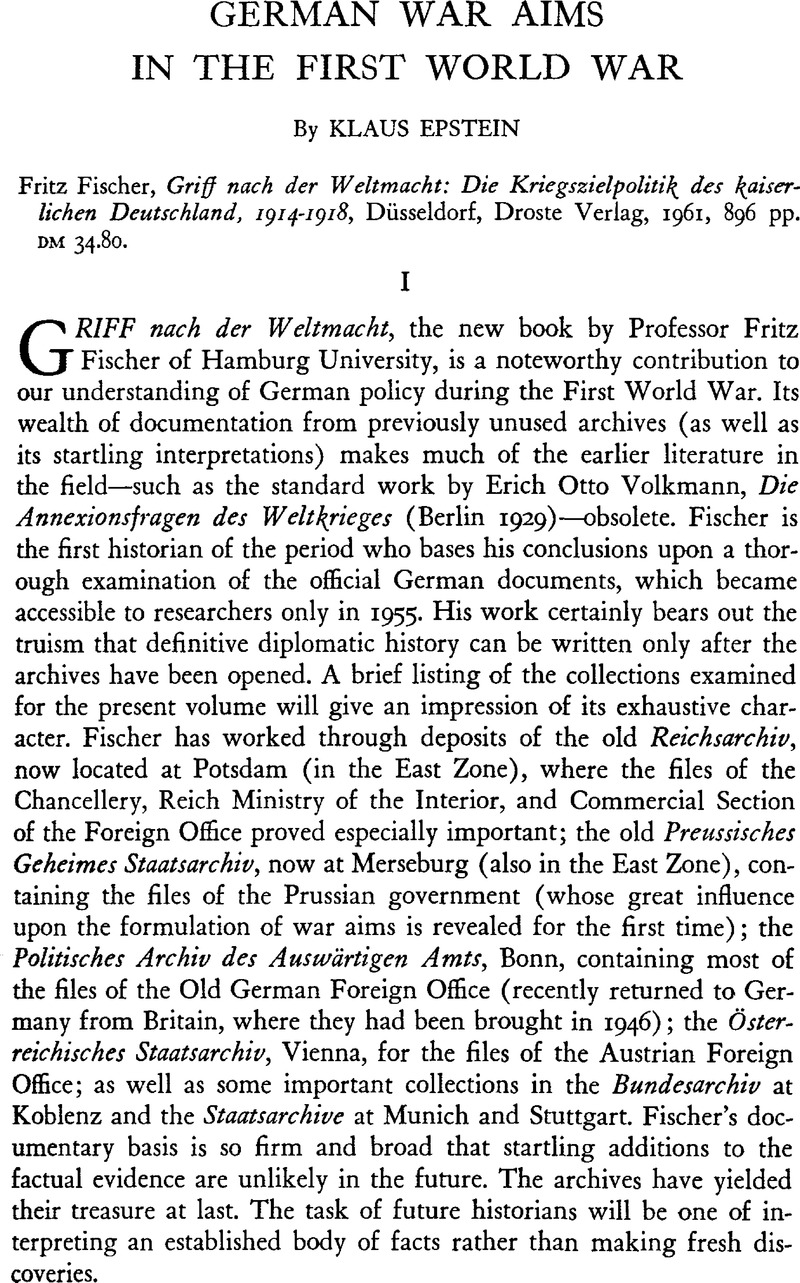
3 Bethmann's important memorandum of September 9, 1914, has not been mentioned by any previous author, including E. O. Volkmann, who had access to many Foreign Office files while serving as an expert adviser to the Reichstag Committee of Inquiry in the 1920's. Did Volkmann know this memorandum and conceal its existence for patriotic reasons? The question—which is important in reaching any judgment about both Volkmann and the work of the Reichstag Committee—cannot be answered conclusively. Fischer found the memorandum in the Chancellery files, not the regular Foreign Office files, and it is improbable that Volkmann had access to the former. It can be proved, however, that the Foreign Office did exercise a “patriotic” censorship over what materials were made available to die Reichstag Committee. See an important unpublished letter of Consul Max Müller, Foreign Office liaison man with the Committee of Inquiry, to Senator Petersen, Chairman of the Committee, dated December 11, 1919, and a request of Müller for additional personnel because he could not cope with the work load by himself, dated December 18, 1919. (Foreign Office files, Serial 2787:D540925–927 and D540922.) The use of executive privilege to hamstring the work of parliamentary committees is, of course, a practice known in many countries and is not especially discreditable to either the Foreign Office or the Reichstag Committee. It does, however, show the indispensability of the kind of archival work done by Fischer even upon subjects covered at length by the Committee of Inquiry.