
Anna's Hummingbird Calypte anna
Sign in to see your badges
Species names in eBird-supported languages
| Language | Common name |
|---|---|
| Afrikaans | Robynsluierkolibrie |
| Azerbaijani | Qırmızıbaş kolibri |
| Bulgarian | Пурпуроглаво колибри |
| Catalan | colibrí d'Anna |
| Croatian | annin kolibrić |
| Czech | kalypta růžovohlavá |
| Danish | Anna´ Kolibri |
| Dutch | Annakolibrie |
| English | Anna's Hummingbird |
| English (AVI) | Anna's Hummingbird |
| English (United States) | Anna's Hummingbird |
| Estonian | roosapea-koolibri |
| Finnish | rubiinipartakolibri |
| French | Colibri d'Anna |
| German | Annakolibri |
| Icelandic | Drottningarbríi |
| Japanese | アンナハチドリ |
| Latvian | Annas kolibri |
| Norwegian | rødmaskekolibri |
| Polish | koliberek żarogłowy |
| Russian | Рубиновый калипсо |
| Serbian | Anin kolibri |
| Slovak | čmeľovec Annin |
| Spanish | Colibrí de Anna |
| Spanish (Mexico) | Colibrí Cabeza Roja |
| Spanish (Spain) | Colibrí de Anna |
| Swedish | chaparralkolibri |
| Turkish | Anna Kolibrisi |
| Ukrainian | Каліпта рубіновоголова |
Full content is available exclusively to Birds of the World subscribers. Sign in Learn more
Introduction
Anna's Hummingbird has expanded its range dramatically since the mid-1930s. It once nested only on the Pacific slope of northern Baja California and California north to the San Francisco Bay area, but now breeds north to Vancouver Island, British Columbia, eastward through southern Arizona, and it has an increasing presence in West Texas. This species' effective use of widely cultivated urban and suburban exotic plants and hummingbird feeders has contributed to its increased numbers and expanded range. In many localities Anna's is present throughout the year, although it is rarely known if nesting birds are resident or if they are replaced by individuals from another region.
Male Anna's Hummingbirds attract attention through their elaborate dive displays, in which they ascend ~35 meters and then plummet toward their target—a female Anna's Hummingbird or other bird. Males sing more conspicuously than any other North American hummingbird, and their songs are learned and complex, unusual in nonpasserine birds.
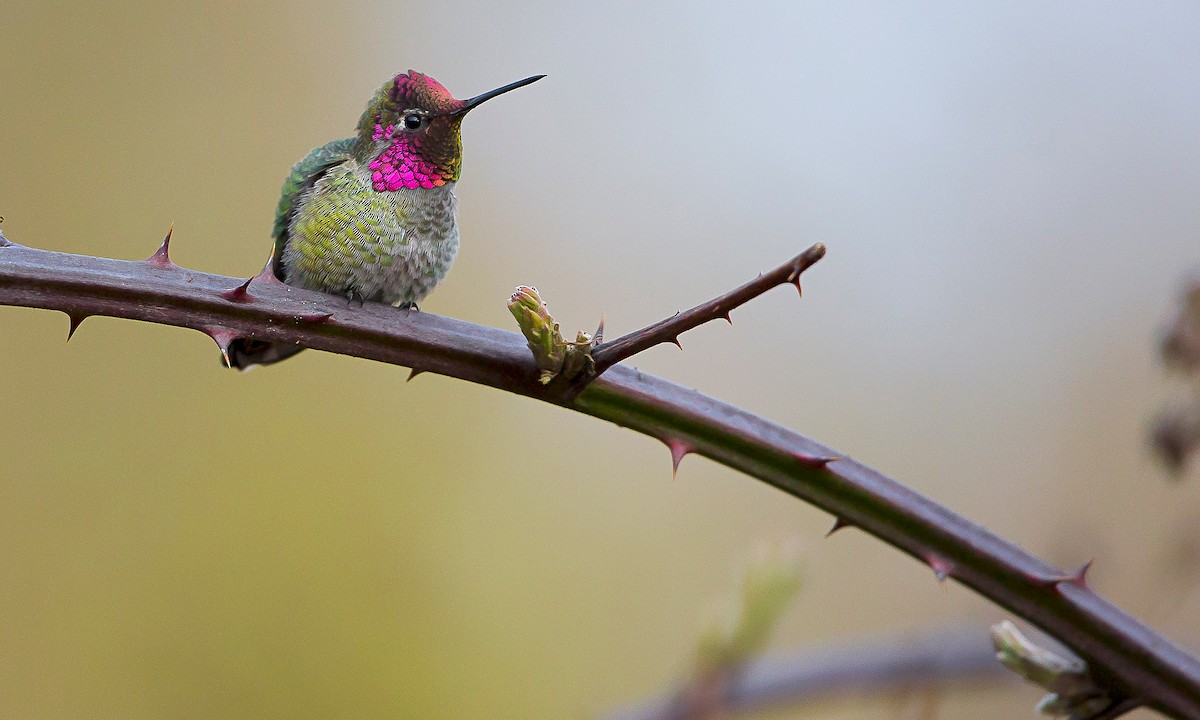
Anna's Hummingbird was originally named Ornismya anna by René Primevère Lesson in 1829, based on specimens collected by Paolo-Émilio Botta and owned by the duke and duchess of Rivoli. Lesson regarded it as one of the most beautiful hummingbirds, on account of “the bright sparkle of a red cap of the richest amethyst...” on the male's head, and so named it after the duchess of Rivoli, Anna de Belle Masséna. Gould (1861) placed it in a new genus, Calypte, for “not only the throat, but the entire head as glitteringly resplendent as if they had been dipped in molten metal”. Calypte is greek (Кαλυπτη) for covered or hood (Holloway 2003), a reference to the male's iridescent crown. Males turn their head from side to side as they sing, flashing the brilliant iridescence as a signal to other hummingbirds.
Female Anna's Hummingbirds are less conspicuous than males and sometimes defend feeding territories, but usually away from those of males. They associate with males only long enough to copulate. The female constructs the nest, incubates the eggs, and cares for nestlings, typically in winter and early spring, timed with the arrival of winter rain in the Mediterranean climate of California, and the consequent increased availability of nectar and small insects for food.
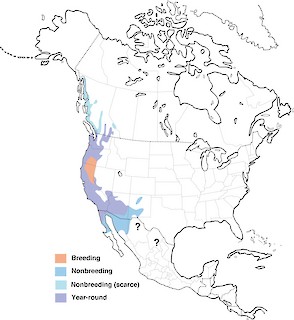
- Year-round
- Migration
- Breeding
- Non-Breeding
Anna’s Hummingbird breeds from December through May and occupies its non-breeding range from July through December.