
Ridgway's Rail Rallus obsoletus Scientific name definitions
- NT Near Threatened
- Names (28)
- Subspecies (4)
Text last updated March 21, 2018
Sign in to see your badges
Species names in eBird-supported languages
| Language | Common name |
|---|---|
| Afrikaans | Kaliforniese Riethaan |
| Azerbaijani | Boz su fərəsi |
| Bulgarian | Калифорнийски дърдавец |
| Catalan | rascló de Ridgway |
| Chinese (SIM) | 里氏秧鸡 |
| Croatian | pacifička kokošica |
| Czech | chřástal kalifornský |
| Danish | San Francisco-klapperrikse |
| Dutch | Californische Ral |
| English | Ridgway's Rail |
| English (AVI) | Ridgway's Rail |
| English (United States) | Ridgway's Rail |
| Estonian | kalifornia ruik |
| Finnish | kalifornianluhtakana |
| French | Râle de Californie |
| German | Ridgwayralle |
| Japanese | ニシオニクイナ |
| Norwegian | spartinarikse |
| Polish | wodnik kalifornijski |
| Russian | Калифорнийский пастушок |
| Serbian | Ridžvejev petlovan |
| Slovak | chriašteľ kalifornský |
| Spanish | Rascón de Ridgway |
| Spanish (Mexico) | Rascón Costero del Pacífico |
| Spanish (Spain) | Rascón de Ridgway |
| Swedish | californiarall |
| Turkish | Ridgway Sukılavuzu |
| Ukrainian | Пастушок каліфорнійський |
Rallus obsoletus Ridgway, 1874
Definitions
- RALLUS
- obsoleta / obsoletum / obsoletus
The Key to Scientific Names
Legend Overview
Originally Appeared in
Content Partner

Full content is available exclusively to Birds of the World subscribers. Sign in Learn more
Introduction
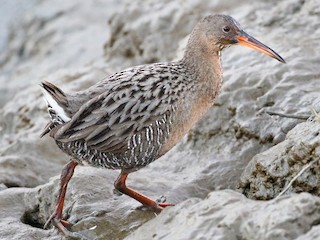
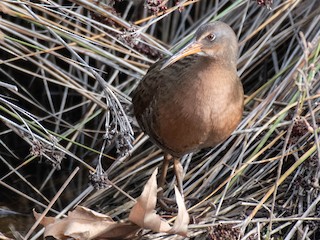
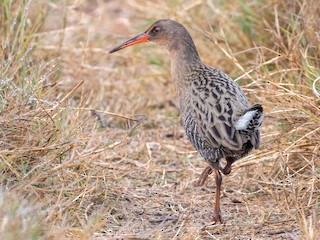
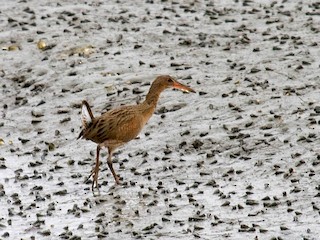
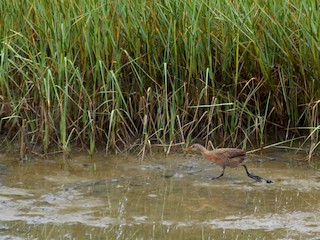
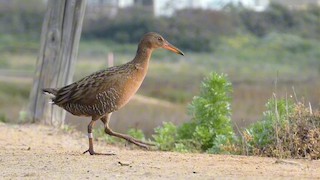
A large cinnamon-brown rail of tidal wetlands along the Pacific Coast from northern California (San Francisco Bay area) and Baja California south to central Mexico (Colima), as well as freshwater wetlands in the extreme southwestern United States and northwestern Mexico. Long considered by many ornithologists as a subspecies of the Clapper Rail (Rallus crepitans), phylogenetic analyses have revealed that Ridgway's Rail (R. obsoletus) is more closely related to the Aztec Rail (R. tenuirostris) of central Mexico. Up to six subspecies of the Ridgway's Rail are recognized and these breed in a range of different wetland habitats. For example, California Ridgway's Rail (R. o. obsoletus) and Light-footed Ridgway's Rail (R. o. levipes) occupy coastal saltmarshes of California and northwestern Baja California; Yuma Ridgway's Rail (R. o. yumanensis) occurs in freshwater, brackish, and salt marshes from southeastern California and southwestern Arizona south to northwestern Sonora; and R. o. nayaritensis breeds in coastal saltmarshes and mangroves in western Mexico from central Sinaloa to southern Nayarit.
Ridgway's Rail typically feeds on crustaceans, but take a variety of other invertebrate prey, fish and other small vertebrates, and seeds. Males average larger in size and mass than females, but sexes are similar in plumage. Both sexes assist in incubation and brood-rearing. The species is sedentary, but may undergo postbreeding dispersal, as indicated by radio-telemetry studies and by occasional inland records away from breeding habitats.
Within the U.S., Ridgway's Rail is represented by three subspecies: obsoletus, levipes, and yumanensis. These subspecies have limited habitat availability, and consequently face threats from habitat loss, pollutants, urbanization, and non-native predators; all three subspecies are classified as endangered by the U.S. Fish and Wildlife Service. Although the species' endangered status has lead to much research on obsoletus, levipes, and yumanensis in the western U.S., there are many aspects of Ridgway's Rail biology that remain poorly understood. Research needs include (1) continued population monitoring to assess distribution, relative abundance, and population size and trends, (2) studies of movement ecology, (3) the effects of habitat management, (4) the effects of sea-level rise and other disturbances, (5) the effects of environmental contaminants on reproduction and survival, (6) taxonomic status of other subspecies, and their distribution and natural history, and (7) investigations of basic biology, with emphasis on population parameters, calling behavior, postbreeding biology, and wintering biology.
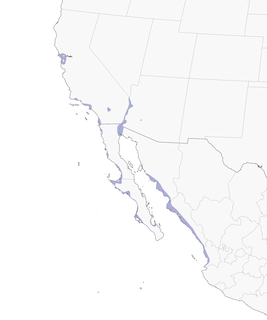
- Year-round
- Migration
- Breeding
- Non-Breeding