
Common Hoopoe Upupa epops Scientific name definitions
- LC Least Concern
- Names (79)
- Subspecies (8)
Revision Notes
Sign in to see your badges
Species names in eBird-supported languages
| Language | Common name |
|---|---|
| Afrikaans | Hoephoep (Gewone Hoephoep) |
| Albanian | Pupëza |
| Arabic | هُدْهُدٌ أَوْرَاسِيٌ |
| Armenian | Հոպոպ |
| Assamese | ফণিকতৰা |
| Asturian | Bubiella común |
| Azerbaijani | Şanapipik |
| Bangla | মোহনচূড়া / হুদহুদ |
| Bangla (Bangladesh) | মোহনচূড়া / হুদহুদ |
| Bangla (India) | মোহনচূড়া |
| Basque | Argi-oilar arrunta |
| Bulgarian | Папуняк |
| Catalan | puput comuna |
| Chinese | 戴勝 |
| Chinese (Hong Kong SAR China) | 戴勝 |
| Chinese (SIM) | 戴胜 |
| Croatian | pupavac |
| Czech | dudek chocholatý |
| Danish | Hærfugl |
| Dutch | Hop |
| English | Common Hoopoe |
| English (AVI) | Common Hoopoe |
| English (Hong Kong SAR China) | Eurasian Hoopoe |
| English (Kenya) | Hoopoe |
| English (Philippines) | Common Hoopoe |
| English (United States) | Common Hoopoe |
| Estonian | vaenukägu (toonetutt) |
| Faroese | Herfuglur |
| Finnish | harjalintu |
| French | Huppe fasciée |
| Galician | Bubela eurasiática |
| Georgian | ოფოფი |
| German | Wiedehopf |
| Greek | Τσαλαπετεινός |
| Gujarati | ઘંટીટાંકણો |
| Hebrew | דוכיפת |
| Hindi | हुदहुद |
| Hungarian | Búbosbanka |
| Icelandic | Herfugl |
| Indonesian | Hupo tunggal |
| Italian | Upupa |
| Japanese | ヤツガシラ |
| Kannada | ಚಂದ್ರಮುಕುಟ |
| Kashmiri (India) | ستُت |
| Kazakh | Бәбісек |
| Konkani | हूड्डो |
| Korean | 후투티 |
| Kyrgyz | Yпүп |
| Ladakhi | ཧུ་ཏུ་ཏུ་སེ། |
| Latvian | Pupuķis |
| Lithuanian | Kukutis |
| Malayalam | ഉപ്പൂപ്പൻ |
| Manipuri | Chonga arangba |
| Marathi | हुदहुद |
| Nepali (India) | फाप्रे चरा |
| Nepali (Nepal) | फाप्रे चरा |
| Norwegian | hærfugl |
| Odia | ସାରଣା |
| Persian | هدهد (پوپک) اوراسیایی |
| Polish | dudek |
| Portuguese (Angola) | Poupa |
| Portuguese (Portugal) | Poupa |
| Punjabi (India) | ਚੱਕੀਰਾਹਾ |
| Romanian | Pupăză |
| Russian | Удод |
| Serbian | Pupavac |
| Slovak | dudok chochlatý |
| Slovenian | Smrdokavra |
| Spanish | Abubilla común |
| Spanish (Spain) | Abubilla común |
| Swedish | härfågel |
| Tajik | Ҳудҳуд |
| Tamil (India) | கொண்டலாத்தி |
| Telugu | కూకుడు పిట్ట |
| Thai | นกกะรางหัวขวาน |
| Turkish | İbibik |
| Ukrainian | Одуд євразійський |
| Welsh | copog |
| Zulu | umzolozolo |
Revision Notes
Steven G. Mlodinow updated the account with the Clements Checklist. Peter Pyle updated the Plumages, Molts, and Structure page, and Guy M. Kirwan and Shawn Billerman contributed to the Systematics page.
Upupa epops Linnaeus, 1758
Definitions
- UPUPA
- upupa
- epops
- Epops
The Key to Scientific Names
Legend Overview
Full content is available exclusively to Birds of the World subscribers. Sign in Learn more
Introduction
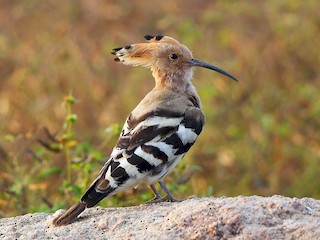
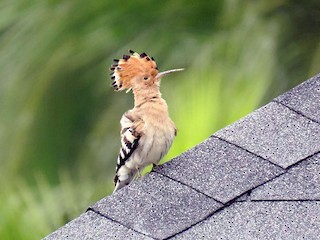
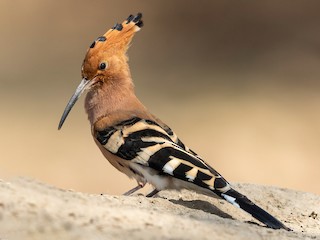
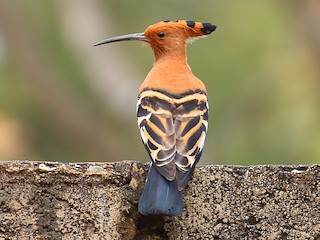
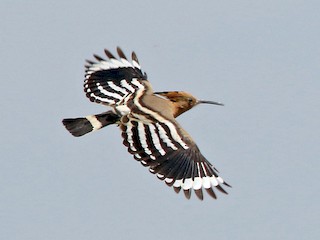
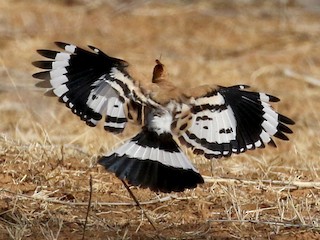
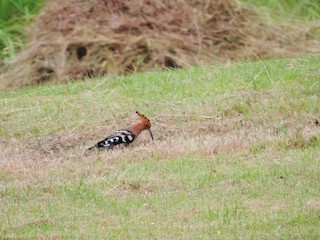
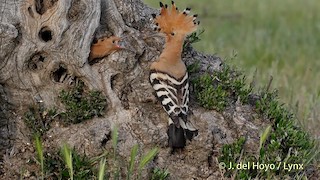
The Common Hoopoe has a rather improbable appearance—an orange bird draped in a black-and-white cape, bearing a sun-evoking headdress and a scythe-like bill. Yet, upon taking flight, it transforms into a giant butterfly born aloft upon broad black-and-white banded wings. Unsurprisingly, it has long captured the human imagination. Its earliest representations in human artwork date back to the Paleolithic Age, when it appeared as the “bird-sun” in what is today Azerbaijan and southern Russia. Subsequently, it has played many roles, mostly positive in Asia and the Middle East (e.g., matron of the hearth and the guardian spirit of babies, bringer of good harvests, protector spirit of warriors, King Solomon’s messenger, protector in the afterlife), and mostly negative in Europe, where it was mostly a symbol of evil, associated with death, demons, and thieves.
The Common Hoopoe is a widespread species, breeding across most of continental Eurasia south of 53°N as well as much of Africa, excepting high mountains, harsh deserts, and extensive tropical forests. Indeed, it breeds almost anywhere there are cavities for nesting (sometimes using niches in rock walls and holes in termite mounds) and soft (typically sandy), sparsely vegetated soil that its bill can penetrate while questing for prey, including lawns and pastures. Its winter habitat is similar, except that nest holes are no longer needed, but frozen ground does impose greater latitudinal restrictions. During the boreal winter, it retreats from Europe (except for much of Iberia and the southern coast of France) and from colder portions of Asia (roughly north of 35°N). Birds breeding in warmer climes tend not to migrate or move only short distances, driven largely by wet-dry cycles. Boreal spring migrants are prone to overshooting their nesting grounds, with >50 per spring found in Great Britain and several making it to Japan annually. Occasionally, an Common Hoopoe reaches even farther afield, with at least two records from Australia and four from North America in Alaska.
The long gracefully curving bill probes the ground in search of Orthoptera (crickets, grasshoppers, and their relatives) and Coleoptera (beetles, adults and larvae), while also feeding heavily upon Lepidoptera (moths and butterflies, mostly larvae and pupae). Occasionally, mussels, lizards and snakes, frogs and toads, and bird eggs are taken, with vertebrate prey sometimes reaching 15 cm. In some places, the Common Hoopoe is highly dependent on one prey item during the breeding season (e.g., European mole cricket [Gryllotalpa gryllotalpa] in Switzerland and pine processionary moth [Thaumetopoea pityocampa] in parts of France), making it especially sensitive to habitat changes.
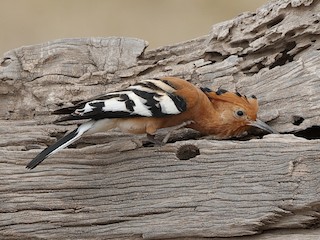
The Common Hoopoe is a secondary hole nester, meaning that it does not create its own hole, but uses naturally occurring cavities, crevices in human structures, or holes created by other animals such as woodpeckers (Picidae). Occasionally an intrepid hoopoe will nest in truly peculiar places such as a rabbit burrow, rolled up carpet, or an abandoned automobile. In most of Africa, 4–7 eggs are laid within the nest, but in Europe and the Middle East, the mean clutch size is typically around seven eggs, and a clutch of ten eggs is common. These large clutches are in excess of what a pair might expect to raise, an approach that has been labelled “optimistic.” This tactic, not rare in birds where prey availability is highly variable and unpredictable, allows a pair to take advantage of years with bountiful food but requires them to abandon smaller young when food supplies are suboptimal. Egg incubation lasts 15–18 d, fledging typically occurs 28–29 d after hatching, and fledglings achieve independence about a month thereafter. Many Common Hoopoe will then attempt to raise a second brood (rarely, even a third), though not necessarily with the same partner or in the same nest.
Actually, Common Hoopoe nests stink. Quite literally. The stench emanates from bactericidal secretions created within the female's uropygial (a.k.a., preening) gland, in part, by a symbiotic bacteria. Furthermore, the fine structure of the eggs allows this substance to stick to the eggs more efficiently. As one might imagine, the rank smell (and presumably taste) may well deter predators, and the secretions have also been shown to lower trans-shell contamination of pathogenic bacteria and increase hatching success.
The current global population of the Common Hoopoe is estimated at 5,000,000–10,000,000 individuals, but is declining, at least locally. The decline is thought to be due to forestry changes, loss of nesting cavities (from cutting of dead trees and snags as well as modernization of buildings), and intensified agricultural practices, including greater mechanical processing of the soil and increased insecticide use. Potential solutions include leaving open swathes within and adjacent to forests, preserving snags, providing nestboxes, and a lesser reliance on chemical insecticides.
Finally, one might ask, why “hoopoe?” The name does seem odd for a bird, and it is not simply the scientific name turned into common usage. “Hoopoe” is an onomatopoeic rendering of the species’ song. Indeed, both the genus and species portions of the scientific name are similarly onomatopoeic. The Common Hoopoe is nearly unique, with only one similar extant species, the Madagascar Hoopoe (Upupa marginata). These two species are most closely related to the somewhat different looking woodhoopoes (Phoeniculidae), and these together, along with ground-hornbills (Bucorvidae) and the hornbills (Bucerotidae), form the order Bucerotiformes.
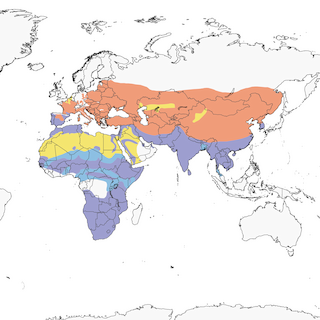
- Year-round
- Migration
- Breeding
- Non-Breeding
Map last updated 29 August 2024.