Right now self-driving cars are a technical challenge. No amount of sensors and mapping can currently produce a 100 percent reliable self-driving car, but plenty of companies are working on it. When this technology does hit the market, the inevitable question is going to be “how much extra does it cost?”
Waymo, the Alphabet self-driving car division that was recently spun off from Google, is working on getting that cost as low as possible. According to a recent article from Bloomberg, the company has spent the last 12 months working on “scalability.” The company’s efforts have lead to a “90 percent” decrease in the cost of the LIDAR sensor, which is typically the most costly item in a self-driving car solution.
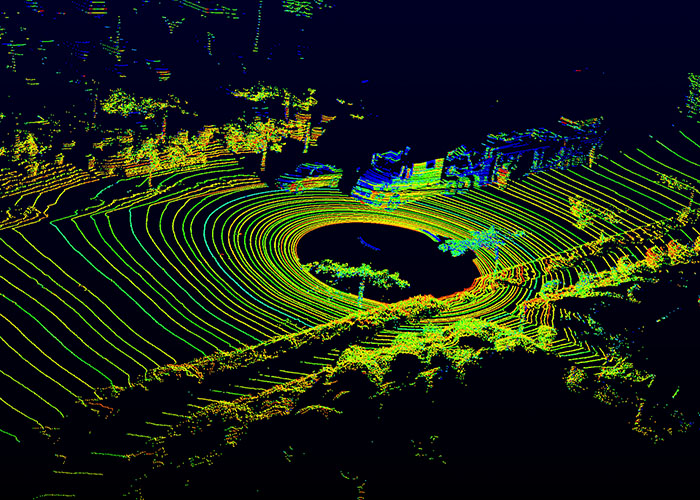
On a self-driving car, the LIDAR sensor is a spinning cylinder that usually sits on the roof. By bouncing a laser off an object and measuring the time of flight, LIDAR can tell how far away something is. Thanks to the spinning, these sensors can “see” in 360 degrees. Most self-driving car solutions use LIDAR as the major sensor, giving the car a “big picture” view of the world so it can see pedestrians and other vehicles.
The first public Google Self-Driving Car prototype, built on a Toyota Prius, is a good example of how everything works. The biggest component was the Velodyne HDL-64E LIDAR sensor, which cost a whopping $75,000. The LIDAR sensor needed to be up high to see around the vehicle, so Google mounted it on a large riser. This 360 degree sensing was good for a distance view, but not great at detecting up-close objects, thanks to a dead zone around the LIDAR and obstructions from the car body. To fix this, Google augmented the LIDAR input with several black radar boxes stuck to the front and back of the vehicle. These boxes filled in the blanks for close objects.

 Loading comments...