Learn more
These promotions will be applied to this item:
Some promotions may be combined; others are not eligible to be combined with other offers. For details, please see the Terms & Conditions associated with these promotions.
Your Memberships & Subscriptions
Download the free Kindle app and start reading Kindle books instantly on your smartphone, tablet, or computer - no Kindle device required.
Read instantly on your browser with Kindle for Web.
Using your mobile phone camera - scan the code below and download the Kindle app.
Follow the authors
OK
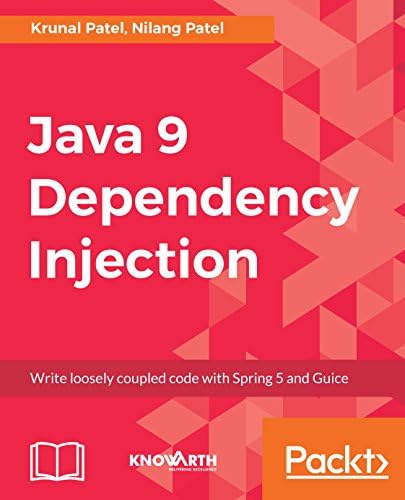
Java 9 Dependency Injection: Write loosely coupled code with Spring 5 and Guice
Create clean code with Dependency Injection principles
Key Features
- Use DI to make your code loosely coupled to manage and test your applications easily on Spring 5 and Google Guice
- Learn the best practices and methodologies to implement DI
- Write more maintainable Java code by decoupling your objects from their implementations
Book Description
Dependency Injection (DI) is a design pattern that allows us to remove the hard-coded dependencies and make our application loosely coupled, extendable, and maintainable. We can implement DI to move the dependency resolution from compile-time to runtime. This book will be your one stop guide to write loosely coupled code using the latest features of Java 9 with frameworks such as Spring 5 and Google Guice.
We begin by explaining what DI is and teaching you about IoC containers. Then you’ll learn about object compositions and their role in DI. You’ll find out how to build a modular application and learn how to use DI to focus your efforts on the business logic unique to your application and let the framework handle the infrastructure work to put it all together.
Moving on, you’ll gain knowledge of Java 9’s new features and modular framework and how DI works in Java 9. Next, we’ll explore Spring and Guice, the popular frameworks for DI. You’ll see how to define injection keys and configure them at the framework-specific level. After that, you’ll find out about the different types of scopes available in both popular frameworks. You’ll see how to manage dependency of cross-cutting concerns while writing applications through aspect-oriented programming.
Towards the end, you’ll learn to integrate any third-party library in your DI-enabled application and explore common pitfalls and recommendations to build a solid application with the help of best practices, patterns, and anti-patterns in DI.
What you will learn
- Understand the benefits of DI and fo from a tightly coupled design to a cleaner design organized around dependencies
- See Java 9’s new features and modular framework
- Set up Guice and Spring in an application so that it can be used for DI
- Write integration tests for DI applications
- Use scopes to handle complex application scenarios
- Integrate any third-party library in your DI-enabled application
- Implement Aspect-Oriented Programming to handle common cross-cutting concerns such as logging, authentication, and transactions
- Understand IoC patterns and anti-patterns in DI
Who this book is for
This book is for Java developers who would like to implement DI in their application. Prior knowledge of the Spring and Guice frameworks and Java programming is assumed.
Table of Contents
- Why Dependency Injection?
- Dependency Injection in Java 9
- Dependency Injection with Spring
- Dependency Injection with Google Guice
- Scopes
- Aspect-Oriented Programming and Interceptors
- IoC Patterns and Best Practices
- LanguageEnglish
- PublisherPackt Publishing
- Publication dateApril 26, 2018
- File size7.2 MB
Editorial Reviews
About the Author
Krunal Patel has been working at Liferay Portal for over 5 years and has over 9 years of experience in enterprise application development using Java and Java EE technologies. He has worked in various domains, such as healthcare, hospitality, and enterprise intranet.
He was awarded an ITIL® Foundation Certificate in IT Service Management in 2015, a Liferay 6.1 Developer Certification in 2013, and a MongoDB for Java Developers certificate in 2013.
He has reviewed Mastering Apache Solr 7.x by Packt Publishing.
Nilang Patel has over 14 years of core IT experience in leading project, software design and development, and supporting enterprise applications using enterprise Java technologies.
He is experienced in core Java/J2EE based application and has experience in healthcare, human resource, taxation, intranet application, energy and risk management domain. He contributes to various forums and has a personal blog.
He acquired the Liferay 6.1 Developer Certification in 2013, Brainbench Java 6 certification in 2012, and a Sun Certified Programmer for the Java 2 Platform 1.5 (SCJP) in 2007.
Product details
- ASIN : B077XJ69KX
- Publisher : Packt Publishing
- Accessibility : Learn more
- Publication date : April 26, 2018
- Edition : 1st
- Language : English
- File size : 7.2 MB
- Screen Reader : Supported
- Enhanced typesetting : Enabled
- X-Ray : Not Enabled
- Word Wise : Not Enabled
- Print length : 248 pages
- ISBN-13 : 978-1788296472
- Page Flip : Enabled
- Best Sellers Rank: #1,694 in Software Design Tools
- #2,255 in Java Programming
- Customer Reviews:
About the authors

Krunal Patel has more than 9 years of experience of Java and Java EE technologies. His developing enterprise solutions using the Liferay Platform since 2012. He has worked in various domains such as healthcare, hospitality, and enterprise intranet. He was awarded an ITIL® Foundation Certificate in IT Service Management in 2015 and a Liferay 6.1 Developer Certification in 2013. His passions are Movies and Travel, besides programming.

Nilang Patel has over 14 years of core IT experience in leading project, software design and development, and supporting enterprise applications using enterprise Java technologies.
He is experienced in core Java/J2EE based application and has experience in healthcare, human resource, taxation, intranet application, energy and risk management domain. He contributes to various forums and has a personal blog.
He acquired the Liferay 6.1 Developer Certification in 2013, Brainbench Java 6 certification in 2012, and a Sun Certified Programmer for the Java 2 Platform 1.5 (SCJP) in 2007.
Customer reviews
- 5 star4 star3 star2 star1 star2 star22%31%47%0%0%0%
- 5 star4 star3 star2 star1 star1 star22%31%47%0%0%0%
Customer Reviews, including Product Star Ratings help customers to learn more about the product and decide whether it is the right product for them.
To calculate the overall star rating and percentage breakdown by star, we don’t use a simple average. Instead, our system considers things like how recent a review is and if the reviewer bought the item on Amazon. It also analyzed reviews to verify trustworthiness.
Learn more how customers reviews work on Amazon