

Buy New
-32%
$39.56$39.56
FREE delivery Sunday, October 11
Ships from: Amazon.com Sold by: Amazon.com
Used - Very Good
$35.00$35.00
FREE delivery Sunday, October 11
Ships from: Amazon Sold by: Alfar Deals
Download the free Kindle app and start reading Kindle books instantly on your smartphone, tablet, or computer - no Kindle device required.
Read instantly on your browser with Kindle for Web.
Using your mobile phone camera - scan the code below and download the Kindle app.

Follow the author
OK
Machine Learning for Time-Series with Python: Forecast, predict, and detect anomalies with state-of-the-art machine learning methods
Purchase options and add-ons
Become proficient in deriving insights from time-series data and analyzing a model’s performance
Key Features
- Explore popular and modern machine learning methods including the latest online and deep learning algorithms
- Learn to increase the accuracy of your predictions by matching the right model with the right problem
- Master time-series via real-world case studies on operations management, digital marketing, finance, and healthcare
Book Description
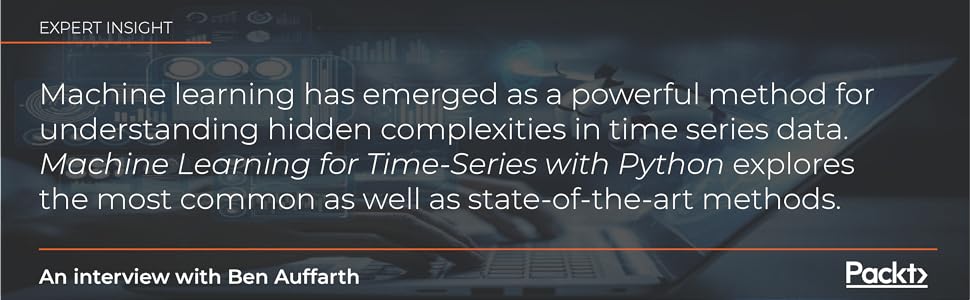
Machine learning has emerged as a powerful tool to understand hidden complexities in time-series datasets, which frequently need to be analyzed in areas as diverse as healthcare, economics, digital marketing, and social sciences. These datasets are essential for forecasting and predicting outcomes or for detecting anomalies to support informed decision making.
This book covers Python basics for time-series and builds your understanding of traditional autoregressive models as well as modern non-parametric models. You will become confident with loading time-series datasets from any source, deep learning models like recurrent neural networks and causal convolutional network models, and gradient boosting with feature engineering.
Machine Learning for Time-Series with Python explains the theory behind several useful models and guides you in matching the right model to the right problem. The book also includes real-world case studies covering weather, traffic, biking, and stock market data.
By the end of this book, you will be proficient in effectively analyzing time-series datasets with machine learning principles.
What you will learn
- Understand the main classes of time-series and learn how to detect outliers and patterns
- Choose the right method to solve time-series problems
- Characterize seasonal and correlation patterns through autocorrelation and statistical techniques
- Get to grips with time-series data visualization
- Understand classical time-series models like ARMA and ARIMA
- Implement deep learning models, like Gaussian processes, transformers, and state-of-the-art machine learning models
- Become familiar with many libraries like Prophet, XGboost, and TensorFlow
Who this book is for
This book is ideal for data analysts, data scientists, and Python developers who are looking to perform time-series analysis to effectively predict outcomes. Basic knowledge of the Python language is essential. Familiarity with statistics is desirable.
Table of Contents
- Introduction to Time-Series with Python
- Time-Series Analysis with Python
- Preprocessing Time-Series
- Introduction to Machine Learning for Time Series
- Forecasting with Moving Averages and Autoregressive Models
- Unsupervised Methods for Time-Series
- Machine Learning Models for Time-Series
- Online Learning for Time-Series
- Probabilistic Models for Time-Series
- Deep Learning for Time-Series
- Reinforcement Learning for Time-Series
- Multivariate Forecasting
- ISBN-101801819629
- ISBN-13978-1801819626
- PublisherPackt Publishing
- Publication dateOctober 29, 2021
- LanguageEnglish
- Dimensions7.5 x 0.84 x 9.25 inches
- Print length370 pages
There is a newer edition of this item:
$49.99
This title will be released on October 9, 2026.
Customers who viewed this item also viewed
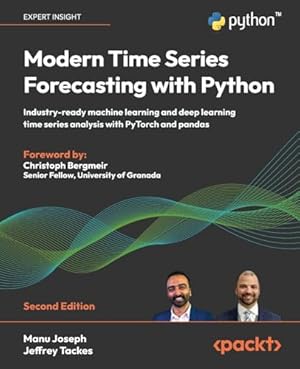
- Modern Time Series Forecasting with Python: Industry-ready machine learning and deep learning time series analysis with PyTorch and pandasPaperbackFREE Shipping by AmazonGet it as soon as Sunday, Oct 110% Claimed
Customers also bought or read
- Modern Time Series Forecasting with Python: Industry-ready machine learning and deep learning time series analysis with PyTorch and pandas
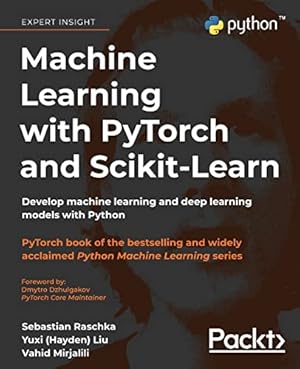
Paperback$40.60$40.60FREE delivery Sun, Oct 11 - Machine Learning with PyTorch and Scikit-Learn: Develop machine learning and deep learning models with Python#1 Best SellerSpeech & Audio Processing
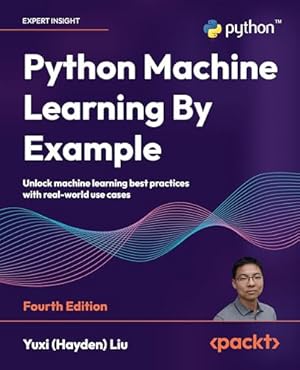
Paperback$32.51$32.51Delivery Sun, Oct 11 - Python Machine Learning By Example: Unlock machine learning best practices with real-world use cases
Paperback$28.07$28.07Delivery Sun, Oct 11 - AI Engineering: Building Applications with Foundation Models#1 Best SellerEnterprise Applications
Paperback$52.40$52.40FREE delivery Sun, Oct 11 - Build a Large Language Model (From Scratch)#1 Best SellerComputer Neural Networks
Paperback$49.24$49.24FREE delivery Sun, Oct 11
From the Publisher
Key Features:
- Learn how to derive insights from time series and analyze a model’s performance
- Identify advantages and disadvantages of common time series models in machine learning
- Learn techniques such as autoencoders, InceptionTime, DeepAR, N-BEATS, Recurrent Neural Networks, ConvNets, and Informer
- Evaluate high-performance forecasting solutions
What are the key takeaways from this book?
This book teaches you how to analyze time series datasets with machine learning principles. An important takeaway is understanding how the ML landscape for time series has evolved. Readers will become aware of the tools for time series analysis. Each topic in the book provides a review of the latest research and an introduction to popular libraries with examples. Dedicated chapters focus on robust machine learning, deep learning, and reinforcement learning models for time series.
Major Topics:
- Probabilistic models for time series such as Facebook Prophet, Markov models, Fuzzy models, and counter-factual causal models such as Bayesian structural time series models as proposed by Google
- Multivariate forecasting and practical examples for multivariate multistep forecasts of energy demand with deep learning models
- Time series techniques such as bandit algorithms and Deep Q-Learning, and their application for a recommender system and trading algorithm
What trajectory does your book follow to help readers master time series with Python?
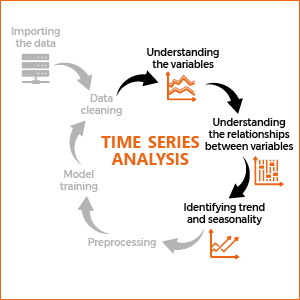
Opening a book and wondering "where do I begin?" can be overwhelming. This book starts by explaining concepts from the ground up. I’ve begun with a historical overview, a broad overview, and a basic introduction to Python for time series, which includes data loading and preprocessing.
My intention was to start with the basics and build your understanding in a step-by-step manner; the pace picks up gradually, with the complexity increasing with each chapter. Time series data manipulation, statistical methods, and time series analysis covered in earlier chapters are systematically connected to a repertoire of ML methods as the book takes you from loading time series datasets from various sources to understanding deep learning models.
Code samples help you to apply all methods to your own problems, and all notebooks used in this book come with links to Google Colab, enabling you to not just read about and learn the theory of new methods but also to experiment with them.
How does your book differ from other books on machine learning for time series?
In the last few years, a lot of progress has been made in machine learning for time series. Traditional methods such as ARIMA now face stiff competition from specialized methods for time series. While there are countless books on machine learning with Python and also a few on time series with Python, I haven’t seen any that include advancements in machine learning for time series within the last 15 years.
Furthermore, many books focus on traditional techniques, but not on recent machine learning approaches. Machine learning methods have won recent high-profile time series competitions such as M4 and M5, but these methods are not covered elsewhere. This book fills this gap.
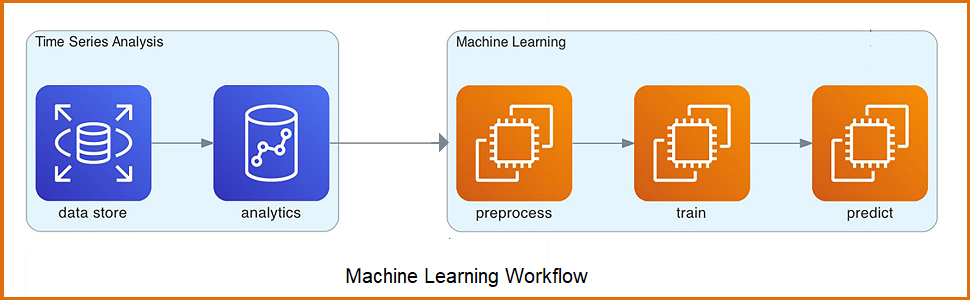
Finally, while other books focus heavily on time series analysis, which is essential for some more traditional models, in this book, I present the best practices for machine learning workflows applied to time series and guide you through matching the right model to the right problem.
If you want to learn about time series and wish to transition from R to Python, you will find this book extremely useful as it includes several practical examples and applications.
Table of Contents:
- Preprocessing Time Series
- Forecasting with Moving Averages and Autoregressive Models
- Machine Learning Models for Time Series
- Online Learning for Time Series
- Probabilistic Models for Time Series
- Deep Learning for Time Series
- Reinforcement Learning for Time Series
- ...and more!
Editorial Reviews
Review
"From the lens of someone looking to break into time-series analysis and prediction, Ben has done a great job at providing a gentle introduction to the field. Machine Learning for Time-Series with Python features introductory chapters on time-series data and models, time-series in Python, and pre-processing time-series data, and then gets the reader up to speed with a variety of machine learning, deep learning, and reinforcement learning approaches. All in all, I believe the book to be a great handbook for anyone exploring the topic of time-series analysis and prediction."
-- Chanin Nantasenamat, Ph.D., Developer Advocate, YouTuber (Data Professor), and Former University Professor
About the Author
Product details
- Publisher : Packt Publishing
- Publication date : October 29, 2021
- Language : English
- Print length : 370 pages
- ISBN-10 : 1801819629
- ISBN-13 : 978-1801819626
- Item Weight : 1.4 pounds
- Dimensions : 7.5 x 0.84 x 9.25 inches
- Best Sellers Rank: #1,262,244 in Books (See Top 100 in Books)
- #398 in Data Modeling & Design (Books)
- #1,102 in Python Programming
- #1,172 in Artificial Intelligence (Books)
- Customer Reviews:
About the author

Ben Auffarth, PhD, is a bestselling author and AI implementation expert with over 15 years of experience bridging advanced technology with measurable business outcomes. As founder of Chelsea AI Ventures, he specializes in helping small and medium enterprises implement enterprise-grade AI solutions that deliver tangible ROI. His systems have prevented millions in fraud losses and process transactions at sub-300ms latency. With a background in computational neuroscience, Ben brings rare depth to practical AI applications—from supercomputing brain models to production systems that combine technical excellence with business strategy. His books are practical "cookbooks" that explain complex AI concepts in accessible, hands-on ways, while his consulting work focuses on delivering concrete, measurable outcomes for businesses. Based in London, Ben balances his technical expertise with family time and participation in the Data Science Speakers community.
Customer reviews
Customer Reviews, including Product Star Ratings help customers to learn more about the product and decide whether it is the right product for them.
To calculate the overall star rating and percentage breakdown by star, we don’t use a simple average. Instead, our system considers things like how recent a review is and if the reviewer bought the item on Amazon. It also analyzed reviews to verify trustworthiness.
Learn more how customers reviews work on Amazon