

The New Power Party (NPP) caucus yesterday proposed amendments to the Referendum Act (公民投票法) to lower referendum thresholds and the minimum voting age and switch to a plurality voting system.
At a post-caucus press conference, the NPP said it would modify the act to lower the signature threshold from 0.5 percent to 0.01 percent of the electorate to initiate a referendum proposal and lower the threshold to put a referendum proposal to a vote from 5 percent to 1.5 percent of the electorate.
“The Referendum Act is often described as a birdcage act, because its thresholds are set so high that it deprives people of their rights to referendum and makes referendums a tool of large parties capable of mobilizing a large number of voters,” NPP Legislator Hsu Yung-ming (徐永明) said.
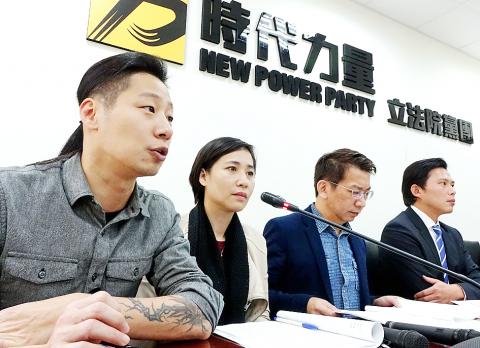
Photo: Chu Pei-hsiung, Taipei Times
The party also proposed lowering the minimum voting age from 20 to 18, establishing absentee voting and shifting to a plurality voting system from the simple majority system, under which a referendum proposal is passed when more than 50 percent of eligible voters cast ballots and when more than 50 percent of the ballots cast are in approval of the proposal.
While average voter turnout is about 70 percent in Taiwan, the so-called “double-50-percent thresholds” are advantageous to opponents of a referendum proposal, because their parties can vote down a proposal simply by persuading 20 percent of the public not to vote, making the act unfair, Hsu said.
The NPP plans to revise the act to include Aborigines’ rights to be informed of and approve Aboriginal affairs, as well as allowing people to vote on modifications to territory.
NPP Legislator Kawlo Iyun Pacidal said many laws were made without taking into consideration the rights of Aborigines, and because they are minorities, the government should not resort to public votes to decide Aboriginal-related affairs, which should be determined by Aborigines themselves.
The party proposed to abolish a provision mandating the establishment of the Information and Communication Security Technology Center as an administrative institution of the Ministry of Science and Technology.
NPP Legislator Huang Kuo-chang (黃國昌) said that information security is national security, which should not be put in the hands of a low-level, semi-government body not invested with the power to investigate.
The center should not be formed as a research institute of the ministry, whose duties do not involve information security, but should be run as an independent, cyberpolice-like agency with investigative rights under the National Security Bureau or the Ministry of the Interior, Huang said.
National Cheng Kung University professor Li Jung-shian (李忠憲) said a semi-government security agency could actually harm information security, as the center’s employees are not government officials bound by government laws, meaning they might reveal sensitive data to China after they retire from the center.
“The hasty establishment of the center [as an entity run by the ministry] would only impede reformation, so the NPP proposes to abolish its establishment,” Huang said.
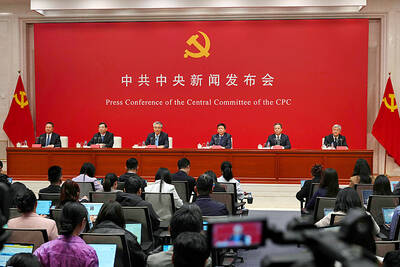
SHORT-TERM OUTLOOK: The Chinese military would most likely focus on rebuilding its organization and leadership in the next few years, experts said Chinese President Xi Jinping’s (習近平) military purge has reduced the risks of a planned war against Taiwan, yet increased the danger of a conflict sparked by a miscalculation or accident, Taiwanese experts said yesterday. They made the comments at a seminar on the Fifth Plenary Session of the Chinese Communist Party’s (CCP) 20th Central Committee held by the research group Secure Taiwan Associate Corp (STA) in Taipei. The wholesale sacking of Chinese People’s Liberation Army (PLA) officers and managers of the aerospace and defense industry is sure to set back Xi’s timetable to prepare the PLA to launch an invasion of Taiwan

BATTLE-TESTED: Czech companies’ drones, software and navigation systems have been tested in the Ukraine war, while other countries’ are lab-tested, a Czech ex-official said Czech manufacturers are interested in setting up drone assembly lines in Taiwan, former Czech Chamber of Deputies president Marketa Pekarova Adamova told a forum in Taipei yesterday. Adamova made the comments at the inauguration of the Global UAV Academy, an organization dedicated to international cooperation in drone supply chains, technological certification and pilot training. The Research Institute for Democracy, Society and Emerging Technology said the Czech Republic is the largest importer of Taiwanese drones and uncrewed aerial vehicle (UAV) components. Adamova, who transitioned to the defense industry after retiring from politics, said the Roman adage “si vis pacem, para bellum” — “If you
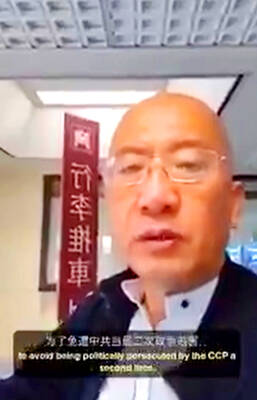
Former China Central Television (CCTV) talk show host Cheng Wanjun (程萬軍) yesterday sought political asylum in Taiwan, a day after arriving at Taiwan Taoyuan International Airport on a connecting flight from Thailand. In a video posted on X, Cheng said he was appealing to Taiwan to grant him temporary asylum on humanitarian grounds while he sought permanent resettlement in a third country. Cheng said he previously served as editor-in-chief of the journal Law and Life and hosted legal affairs programs on state-run CCTV. He said he ran afoul of Chinese authorities in 2019 after a video surfaced showing him discussing rulers whose actions

Support for Democratic Progressive Party Legislator and Taipei mayoral candidate Puma Shen (沈伯洋) reached 52.6 percent, compared with 35.3 percent for Taipei Mayor Chiang Wan-an (蔣萬安) of the Chinese Nationalist Party (KMT), a poll released yesterday by the Strategy and Public Research Institute of Taiwan showed. The poll was held after the candidates’ first debate on Saturday. It showed support for Shen surpassing 50 percent for the first time, with the gap between the two widening to 17.3 percentage points. A breakdown of voting intentions by district found that Shen led Chiang in 11 of Taipei’s 12 districts. His strongest


 RSS