

The Taiwan Solidarity Union (TSU) is showing no sign of giving up its fight to turn the recently signed cross-strait trade agreement over to a public referendum.
Delivering nearly 100 boxes, each holding more than 1,000 signed petition forms, to the Central Election Commission (CEC) yesterday, TSU officials said the Economic Cooperation Framework Agreement (ECFA) could alter the status quo for Taiwan and lock the country into a “one China” framework.
“Everyone can clearly see that this ECFA will change Taiwan’s economic, social and political relationship with China,” TSU Chairman Huang Kun-huei (黃昆輝) said outside the CEC in Taipei. “President Ma Ying-jeou (馬英九) is unilaterally changing the cross-strait situation, and we want to ask him: Doesn’t this require the people’s approval?”
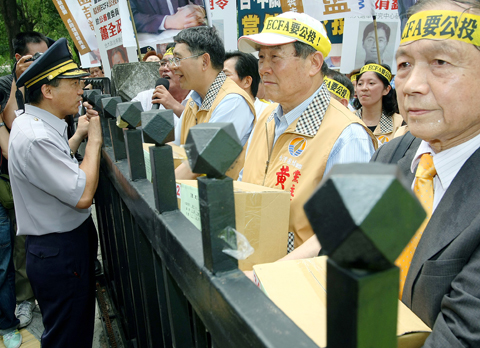
PHOTO: CNA
This is the second referendum proposal on the controversial agreement raised by the TSU, which wants to ask voters whether they agree with the government’s decision to sign the ECFA with China. The earlier proposal was rejected by the Referendum Review Commission last month after it said the TSU’s referendum question and content contradicted one another.
Flanked by a number of pro-independence organizations, including the Taiwan Association of University Professors and the World United Formosans for Independence, a dozen TSU officials arrived outside the commission, wheeling dozens of brown boxes containing the petition forms.
An apparent misunderstanding initially took place between the TSU officials and police after police officers first closed the outside gates, barring entry to party officials trying to hand their petition forms over to the CEC.
Amid cries from dozens of protesters at the scene, who yelled that a referendum “is a public right,” and “the ECFA needs a referendum,” police opened the outside gate to a small number of TSU officials including Huang, but subsequently tried to close the glass doors to the building.
All of the TSU’s 105,000 petition forms were eventually delivered after CEC officials came out to officially accept the TSU proposal, which prevented tension from boiling over as more than 20 police officers looked on.
Under the Referendum Act (公民投票法), the CEC has 15 days to either accept the proposal and pass it on to the Referendum Review Committee or send it back to the organizers pending corrections of any errors found.
The referendum review committee must then make a decision on whether to give the go-ahead within one month.
If passed, the TSU will have to gather a total of 860,000 petition forms — 5 percent of the voting public in the last presidential election — before the proposal can be put to the ballot box.
Fearing a repeat of last month’s rejection of the more than 110,000 petitions submitted at the time, Huang called on members of the Referendum Review Committee to avoid politicizing the referendum process.
“The committee and the CEC are responsible for aiding the people’s right to a referendum, not blocking it. Committee members should not see the public as the enemy,” Huang said.
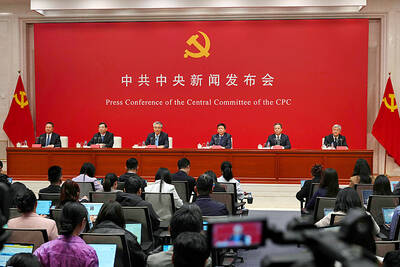
SHORT-TERM OUTLOOK: The Chinese military would most likely focus on rebuilding its organization and leadership in the next few years, experts said Chinese President Xi Jinping’s (習近平) military purge has reduced the risks of a planned war against Taiwan, yet increased the danger of a conflict sparked by a miscalculation or accident, Taiwanese experts said yesterday. They made the comments at a seminar on the Fifth Plenary Session of the Chinese Communist Party’s (CCP) 20th Central Committee held by the research group Secure Taiwan Associate Corp (STA) in Taipei. The wholesale sacking of Chinese People’s Liberation Army (PLA) officers and managers of the aerospace and defense industry is sure to set back Xi’s timetable to prepare the PLA to launch an invasion of Taiwan

BATTLE-TESTED: Czech companies’ drones, software and navigation systems have been tested in the Ukraine war, while other countries’ are lab-tested, a Czech ex-official said Czech manufacturers are interested in setting up drone assembly lines in Taiwan, former Czech Chamber of Deputies president Marketa Pekarova Adamova told a forum in Taipei yesterday. Adamova made the comments at the inauguration of the Global UAV Academy, an organization dedicated to international cooperation in drone supply chains, technological certification and pilot training. The Research Institute for Democracy, Society and Emerging Technology said the Czech Republic is the largest importer of Taiwanese drones and uncrewed aerial vehicle (UAV) components. Adamova, who transitioned to the defense industry after retiring from politics, said the Roman adage “si vis pacem, para bellum” — “If you
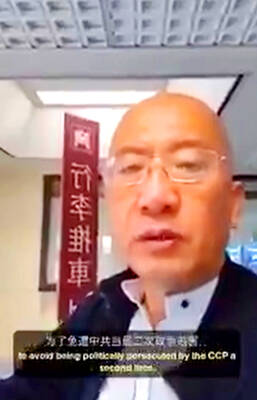
Former China Central Television (CCTV) talk show host Cheng Wanjun (程萬軍) yesterday sought political asylum in Taiwan, a day after arriving at Taiwan Taoyuan International Airport on a connecting flight from Thailand. In a video posted on X, Cheng said he was appealing to Taiwan to grant him temporary asylum on humanitarian grounds while he sought permanent resettlement in a third country. Cheng said he previously served as editor-in-chief of the journal Law and Life and hosted legal affairs programs on state-run CCTV. He said he ran afoul of Chinese authorities in 2019 after a video surfaced showing him discussing rulers whose actions
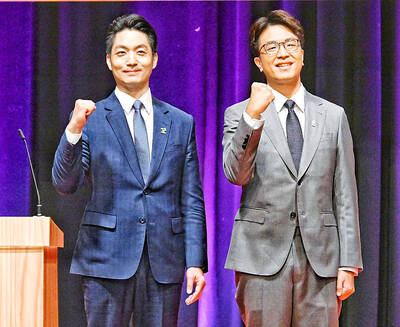
Support for Democratic Progressive Party Legislator and Taipei mayoral candidate Puma Shen (沈伯洋) reached 52.6 percent, compared with 35.3 percent for Taipei Mayor Chiang Wan-an (蔣萬安) of the Chinese Nationalist Party (KMT), a poll released yesterday by the Strategy and Public Research Institute of Taiwan showed. The poll was held after the candidates’ first debate on Saturday. It showed support for Shen surpassing 50 percent for the first time, with the gap between the two widening to 17.3 percentage points. A breakdown of voting intentions by district found that Shen led Chiang in 11 of Taipei’s 12 districts. His strongest


 RSS