

Taiwan should adopt a pragmatic strategy to its participation in ASEAN and China should stop intervening in Taiwan’s regional economic cooperation with other countries, Vice President Vincent Siew (蕭萬長) said yesterday.
The country’s participation in ASEAN would create a win-win situation for Taiwan and the organization in pushing peace and stability in the region and economic development, he said.
“Regional economic integration has become a global trend and Taiwan must participate in ASEAN with a pragmatic attitude,” Siew said in a speech delivered at a forum held on the issue of free-trade agreements (FTA) between Taiwan and East Asian countries in Taipei.
ASEAN, established in 1967, aims to accelerate economic growth, social progress and cultural development in the region and to promote regional peace. It comprises Indonesia, the Philippines, Malaysia, Brunei, Singapore, Thailand, Vietnam, Laos, Cambodia and Myanmar. Arguing that a Taiwan-ASEAN free trade pact would be beneficial to both sides, Siew said that Taiwan ranks as the third largest source of foreign investment in Thailand and Cambodia and the largest source in Vietnam, with investment amounting to US$1.8 billion last year alone, up 630 percent over the previous year. Taiwanese investment in Singapore last year reached US$1.2 billion, up 46 percent, with the figure for the Philippines rising 878 percent to US$200 million, he added.
All these statistics clearly illustrate that Taiwan has brought technological development and job opportunities to the region and that the importance of this bilateral cooperation has been increasing significantly, Siew said.
Siew said Taiwan has expressed many times its wish to join ASEAN, but was rejected because of obstructions from China. He urged the Chinese government to soften its stance.
“China should change its rigid policies and stop interfering in Taiwan’s participation in regional economic cooperation,” he said.
Siew said the government would improve its relations with China and try to sign an FTA with China, seeking to reduce obstructions when negotiating with ASEAN members in the future.
Siew said Taiwan’s GDP could get a significant boost if it were allowed to join the ASEAN plus three (China, Japan and South Korea), or if a cross-strait FTA were inked. He said that Taiwan’s economy would suffer greatly if the country fails to join ASEAN before it expands into ASEAN plus six, with India, Australia and New Zealand also joining.
Siew stressed that Taiwan would use its geographical and transportation advantages to promote the development of peace and stability in the region and at the same time maintain its practical approach to achieving greater economic integration with the region to the benefit of all parties involved.
A former ASEAN secretary-general, Rodolfo Severino, suggested in the forum that Taiwan should join the ASEAN as an “economic entity,” rather than as a sovereign country. The economic relations between Taiwan and Southeast Asian countries were complicated, and ASEAN was also pondering on how to include both China and Taiwan in the organization, he said.
Severino said Southeast Asian countries understood the economic strength of Taiwan, and wanted to strengthen economic ties. However, Taiwan would not be able to join ASEAN if the country failed to adopt a pragmatic strategy.
ADDITIONAL REPORTING BY CNA
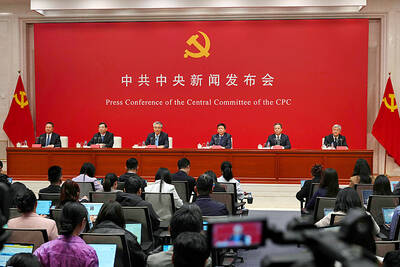
SHORT-TERM OUTLOOK: The Chinese military would most likely focus on rebuilding its organization and leadership in the next few years, experts said Chinese President Xi Jinping’s (習近平) military purge has reduced the risks of a planned war against Taiwan, yet increased the danger of a conflict sparked by a miscalculation or accident, Taiwanese experts said yesterday. They made the comments at a seminar on the Fifth Plenary Session of the Chinese Communist Party’s (CCP) 20th Central Committee held by the research group Secure Taiwan Associate Corp (STA) in Taipei. The wholesale sacking of Chinese People’s Liberation Army (PLA) officers and managers of the aerospace and defense industry is sure to set back Xi’s timetable to prepare the PLA to launch an invasion of Taiwan

BATTLE-TESTED: Czech companies’ drones, software and navigation systems have been tested in the Ukraine war, while other countries’ are lab-tested, a Czech ex-official said Czech manufacturers are interested in setting up drone assembly lines in Taiwan, former Czech Chamber of Deputies president Marketa Pekarova Adamova told a forum in Taipei yesterday. Adamova made the comments at the inauguration of the Global UAV Academy, an organization dedicated to international cooperation in drone supply chains, technological certification and pilot training. The Research Institute for Democracy, Society and Emerging Technology said the Czech Republic is the largest importer of Taiwanese drones and uncrewed aerial vehicle (UAV) components. Adamova, who transitioned to the defense industry after retiring from politics, said the Roman adage “si vis pacem, para bellum” — “If you
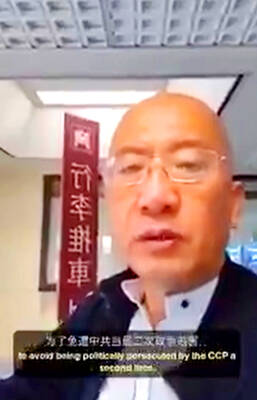
Former China Central Television (CCTV) talk show host Cheng Wanjun (程萬軍) yesterday sought political asylum in Taiwan, a day after arriving at Taiwan Taoyuan International Airport on a connecting flight from Thailand. In a video posted on X, Cheng said he was appealing to Taiwan to grant him temporary asylum on humanitarian grounds while he sought permanent resettlement in a third country. Cheng said he previously served as editor-in-chief of the journal Law and Life and hosted legal affairs programs on state-run CCTV. He said he ran afoul of Chinese authorities in 2019 after a video surfaced showing him discussing rulers whose actions
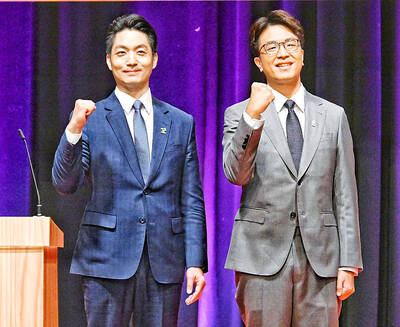
Support for Democratic Progressive Party Legislator and Taipei mayoral candidate Puma Shen (沈伯洋) reached 52.6 percent, compared with 35.3 percent for Taipei Mayor Chiang Wan-an (蔣萬安) of the Chinese Nationalist Party (KMT), a poll released yesterday by the Strategy and Public Research Institute of Taiwan showed. The poll was held after the candidates’ first debate on Saturday. It showed support for Shen surpassing 50 percent for the first time, with the gap between the two widening to 17.3 percentage points. A breakdown of voting intentions by district found that Shen led Chiang in 11 of Taipei’s 12 districts. His strongest


 RSS