

Yesterday's election was billed as a must win for Chinese Nationalist Party (KMT) Chairman Ma Ying-jeou (馬英九), as an unfavorable result would raise the prospect of challenges to his leadership emerging in the pan-blue camp in the lead up to the 2008 presidential election, political analysts said.
The result -- retaining the mayoral position in Taipei but failing to challenge the Democratic Progressive Party (DPP) in Kaohsiung -- did not provide the unambiguous result Ma needed, they said.
Taipei has usually been considered a pan-blue city, with two-thirds of voters favoring the pan-blue camp -- consisting of the KMT, People First Party (PFP) and the New Party -- in previous elections.
As electoral behavior in Taipei hasn't changed much in recent years, the KMT's re-election was predicable, said Liu I-chu (劉義周), a political science professor at National Chengchi University.
"Because we had candidates that were incapable of drawing voters from the other side, and a string of scandals had dissuaded swing voters from casting ballots, the election was basically determined by diehard pan-blue and pan-green voters," Liu said.
In this regard, the indicator needed to gauge how convincingly the KMT won Taipei was not Hau Lung-bin's (郝龍斌) level of voter support but the number of votes PFP Chairman James Soong (宋楚瑜) obtained, said Chao Yung-mau (趙永茂), a political science professor at National Taiwan University.
According to the Taipei Municipal Election Committee, Soong garnered 4.14 percent of the vote, much lower than the party's 17.6 percent showing in the 2002 city councilor election and 17.11 percent it won in the 2004 legislative election.
`Dump-save'
The "dump save" tactic of the 1998 Taipei mayoral election -- in which the New Party candidate ran a distant third with 2.97 percent of the vote, one-tenth of what the party received in 1994 -- emerged again.
"The result will make KMT-PFP relations, which were already damaged due to their deep rifts ahead of the election, even worse," Chao said. "With Soong receiving few votes, the drag effect that PFP has been exerting on the KMT would be significantly reduced."
Liu shared a similar view, saying that the election had proved that smaller parties or independents have little chance of winning elections, especially in polls where only one seat is being contested.
"The PFP will be gradually weakened in the face of the 2007 legislative election, which is going to employ the single member-district, two-vote system,'" Liu said.
Considering this, Liu said the gauge of the KMT's victory this time should be the Kaohsiung mayoral election, which is also of significance to the party's development.
"At this time when the DPP's support rate is at an historically low, Ma needs to explain why the KMT was unable to beat DPP," said Chiou Chang-tay (丘昌泰), a former director of the Research Center for Public Opinion and Election Studies at National Taipei University.
Chiou said that while the southern city has been the stronghold of the pan-green camp, standard electoral behavior provides an insufficient explanation of the KMT's failure in Kaohsiung.
"The failure would surely pose a challenge to Ma's leadership of the KMT. On the one hand, Ma's acceptability in southern Taiwan is still questionable. On the other, failing to defeat a DPP embroiled in multiple troubles was a frustration to the KMT," Chiou said.
While Ma has been widely viewed as a shoo-in for the 2008 presidential election by pan-blue supporters, a small group of ethnic Taiwanese lawmakers are not so confident.
Lien-Wang ticket
About 30 lawmakers, who are on good terms with former KMT chairman Lien Chan (
"The DPP's election could provide encouragement to the KMT's pro-localizational faction, empowering them to make more demands of Ma on issues of concern to them," Chao said.
For the KMT as a whole, Chiou said the party should take it as a "warning."
"Over the past six years after losing power in 2000, the fact that Hau didn't garner as many votes as expected and KMT candidate Huang Chun-ying's (黃俊英) loss to DPP candidate Chen Chu (陳菊) suggests that the party hasn't extended its supporting basis through reform," he added.
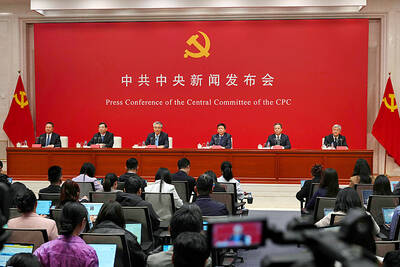
SHORT-TERM OUTLOOK: The Chinese military would most likely focus on rebuilding its organization and leadership in the next few years, experts said Chinese President Xi Jinping’s (習近平) military purge has reduced the risks of a planned war against Taiwan, yet increased the danger of a conflict sparked by a miscalculation or accident, Taiwanese experts said yesterday. They made the comments at a seminar on the Fifth Plenary Session of the Chinese Communist Party’s (CCP) 20th Central Committee held by the research group Secure Taiwan Associate Corp (STA) in Taipei. The wholesale sacking of Chinese People’s Liberation Army (PLA) officers and managers of the aerospace and defense industry is sure to set back Xi’s timetable to prepare the PLA to launch an invasion of Taiwan

BATTLE-TESTED: Czech companies’ drones, software and navigation systems have been tested in the Ukraine war, while other countries’ are lab-tested, a Czech ex-official said Czech manufacturers are interested in setting up drone assembly lines in Taiwan, former Czech Chamber of Deputies president Marketa Pekarova Adamova told a forum in Taipei yesterday. Adamova made the comments at the inauguration of the Global UAV Academy, an organization dedicated to international cooperation in drone supply chains, technological certification and pilot training. The Research Institute for Democracy, Society and Emerging Technology said the Czech Republic is the largest importer of Taiwanese drones and uncrewed aerial vehicle (UAV) components. Adamova, who transitioned to the defense industry after retiring from politics, said the Roman adage “si vis pacem, para bellum” — “If you
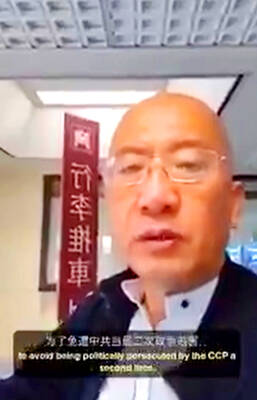
Former China Central Television (CCTV) talk show host Cheng Wanjun (程萬軍) yesterday sought political asylum in Taiwan, a day after arriving at Taiwan Taoyuan International Airport on a connecting flight from Thailand. In a video posted on X, Cheng said he was appealing to Taiwan to grant him temporary asylum on humanitarian grounds while he sought permanent resettlement in a third country. Cheng said he previously served as editor-in-chief of the journal Law and Life and hosted legal affairs programs on state-run CCTV. He said he ran afoul of Chinese authorities in 2019 after a video surfaced showing him discussing rulers whose actions
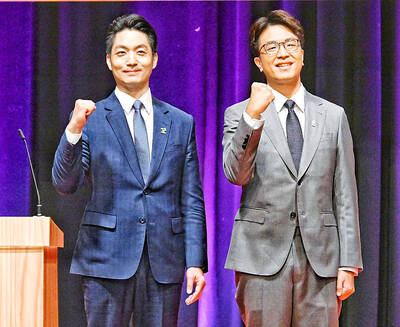
Support for Democratic Progressive Party Legislator and Taipei mayoral candidate Puma Shen (沈伯洋) reached 52.6 percent, compared with 35.3 percent for Taipei Mayor Chiang Wan-an (蔣萬安) of the Chinese Nationalist Party (KMT), a poll released yesterday by the Strategy and Public Research Institute of Taiwan showed. The poll was held after the candidates’ first debate on Saturday. It showed support for Shen surpassing 50 percent for the first time, with the gap between the two widening to 17.3 percentage points. A breakdown of voting intentions by district found that Shen led Chiang in 11 of Taipei’s 12 districts. His strongest


 RSS