

The purpose of the "defensive referendum" is to maintain the status quo on both sides of the Taiwan Strait and has nothing to do with independence, President Chen Shui-bian (
Opposition parties have accused Chen of provoking China following his campaign promise last Saturday to hold a "defensive referendum" on the day of the presidential election. The international community has also speculated about whether Chen's "defensive referendum" is a concrete action toward Taiwanese independence.
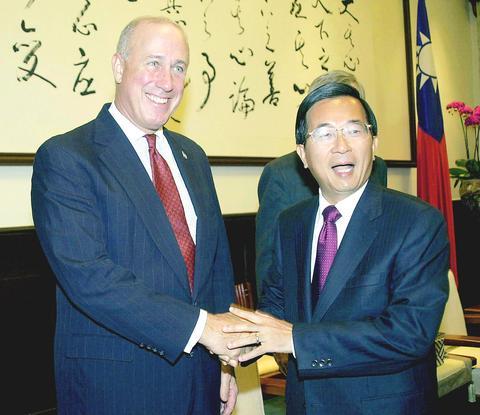
PHOTO: REUTERS
peacemaking
Chen told foreign guests at a reception at the Presidential Office yesterday that the referendum is not meant to provoke, but is rather a way to make peace.
"I have to reaffirm that I will firmly maintain my `five noes' policy, which was revealed on May 20, 2000," Chen said.
"Like I have asserted many times before, any movement to deepen Taiwan's democracy, including the people's basic right to have a referendum and hastening the process to write a new constitution, will honor the five-noes promise. It would have no bearing on the independence-versus-reunification debate."
Chen said article 17 of the new Referendum Law (公民投票法), which refers to a "defensive referendum," can be used to strengthen a united country and would be highly effective in bringing foreign dangers to the public's attention.
psychological defense
"The lack of awareness about possible crises and enemy threats is one of the major problems in Taiwan. We must promote the concept of national defense as well as individuals' psychological defenses," Chen said.
He said that China still refused to denounce military action against Taiwan while it is continuing to buy more arms and increasing military expenditure, including the deployment of 496 ballistic missiles targeted at Taiwan.
"Every citizen of Taiwan should fully understand this serious case, and I must also appeal to all the countries in the Asia-Pacific region to squarely face China's threat, which poses a danger not only to Taiwan, but also to regional peace and stability," Chen said.
He said that the defensive referendum would be an effective means of letting China know what Taiwan's 23 million people are really thinking. According to Chen, most Taiwanese want peace.
status quo
"It is extremely important that Beijing should listen to Taiwan's mainstream public opinion. Therefore the goal of the defensive referendum is to protect the status quo in Taiwan," he said.
Chen made the remarks during a meeting with US Senator Jeff Bingman, who arrived in Taipei on Wednesday on a fact-finding mission concerning Taiwan's high-tech development and the nation's supply of and demand for energy.
During yesterday's meeting, Chen made a point of standing next to Douglas Paal, director of the American Institute in Taiwan, to allow the media to take pictures of them. Some Chinese-language media reported that Paal had been summoned back to Washington for a briefing on Taiwan's referendum controversy. According to these reports, this was a sign that the US is upset with Chen.
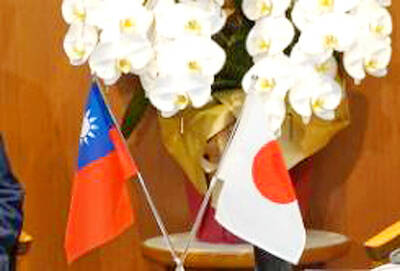
Taiwan and Japan might sign a wide-ranging trade agreement by the end of this year, which could help break a deadlock in Taiwan’s trade diplomacy if completed, Nikkei Asia reported yesterday. Japan is negotiating with the administration of President William Lai (賴清德) to reach a comprehensive economic agreement modeled after the Enhanced Trade Partnership Arrangement finalized by the UK and Taiwan in 2023, it said, citing two sources familiar with the matter. “The Enhanced Trade Partnership between the UK and Taiwan sets a precedent for Japan to follow,” one of the sources told the media outlet. The framework leaves room for future agreements
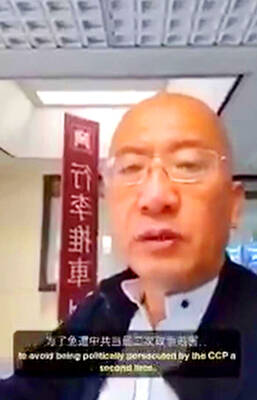
Chinese national Cheng Wanjun (程萬軍), who was at Taiwan Taoyuan International Airport after arriving on a connecting flight from Thailand on Monday and sought asylum in Taiwan, was deported to Thailand early yesterday, the National Immigration Agency (NIA) said. In a video circulating on X, Cheng identified himself as a former host at China Central Television (CCTV) and said he was seeking temporary humanitarian protection in Taiwan. Cheng said he was sentenced to six years in prison after he was recorded and reported to authorities in 2019 for criticizing “a ruler who loses his country.” After his release, he was forced to go
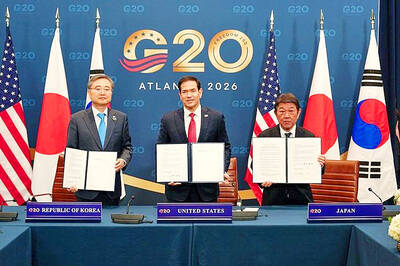
Taiwan yesterday welcomed and expressed appreciation for foreign ministers from the US, Japan and South Korea for emphasizing the importance of maintaining peace and stability across the Taiwan Strait at a trilateral meeting on the sidelines of the G20 in Atlanta, Georgia, on Friday. US Secretary of State Marco Rubio met with Japanese Minister of Foreign Affairs Motegi Toshimitsu and South Korean Minister of Foreign Affairs Cho Hyun to review the progress of a trilateral partnership that aims to advance security and prosperity in a free and open Indo-Pacific region, the US Department of State said in a statement. They emphasized
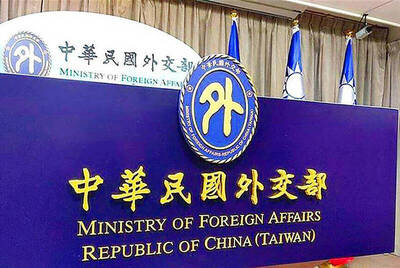
VARYING TREATMENT: During Chen Shui-bian’s presidency, China had rejected Taiwan’s APEC envoy, but had personally handed an invitation to the MAC head under the KMT Taiwan has lodged a protest over China’s discriminatory handling of its invitation to the upcoming APEC summit in Shenzhen, China, the Ministry of Foreign Affairs said yesterday. China, the host of the meeting on Nov. 18 and 19, sent Taiwan a letter, but it was not a formal invitation, an official familiar with the matter said on condition of anonymity. China did not address Taiwan as “Chinese Taipei,” the nation’s official APEC designation, in the invitation, deviating from established protocol and downgrading the nation’s status, the official said. The government immediately lodged a strong protest against actions by China that undermine Taiwan’s status,


 RSS