

President Chen Shui-bian (
Since the planned referendums have nothing to do with sovereignty, Chen said, China also has no right to oppose them.
"The US government's position is clear. They understand that referendums are a universal value and a basic right of people. They have, therefore, never opposed the idea of referendums in Taiwan, recognizing that this is a matter for Taiwan's people [to decide]," Chen said at a tea gathering with local media chiefs last night.
"Actually, the US government is only responding to the Chinese government's concern that referendums have implications for sovereignty," Chen said. "But, of the whole series of democratic reforms that Taiwan has undergone in the past, which of them has China supported?"
"The lifting of martial law, press freedom, legislative reform, direct presidential elections -- they opposed each from beginning to end. But these things are now realities," he said, adding that Taiwan will not halt reforms and progress just because of opposition from China.
Chen said that China was concerned about the impact of referendums on sovereignty, despite his having made clear that they would only be used for civil affairs.
"They [referendums] have nothing to do with sovereignty and the other side of the Strait has no reason to oppose them," he said.
"If Taiwan wishes to hold referendums to protect its sovereignty, China has no grounds to oppose its doing so, especially since referendums are not a matter relating to the sovereignty issue," he said.
Chen was reacting to questions from the media about the attitudes of the US and China toward referendums in Taiwan.
His remarks came during a discussion with more than 50 media executives on the second day of his cross-country tour.
The president said the referendum issue in the past has been associated with Taiwan independence and war mongering, but that people now see things differently. According to Chen, people now recognize that referendums are a universal value and a basic right that cannot be denied by any person, political party or state.
Chen has said that before the presidential election next March, the Cabinet will hold referendums on the fate of the partially completed Fourth Nuclear Power Plant and Taiwan's participation in the World Health Organization (WHO).
As for whether the nation's entry to the WHO was an issue that had a bearing on sovereignty, Chen said, "Medical treatment has no borders. There is no reason why Taiwan should not enter the WHO.
"This problem stems from the over-politicization of the other side," he said.
"If Taiwan could enter the WHO without hindrance, then it wouldn't need to hold a referendum to address this question. But the problem is that Taiwan has fought to gain WHO entry for seven years and has constantly come up against China's obstruction represented by the view that Taiwan's entry to the WHO would amount to a challenge to Beijing's `one China' principle," he said.
That the country should enter the WHO is perfectly right and proper and reflects the will of the nation's 23 million people, Chen said.
Also See Story:
Taiwan to sign its first-ever FTA
Lu calls for Panamanian solidarity
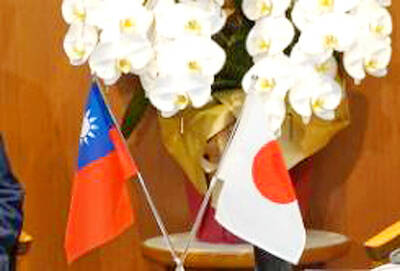
Taiwan and Japan might sign a wide-ranging trade agreement by the end of this year, which could help break a deadlock in Taiwan’s trade diplomacy if completed, Nikkei Asia reported yesterday. Japan is negotiating with the administration of President William Lai (賴清德) to reach a comprehensive economic agreement modeled after the Enhanced Trade Partnership Arrangement finalized by the UK and Taiwan in 2023, it said, citing two sources familiar with the matter. “The Enhanced Trade Partnership between the UK and Taiwan sets a precedent for Japan to follow,” one of the sources told the media outlet. The framework leaves room for future agreements
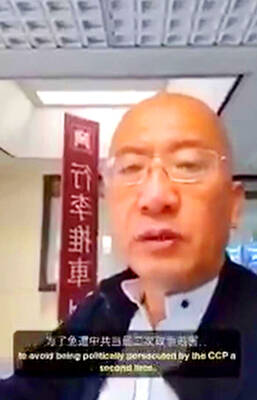
Chinese national Cheng Wanjun (程萬軍), who was at Taiwan Taoyuan International Airport after arriving on a connecting flight from Thailand on Monday and sought asylum in Taiwan, was deported to Thailand early yesterday, the National Immigration Agency (NIA) said. In a video circulating on X, Cheng identified himself as a former host at China Central Television (CCTV) and said he was seeking temporary humanitarian protection in Taiwan. Cheng said he was sentenced to six years in prison after he was recorded and reported to authorities in 2019 for criticizing “a ruler who loses his country.” After his release, he was forced to go
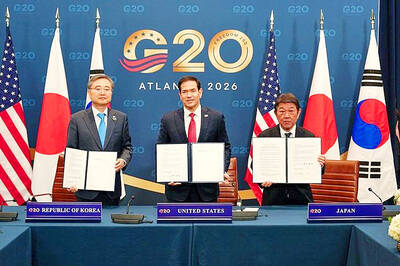
Taiwan yesterday welcomed and expressed appreciation for foreign ministers from the US, Japan and South Korea for emphasizing the importance of maintaining peace and stability across the Taiwan Strait at a trilateral meeting on the sidelines of the G20 in Atlanta, Georgia, on Friday. US Secretary of State Marco Rubio met with Japanese Minister of Foreign Affairs Motegi Toshimitsu and South Korean Minister of Foreign Affairs Cho Hyun to review the progress of a trilateral partnership that aims to advance security and prosperity in a free and open Indo-Pacific region, the US Department of State said in a statement. They emphasized
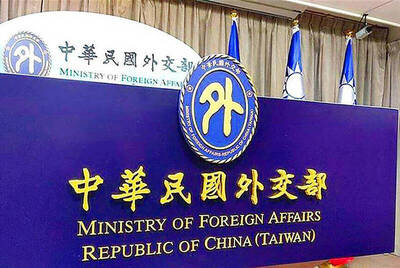
VARYING TREATMENT: During Chen Shui-bian’s presidency, China had rejected Taiwan’s APEC envoy, but had personally handed an invitation to the MAC head under the KMT Taiwan has lodged a protest over China’s discriminatory handling of its invitation to the upcoming APEC summit in Shenzhen, China, the Ministry of Foreign Affairs said yesterday. China, the host of the meeting on Nov. 18 and 19, sent Taiwan a letter, but it was not a formal invitation, an official familiar with the matter said on condition of anonymity. China did not address Taiwan as “Chinese Taipei,” the nation’s official APEC designation, in the invitation, deviating from established protocol and downgrading the nation’s status, the official said. The government immediately lodged a strong protest against actions by China that undermine Taiwan’s status,


 RSS