Three Optimization Tips for C++

                                Andrei Alexandrescu, Ph.D.
                                   Research Scientist, Facebook
                                  andrei.alexandrescu@fb.com


© 2012- Facebook. Do not redistribute.                            1 / 33
This Talk


         • Basics
         • Reduce strength
         • Minimize array writes


© 2012- Facebook. Do not redistribute.   2 / 33
Things I Shouldn’t Even


© 2012- Facebook. Do not redistribute.       3 / 33
Today’s Computing Architectures


         • Extremely complex
         • Trade reproducible performance for average
           speed
         • Interrupts, multiprocessing are the norm
         • Dynamic frequency control is becoming
           common
         • Virtually impossible to get identical timings
           for experiments


© 2012- Facebook. Do not redistribute.                     4 / 33
Intuition


         • Ignores aspects of a complex reality
         • Makes narrow/obsolete/wrong assumptions


© 2012- Facebook. Do not redistribute.               5 / 33
Intuition


         • Ignores aspects of a complex reality
         • Makes narrow/obsolete/wrong assumptions


         • “Fewer instructions = faster code”


© 2012- Facebook. Do not redistribute.               5 / 33
Intuition


         • Ignores aspects of a complex reality
         • Makes narrow/obsolete/wrong assumptions


         • “Fewer instructions = faster code”


© 2012- Facebook. Do not redistribute.               5 / 33
Intuition


         • Ignores aspects of a complex reality
         • Makes narrow/obsolete/wrong assumptions


         • “Fewer instructions = faster code”
         • “Data is faster than computation”


© 2012- Facebook. Do not redistribute.               5 / 33
Intuition


         • Ignores aspects of a complex reality
         • Makes narrow/obsolete/wrong assumptions


         • “Fewer instructions = faster code”
         • “Data is faster than computation”


© 2012- Facebook. Do not redistribute.               5 / 33
Intuition


         • Ignores aspects of a complex reality
         • Makes narrow/obsolete/wrong assumptions


         • “Fewer instructions = faster code”
         • “Data is faster than computation”
         • “Computation is faster than data”


         • The only good intuition: “I should time this.”


© 2012- Facebook. Do not redistribute.                      5 / 33
Paradox


      Measuring gives you a
      leg up on experts who
      don’t need to measure


© 2012- Facebook. Do not redistribute.   6 / 33
Common Pitfalls


         • Measuring speed of debug builds
         • Different setup for baseline and measured
             ◦ Sequencing: heap allocator
             ◦ Warmth of cache, files, databases, DNS
         • Including ancillary work in measurement
             ◦ malloc, printf common
         • Mixtures: measure ta + tb , improve ta ,
           conclude tb got improved
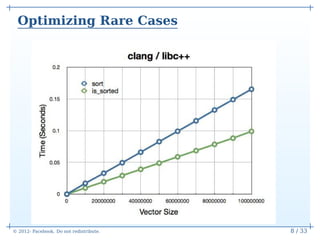
         • Optimize rare cases, pessimize others


© 2012- Facebook. Do not redistribute.                 7 / 33
Optimizing Rare Cases


© 2012- Facebook. Do not redistribute.   8 / 33
More generalities


         • Prefer static linking and PDC
         • Prefer 64-bit code, 32-bit data
         • Prefer (32-bit) array indexing to pointers
            ◦ Prefer a[i++] to a[++i]
         • Prefer regular memory access patterns
         • Minimize flow, avoid data dependencies


© 2012- Facebook. Do not redistribute.                  9 / 33
Storage Pecking Order


         • Use enum for integral constants
         • Use static const for other immutables
            ◦ Beware cache issues
         • Use stack for most variables
         • Globals: aliasing issues
         • thread_local slowest, use local caching
            ◦ 1 instruction in Windows, Linux
            ◦ 3-4 in OSX


© 2012- Facebook. Do not redistribute.               10 / 33
Reduce Strength


© 2012- Facebook. Do not redistribute.             11 / 33
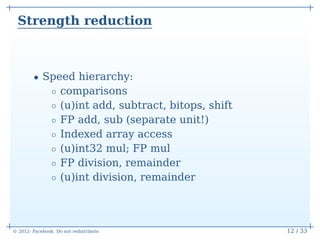
Strength reduction


         • Speed hierarchy:
            ◦ comparisons
            ◦ (u)int add, subtract, bitops, shift
            ◦ FP add, sub (separate unit!)
            ◦ Indexed array access
            ◦ (u)int32 mul; FP mul
            ◦ FP division, remainder
            ◦ (u)int division, remainder


© 2012- Facebook. Do not redistribute.              12 / 33
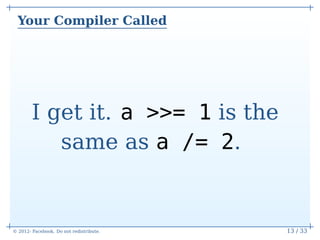
Your Compiler Called


        I get it. a >>= 1 is the
           same as a /= 2.


© 2012- Facebook. Do not redistribute.   13 / 33
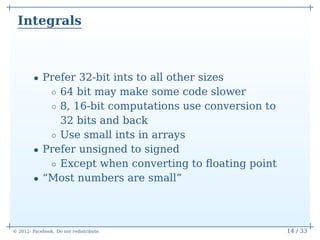
Integrals


         • Prefer 32-bit ints to all other sizes
            ◦ 64 bit may make some code slower
            ◦ 8, 16-bit computations use conversion to
              32 bits and back
            ◦ Use small ints in arrays
         • Prefer unsigned to signed
            ◦ Except when converting to floating point
         • “Most numbers are small”


© 2012- Facebook. Do not redistribute.                   14 / 33
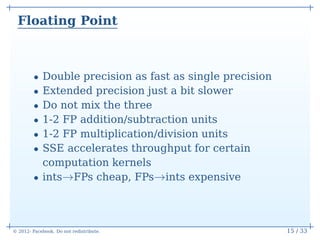
Floating Point


         • Double precision as fast as single precision
         • Extended precision just a bit slower
         • Do not mix the three
         • 1-2 FP addition/subtraction units
         • 1-2 FP multiplication/division units
         • SSE accelerates throughput for certain
           computation kernels
         • ints→FPs cheap, FPs→ints expensive


© 2012- Facebook. Do not redistribute.                    15 / 33
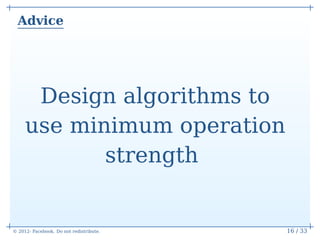
Advice


      Design algorithms to
     use minimum operation
            strength


© 2012- Facebook. Do not redistribute.   16 / 33
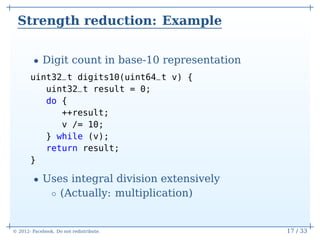
Strength reduction: Example


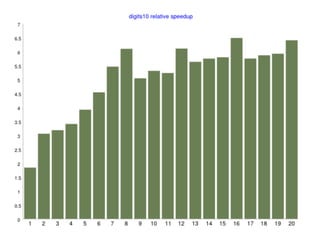
         • Digit count in base-10 representation
       uint32_t digits10(uint64_t v) {
          uint32_t result = 0;
          do {
             ++result;
             v /= 10;
          } while (v);
          return result;
       }

         • Uses integral division extensively
            ◦ (Actually: multiplication)


© 2012- Facebook. Do not redistribute.             17 / 33
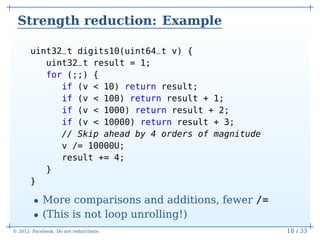
Strength reduction: Example

       uint32_t digits10(uint64_t v) {
          uint32_t result = 1;
          for (;;) {
             if (v < 10) return result;
             if (v < 100) return result + 1;
             if (v < 1000) return result + 2;
             if (v < 10000) return result + 3;
             // Skip ahead by 4 orders of magnitude
             v /= 10000U;
             result += 4;
          }
       }

         • More comparisons and additions, fewer /=
         • (This is not loop unrolling!)
© 2012- Facebook. Do not redistribute.                18 / 33
Minimize Array Writes


© 2012- Facebook. Do not redistribute.        20 / 33
Minimize Array Writes: Why?


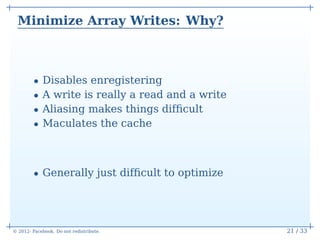
         •   Disables enregistering
         •   A write is really a read and a write
         •   Aliasing makes things difficult
         •   Maculates the cache


         • Generally just difficult to optimize


© 2012- Facebook. Do not redistribute.              21 / 33
Minimize Array Writes


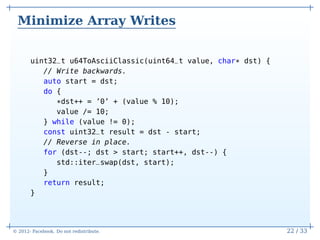
       uint32_t u64ToAsciiClassic(uint64_t value, char* dst) {
          // Write backwards.
          auto start = dst;
          do {
             *dst++ = ’0’ + (value % 10);
             value /= 10;
          } while (value != 0);
          const uint32_t result = dst - start;
          // Reverse in place.
          for (dst--; dst > start; start++, dst--) {
             std::iter_swap(dst, start);
          }
          return result;
       }


© 2012- Facebook. Do not redistribute.                           22 / 33
Minimize Array Writes
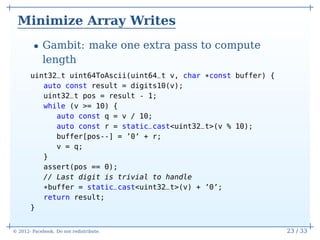
         • Gambit: make one extra pass to compute
            length
       uint32_t uint64ToAscii(uint64_t v, char *const buffer) {
          auto const result = digits10(v);
          uint32_t pos = result - 1;
          while (v >= 10) {
             auto const q = v / 10;
             auto const r = static_cast<uint32_t>(v % 10);
             buffer[pos--] = ’0’ + r;
             v = q;
          }
          assert(pos == 0);
          // Last digit is trivial to handle
          *buffer = static_cast<uint32_t>(v) + ’0’;
          return result;
       }


© 2012- Facebook. Do not redistribute.                            23 / 33
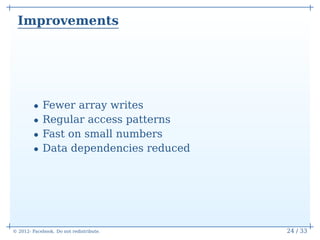
Improvements


         •   Fewer array writes
         •   Regular access patterns
         •   Fast on small numbers
         •   Data dependencies reduced


© 2012- Facebook. Do not redistribute.   24 / 33
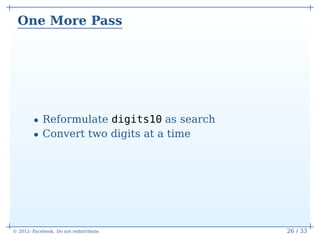
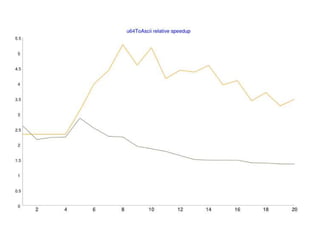
One More Pass


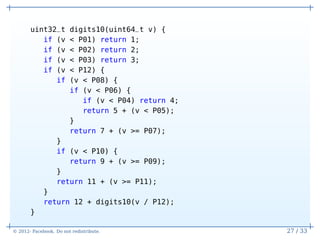
         • Reformulate digits10 as search
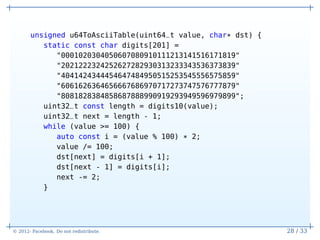
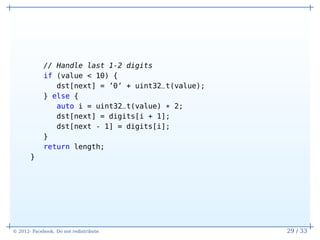
         • Convert two digits at a time


© 2012- Facebook. Do not redistribute.      26 / 33
uint32_t         digits10(uint64_t v) {
          if (v         < P01) return 1;
          if (v         < P02) return 2;
          if (v         < P03) return 3;
          if (v         < P12) {
             if         (v < P08) {
                        if (v < P06) {
                           if (v < P04) return 4;
                           return 5 + (v < P05);
                        }
                        return 7 + (v >= P07);
                   }
                   if (v < P10) {
                      return 9 + (v >= P09);
                   }
                   return 11 + (v >= P11);
             }
             return 12 + digits10(v / P12);
       }

© 2012- Facebook. Do not redistribute.              27 / 33
unsigned u64ToAsciiTable(uint64_t value, char* dst) {
          static const char digits[201] =
             "0001020304050607080910111213141516171819"
             "2021222324252627282930313233343536373839"
             "4041424344454647484950515253545556575859"
             "6061626364656667686970717273747576777879"
             "8081828384858687888990919293949596979899";
          uint32_t const length = digits10(value);
          uint32_t next = length - 1;
          while (value >= 100) {
             auto const i = (value % 100) * 2;
             value /= 100;
             dst[next] = digits[i + 1];
             dst[next - 1] = digits[i];
             next -= 2;
          }


© 2012- Facebook. Do not redistribute.                         28 / 33
// Handle last 1-2 digits
             if (value < 10) {
                dst[next] = ’0’ + uint32_t(value);
             } else {
                auto i = uint32_t(value) * 2;
                dst[next] = digits[i + 1];
                dst[next - 1] = digits[i];
             }
             return length;
       }


© 2012- Facebook. Do not redistribute.               29 / 33
Summary


© 2012- Facebook. Do not redistribute.             32 / 33
Summary


         • You can’t improve what you can’t measure
            ◦ Pro tip: You can’t measure what you don’t
              measure
         • Reduce strength
         • Minimize array writes


© 2012- Facebook. Do not redistribute.                    33 / 33
Ad