• About Us
  • Contact Us
  • Advertise
  • Newsletter sign-up
  • Login/Register
Electronics Weekly
  • News
  • Business
  • Markets
  • Design
  • Products
    Linear / Mixed Signal ICs
    Analogue

    Asics

    Connectors
    Digital ICs
    Discretes
    Displays

    DSPs

    Emech & Enclosures
    FPGAS
    LED Technologies
    Memory
    MPUS/MCUS
    Passives
    Power

    Raspberry Pi

    RF & Microwave

    Sensors
    Software/EDA

    Test & Measurement

  • Blogs
  • Media
    • EW Podcast – CHIIPS
    • EW TV
    • EW Issue Archive
  • Events
    • Calendar
    • Electronica
    • Electronics Weekly Elektra Awards
    • Electronics Weekly BrightSparks Awards
    • Electronics Weekly Women Leaders in Electronics Awards
    • Embedded World
    • Energy Efficiency for the AI Age
  • Resources
    • EW Compare – Comparison Search Engine
    • Component search engine
    • Whitepapers and competitions
No Result
View All Result
Electronics Weekly
No Result
View All Result
Home Made By Monkeys Electrical/Electronics

Shake-to-Charge Flashlight is a Fake

Staff by Staff
21st December 2007
in Electrical/Electronics, Fakes & Frauds, Made in China
3

solarpanela.jpgDiscover Circuits founder Dave Johnson found this broken solar powered path light near a railroad track. Like many engineers who find things and think the part might come in handy, he put it in his pocket. Upon closer inspection, he realized that instead of filling the 3-square-inches of available space with solar cells, the unit skimped, using four skinny cells that yield an active area of only .83 square inches.

shake1-1a.jpg

Craig Johnson, who runs the website www.ledmuseum.org, where he posts some highly entertaining product reviews, had a few choice words to say about this Chinese-made flashlight advertised as “no battery needed.”

He writes in the Discover Circuits forum: “I measured the open circuit voltage at 2.3V and measured the short circuit current at 37ma in sunlight.. I started tracing out the circuit used in this path light assembly. It appears that they used a 1N5819 schottlky diode between the solar panel and a single 1.2v NiMH rechargeable AA cell. The 1.2V from the single cell is too low to power any LED directly, so they used a transistorized (no ICs) DC to DC converter, to boost the voltage high enough to drive a single, most likely yellow, LED.” See circuit here. Dave’s further calculations revealed that while the light lights, it’s only good for about six hours — not nearly enough for the long Colorado winter nights. In other words, he says, “this design stinks.” measured the open circuit voltage at 2.3v and measured the short circuit current at 37ma in direct sunlight. I started tracing out the circuit used in this path light assembly. It appears that they used a 1N5819 schottlky diode between the solar panel and a single 1.2v NiMH rechargeable AA cell. The 1.2 volts from the single cell is too low to power any LED directly, so they used a transistorized (no ICs) DC to DC converter, to boost the voltage high enough to drive a single, most likely yellow, LED. During sunlight charging, the four solar cells act as a constant current source, feeding a maximum 37ma of current to the single battery cell. Other solar powered path lights use a higher solar panel voltage, which can charge two AA cells. The advantage of two cells is that the LED driver circuit is nothing but a current limiting resistor connected to a simple circuit, which turns off the LED when there is sunlight. This is typically done by monitoring the voltage from the solar cells. The thing I picked up seemed to be a cheap knock-off. But, would it work? Let’s make a few assumptions. Let’s say that this thing was placed in a sunny area and got a full 6 hours of sunlight during the day. With a current of 37ma, the current pumped into the rechargeable battery would be 37 x 6 or 222 milliamp-hours into a 1.2v battery cell. That is 1.2 volts times 0.22 amps for 0.27 watt-hours of energy. Now, let’s assume that the yellow LED had a forward voltage drop of 2 volts at 20ma and was driven by this battery. We will not even factor in the losses of the DC to DC converter or the battery charging losses. Two volts times 0.02 amps is 0.04 watts. If we divide 0.27 watt-hours by 0.04 watts, we get 6.75 hours. That means that the energy during those 6 hours of sunlight would be enough to keep the path light lit for about 6 hours at night. At least here in Colorado, that would not be long enough to make it through the night. If the sun went down at 5:00 in the afternoon, the LED path light would turn on but would be off again by 11:00 PM. The battery would be dead. Maybe they drive the LED with less current to extend the operating time. But, overall, I think the design stinks. The manufacturer was trying to save money by using only one rechargeable cell, and a very small solar cell area. Sure, the light lights but not for very long.” “Horse puckey! The LED Survival Light is a plastic flashlight that is supposed to be self-charging (by giving it a shaking or “spanking the monkey” motion), but this shake mechanism is just a phony – the flashlight actually operates from two CR2032 disposable lithium coin cells. The “magnet” inside is just a steel rod, and the two wire leads from the coil are shorted to one another.” Apparently, though, they aren’t all bad, as one of Craig’s readers reports: “My light looks exactly like those pictured, right down to the number of bumps on the body, but the magnet actually IS a magnet! I can lift the unit by holding a jeweller’s screwdriver above the magnet. The leads from the coil aren’t shorted, and are soldered to different connections on the board. I removed the two coin cells and turned the light on, and it works, but the output is very dim. There is a small capacitor on the underside of the board that, I assume, is charged by the magnet/coil. The light was re-assembled and turned on for 42 minutes with no discernable dimming, using the CR2032s, no doubt.” Morale of the story: Buyer Beware, when you’re shopping at a dollar store!


Add us as preferred source
ShareTweetSharePin
Previous Post

Mrs Memec

Next Post

Chairlift Failure Sends Skier Plummeting

Staff

Staff

Next Post

Chairlift Failure Sends Skier Plummeting

Comments 3

  1. Ian Paxton says:
    19 years ago

    Hi,
    I got one of these for Christmas 2006. It is still going strong except that the on switch needs to be pressed to keep it on. Something must have broken so it won’t stay on by itself, even in the on mode.
    I have found that it has dimmed and got so bad it was useless. BUT, I spent a few hours shaking it, I know that is a long time and the noise is irritating, but it has come back to life. I also found that when I did shake it, it got brighter when the magnet passed through the middle, for a second of course.
    So mine seems to work but only with a lot of effort.
    I use it quite often actually.
    Paxo

    Reply
  2. John Goldsmith says:
    19 years ago

    Mine came from a filling station, and looks identical on the outside apart from the rows of bumps but the power definitely comes from the magnet and coil, being stored in a 0.22 Farad (not microfarad!) capacitor on the PCB. The on/off switch has a little magnet on the slider and a reed switch on the PCB. This maintains the integrity of the watertight housing. The operating magnet is actually some small powerful magnets embedded in a larger lump, presumably steel. A nuisance as it drags all the recent UK coinage out of your pocket. I’m sure the unit would be more efficient with metal springs as end stops – the rubber used seems to absorb all the energy. I recently bought a wind-up 3 LED unit which is much brighter and much longer running (and less embarassing to operate).

    Reply
  3. Stav Stef says:
    19 years ago

    i have a shake to charge flashlight and it working i have it for 3 years and when i shake it the light is stronger
    thank u

    Reply

Leave a Reply Cancel reply

Your email address will not be published. Required fields are marked *

Social Media

Most Popular

  • Peter Schiefer, Division President Automotive at Infineon

    Infineon and Qualcomm hook up for in-car computing

    0 shares
    Share 0 Tweet 0
  • FormalOS adds structure to RTL verification and sign-off

    0 shares
    Share 0 Tweet 0
  • Toyota and Waymo to launch robotaxis in Japan

    0 shares
    Share 0 Tweet 0
  • Bosch to spin off semis

    0 shares
    Share 0 Tweet 0
  • Onsemi rumoured to be in talks to acquire Ferric

    0 shares
    Share 0 Tweet 0

Don’t miss out on EW Newsletters

Get our news, blogs and comments straight to your inbox! Sign up for the Electronics Weekly newsletters: Mannerisms, Gadget Master and the Daily and Weekly roundups.


Find out more »

Tune into EW’s CHIIPS Podcast

The excellent Electronics Weekly podcast, CHIIPS, is brought to you by our editor Caroline Hayes. Hear interesting insights from a range of industry figures.


Catch all the episodes »

  • Latest
  • Comments
Apple’s harvest

Apple’s harvest

5th November 2026
Sony IMX742 1mm square image sensor serves single-use endoscopes

Sony IMX742 1mm square image sensor serves single-use endoscopes

4th November 2026
Samtec VITA 90 VNX+ for RF backplane, optical, and power connectivity

Samtec VITA 90 VNX+ for RF backplane, optical, and power connectivity

4th November 2026

AI’s Legacy

4th November 2026

Fable: The Commonsense CEO

4
Who Wants A Sports Car?

Who Wants A Sports Car?

2
PSG XG7 increases test capacity not workspace

PSG XG7 increases test capacity not workspace

2
Payam Pajoohi

Why embedded engineering is becoming a bottleneck for industrial automation 

2

Electronics Weekly @ 65!

Read our special features celebrating 65 years of Electronics Weekly and looking ahead to the future of the industry.
Read the Electronics Weekly @ 65 features »

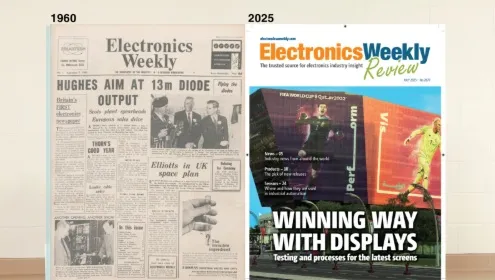
Read the first ever Electronics Weekly online: 7th September 1960. We’ve scanned the very first edition so you can enjoy it.
Read the very first edition »

Work Break

Work Break


Sudoku

About Us


Established in 1960, Electronics Weekly is the market-leading, longest-established electronics brand, read by key decision makers throughout the industry. Electronics Weekly reaches an international audience of 200,000 people each month across online, email, social media and events, and readers rate its editorial as informative, interesting and relevant. Our prestigious events portfolio includes Electronics Weekly’s Elektra Awards, Electronics Weekly’s BrightSparks, and the recently added Electronics Weekly’s Women Leaders in Electronics Awards.

News

  • AI
  • Automotive
  • Embedded Systems
  • Industrial
  • Internet of Things
  • Medical
  • Mil/Hi-Rel/Aerospace
  • Power

Blogs

  • Electro Ramblings
  • Gadget Master
  • Mannerisms
  • Viewpoints

Portfolio

  • Electronica
  • Electronics Weekly Elektra Awards
  • EW BrightSparks Brightsparks Awards
  • Electronics Weekly Women Leaders In Electronics Awards
  • Embedded World
  • Event – Energy Efficiency for the AI Age
  • Site Map

Copyright ©2026 Electronics Weekly |News|Products|Blogs - Owned by Emap, Southern House, CR0 1XG (020 39532600) Terms and Conditions Privacy policy

Ok

Retrieve your password

Please enter your username or email address to reset your password.

Log In
No Result
View All Result
  • News
  • Business
    • Manufacturing
    • Distribution
    • Finance
    • Market Research
    • Information Technology
  • Markets
    • AI
    • Automotive
    • Embedded Systems
    • Industrial
    • Internet of Things
    • Medical
    • Mil/Hi-Rel/Aerospace
    • Power
  • Design
    • Communications
    • EDA and IP
    • Legislation & Skills
    • Research
    • STEM Education
    • Testing
    • University Electronics
  • Products
    • Analogue
    • Asics
    • Connectors
    • Digital ICs
    • Discretes
    • Displays
    • DSPs
    • Emech & Enclosures
    • FPGAS
    • LED Technology
    • Linear / Mixed Signal ICs
    • Memory
    • MPUS/MCUS
    • Passives
    • Power
    • Raspberry Pi
    • RF & Microwave
    • Sensors
    • Software/EDA
    • Test & Measurement
  • Blogs
    • Electro Ramblings
    • Gadget Master
    • Mannerisms
    • Viewpoints
  • Media
    • EW Podcast – CHIIPS
    • EW TV
    • EW Issue Archive
  • Events
    • Calendar
    • Electronica
    • Electronics Weekly Elektra Awards
    • Electronics Weekly BrightSparks Awards
    • Electronics Weekly Women Leaders in Electronics Awards
    • Embedded World
    • Energy Efficiency for the AI Age
  • Resources
    • EW Compare – Comparison Search Engine
    • Component search engine
    • Whitepapers and competitions

Copyright ©2026 Electronics Weekly |News|Products|Blogs - Owned by Emap, Southern House, CR0 1XG (020 39532600) Terms and Conditions Privacy policy